Buying a dedicated server does not always mean paying for the newest processor or hardware generation. For workloads that prioritize memory capacity, storage, and predictable monthly spending, an older server can sometimes offer better value than a newly released machine.
This Hetzner Server Auction review examines how the auction works, what refurbished hardware means, how to evaluate older CPUs and storage devices, and whether the potential savings justify the operational risks.
The key question is not simply whether auction servers are cheap. It is whether the selected configuration can support your workload reliably over time.
Hetzner Server Auction Review: Quick Verdict
Hetzner Server Auction is particularly attractive to experienced Linux administrators, virtualization enthusiasts, developers, and businesses that can manage dedicated hardware without bundled software support.
Its strengths include dedicated physical resources, a changing selection of CPU and memory configurations, no setup fees on standard auction servers, and included network connectivity.
The trade-offs include older hardware generations, unpredictable inventory, limited customization during ordering, and responsibility for system administration and backups.
Our verdict: Hetzner auction servers can represent excellent infrastructure value when hardware specifications match the application, but the cheapest listing is not automatically the smartest purchase.
How Does Hetzner Server Auction Work?
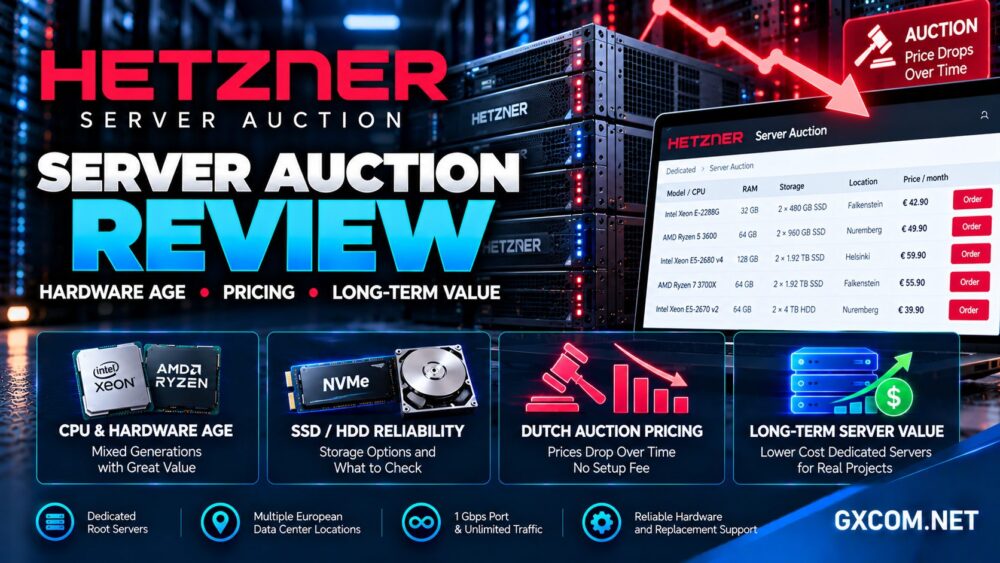
Hetzner uses a Dutch-style auction rather than a conventional bidding system.
Each server enters the auction at a starting price determined by Hetzner. Its advertised price then decreases over time until a customer orders the machine.
There is no need to submit a competing bid or wait for an auction deadline. Buyers can order an available server at its currently displayed rate.
However, waiting for a lower price creates a risk: another customer may purchase the server first.
The available inventory depends on machines returned by previous customers, so hardware models, locations, and configurations change continuously.
For buyers comparing dedicated infrastructure generally, our bare metal server comparison explains the main purchasing criteria.
How Old Is Hetzner Auction Hardware?
Hetzner states that auction servers previously belonged to its regular dedicated server lineup. They are older systems that have returned to inventory after customer cancellations.
That does not mean every auction server has the same age or operating history.
Some configurations use older desktop processors, while others feature enterprise-grade CPUs, ECC memory, and substantial storage capacity.
Hetzner performs hardware testing before listing these machines, but the provider does not publish a universal age or remaining-life guarantee for every component.
Older Hardware Is Not Necessarily Unreliable
A server can continue operating reliably for years beyond its original product generation. Conversely, new components can also fail unexpectedly.
Age should therefore be considered alongside hardware condition, redundancy, monitoring, and the consequences of downtime.
For critical workloads, the ability to recover quickly from failure is usually more important than attempting to predict exactly when a component will fail.
CPU Generations: Old Xeon vs Modern Ryzen
CPU selection is one of the biggest opportunities to make a poor auction purchase.
Older Intel Xeon systems may offer many cores and substantial memory capacity, making them useful for certain virtualization and parallel workloads.
However, a newer AMD Ryzen processor may deliver considerably stronger single-threaded performance, depending on the exact generations being compared.
Processor architecture also influences memory support, instruction sets, power efficiency, and application compatibility.
Match the CPU to Your Workload
- Web applications: Prioritize responsive single-threaded performance and adequate memory.
- Virtualization: Consider physical cores, RAM capacity, storage I/O, and virtualization extensions.
- Databases: Evaluate memory, storage latency, and processing characteristics together.
- Storage services: Prioritize disk configuration, network throughput, and data protection.
A high core count does not guarantee better application performance. Compare independent benchmarks for the exact CPU models before ordering.

RAM Capacity and ECC Memory
One advantage of older enterprise servers is that they may offer substantial RAM capacity relative to their rental price.
This can benefit virtualization hosts, in-memory caches, databases, and applications running multiple services.
Some auction configurations include ECC memory, which can detect and correct certain memory errors.
However, ECC availability depends on the actual processor and platform. Do not assume every server includes it.
Before purchasing, calculate how much memory your applications require at peak load and leave room for the operating system and background processes.
SSD, HDD and NVMe: Storage Matters
Hetzner’s auction inventory can include HDD, SATA SSD, and NVMe configurations.
HDDs may provide economical bulk capacity, while SSDs and NVMe devices are generally more appropriate for latency-sensitive databases and virtual machines.
Storage type alone does not reveal drive condition or remaining endurance.
What About Drive Wear?
Previously used drives may have accumulated substantial operating hours or write activity.
After deployment, administrators should inspect available SMART or NVMe health information, monitor error counters, and investigate unusual behavior.
These measurements are useful indicators, not perfect predictions of future failure.
Hetzner allows customers to request hardware checks and replacements when components appear defective. Detailed diagnostic information can help support technicians investigate faster.
RAID Is Not a Backup
RAID can maintain availability during certain drive failures, but it cannot protect against accidental deletion, ransomware, or every type of corruption.
Keep independent backups and test restoration procedures before placing important data on an auction server.
Network Performance and Data Center Locations
Hetzner’s official Server Auction FAQ specifies a dedicated 1 Gbit/s uplink with guaranteed bandwidth for auction servers and describes unlimited traffic for its dedicated root server products.
Actual application performance still depends on routing, destination networks, latency, and workload characteristics.
Available auction locations depend on returned inventory, so buyers should confirm the location of each listing.
For European audiences, proximity to Hetzner’s German or Finnish infrastructure may be useful. International businesses should test connectivity to their own customer regions.
Hardware Replacement and Support Responsibilities
Hetzner provides hardware support for auction servers, including the ability to request checks and replacement of defective components.
However, auction machines are unmanaged dedicated root servers. Customers are responsible for operating system maintenance, software configuration, security, monitoring, and backups.
Hardware replacement may also require troubleshooting, scheduling, and recovery work.
Businesses without experienced administrators should consider the operational cost of maintaining older dedicated hardware.
Our unmanaged dedicated server guide explains these responsibilities in more detail.
Hetzner Auction Pricing: What Are You Paying For?
The auction’s declining-price model creates opportunities to obtain configurations at rates below comparable new hardware offerings.
Hetzner states that standard auction servers have no setup fee, reducing the initial cost of deployment.
Nevertheless, pricing is influenced by inventory and demand. A particular CPU and memory combination may disappear before its price reaches your target.
Customers should also check applicable taxes, optional hardware, software licenses, additional networking services, and any later changes to the provider’s pricing terms.
Should You Wait for the Price to Drop?
Waiting can reduce the advertised rental rate, but only if the server remains available.
For common configurations, buyers may prefer to establish a target budget and monitor alternatives. For unusual combinations of RAM, storage, and CPU, waiting may be less practical.
Do not choose a weaker configuration merely because its auction price looks attractive.
Long-Term Value: Older Hardware vs New Servers
The best way to evaluate auction value is to calculate total operating cost over a realistic period.
Consider the monthly rental, administration, software licensing, backup infrastructure, and expected downtime impact.
Older processors can also offer lower performance per core than newer designs. A more expensive modern server may complete demanding workloads faster or consolidate more services.
Because customers rent rather than own Hetzner’s hardware, electricity and physical maintenance are generally part of the hosting provider’s service economics rather than separately metered hardware ownership expenses.
Our affordable dedicated server deals guide provides a wider purchasing comparison.
Hetzner Server Auction vs Other Providers
Hetzner is not the only option for customers seeking affordable bare metal infrastructure.
Cherry Servers is relevant to buyers who prefer dedicated hardware with alternative deployment and configuration options.
OVHcloud is worth comparing when integrated Anti-DDoS protection and networking features are major priorities.
Bacloud offers another European dedicated server alternative, particularly for customers evaluating different hardware generations and regional connectivity.

NovoServe may suit organizations comparing dedicated infrastructure and network-oriented hosting services.
These providers do not necessarily offer the same declining-price auction model. Compare available hardware, network policies, support responsibilities, and recurring costs rather than assuming the products are identical.
Our bare metal server providers comparison helps narrow the alternatives.
Who Should Buy a Hetzner Auction Server?
Auction servers are particularly suitable for technically experienced users running development environments, virtualization labs, storage services, and workloads that benefit from dedicated resources without requiring the newest processors.
They may be less suitable for customers needing guaranteed hardware generations, extensive managed support, or strict recovery-time commitments without additional infrastructure.
For production deployments, choose redundancy and backup arrangements according to business risk rather than the rental price alone.
Frequently Asked Questions
Are Hetzner auction servers used?
Yes. They are previously deployed dedicated servers that Hetzner tests before offering them through its auction inventory.
Does Hetzner Server Auction charge setup fees?
Standard auction configurations have no setup fees. Additional hardware or services may involve separate charges.
Can Hetzner replace defective auction hardware?
Yes. Customers can request hardware checks and replacement through the Robot support system.
Are auction servers fully managed?
No. They are dedicated root servers without included software administration support.
Is a Hetzner auction server better than a VPS?
It depends on the workload. Dedicated hardware provides physical resource control, while VPS hosting may offer simpler scaling and lower administration requirements.
Final Verdict: Is Hetzner Server Auction Worth It?
This Hetzner Server Auction review finds a valuable option for experienced buyers who can evaluate older hardware and manage their own dedicated infrastructure.
Its biggest advantages are the declining-price auction model, no standard setup fee, dedicated resources, and a wide variety of configurations.
The principal risks involve older hardware, changing inventory, and operational responsibilities that remain with the customer.
For suitable workloads, Hetzner deserves consideration alongside Cherry Servers, OVHcloud, Bacloud, and NovoServe. Choose based on CPU performance, memory, storage condition, network requirements, and long-term cost—not simply the lowest auction price.