Reseller hosting can be profitable, but the business is rarely as simple as buying hosting cheaply and selling it at a higher price.
The real profit comes from understanding your total costs, pricing services correctly, keeping customers for a long time and controlling how much support each account requires.
For web designers and digital agencies, reseller hosting can be particularly attractive because the customer relationship already exists.
A client who pays you to design or maintain a website may also be willing to pay a recurring fee for hosting, backups, updates and technical support.
That creates a very different business model from launching a generic hosting company and competing for customers entirely on price.
So, is reseller hosting profitable?
Yes, it can be. But profitability depends on your business model, customer acquisition cost, infrastructure expenses, support workload, pricing strategy and customer retention.
This guide explains the economics behind reseller hosting, including costs, pricing, profit margins, break-even calculations and the strategies that can make a reseller hosting business more sustainable.
How Does a Reseller Hosting Business Make Money?
The basic model is straightforward.
You purchase reseller hosting from an upstream provider and divide those resources among multiple customers.
The structure looks like this:
UPSTREAM HOSTING PROVIDER
↓
YOUR RESELLER ACCOUNT
↓
YOUR HOSTING PACKAGES
↓
YOUR CUSTOMERS
↓
RECURRING REVENUE
Your revenue comes from what customers pay.
Your profit is what remains after expenses.
The simplified formula is:
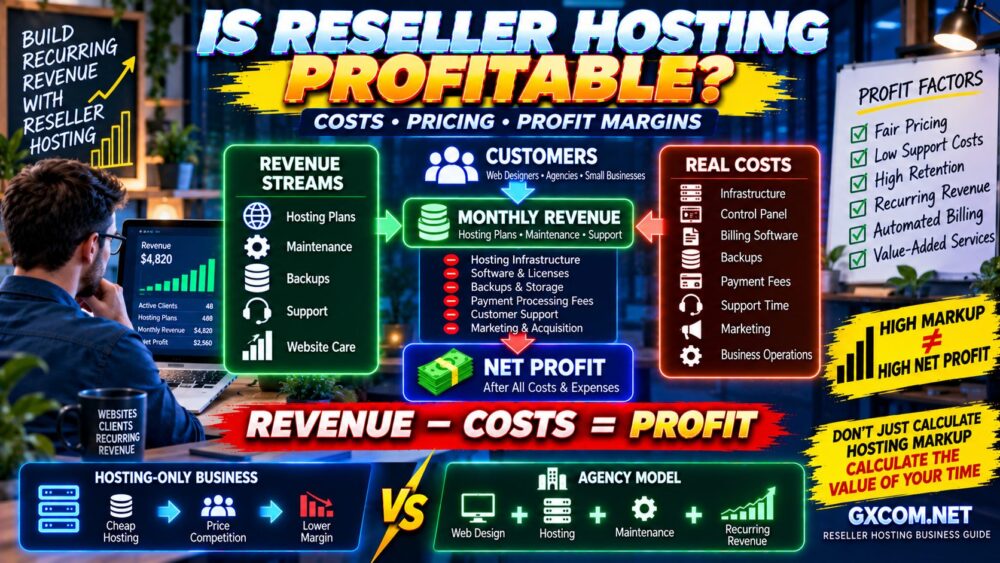
REVENUE − COSTS = PROFIT
But the word costs includes much more than the monthly reseller hosting bill.
Reseller Hosting Revenue vs Profit
This distinction is essential.
If 30 customers each pay you for hosting every month, the total amount collected is revenue.
It is not profit.
Your real calculation is closer to:
CUSTOMER REVENUE
− Hosting Infrastructure
− Control Panel / Software
− Backup Costs
− Payment Processing
− Customer Support
− Marketing
− Refunds
− Administration
− Taxes and Business Costs
=
NET PROFIT
A reseller business can look profitable at the gross revenue level while producing disappointing net profit after labor and customer acquisition are considered.
What Does Reseller Hosting Cost?
The first expense is the reseller hosting platform itself.
Pricing varies substantially depending on:
- Number of customer accounts
- Storage
- Bandwidth
- CPU and RAM allocation
- Control panel
- Backup system
- Datacenter location
- Management level
- Support
- Additional software
Entry-level reseller plans can be relatively inexpensive compared with operating your own server infrastructure.
However, the advertised hosting price should be treated as only one component of your business cost.
RESELLER PLAN PRICE ≠ TOTAL COST OF RUNNING A HOSTING BUSINESS.
The 10 Real Costs of Reseller Hosting
1. Reseller Hosting Subscription
This is the most obvious cost.
You pay the upstream provider for the infrastructure and reseller environment.
Providers such as GreenGeeks, FastComet, Hostwinds and AccuWeb Hosting offer reseller-oriented products with different account structures, control panels and resource allocations.
The cheapest package is not necessarily the most profitable if resource limitations generate support problems or force an early migration.
2. Control Panel Costs
Traditional reseller hosting often uses WHM and cPanel.
Depending on the provider and plan, licensing may be bundled into the service or reflected in the package cost.
Other platforms may use alternative control panels.
This matters because control-panel economics can affect your cost per customer as the business grows.
3. Billing Software
If you operate a larger hosting business, manually invoicing every customer can become inefficient.
Hosting billing systems can help automate:
- Orders
- Invoices
- Recurring payments
- Account provisioning
- Renewal reminders
- Suspensions
- Customer records
Some reseller packages may include billing tools or integrations, while others require separate software.
4. Backup Costs
Backups are not optional when customers depend on you.
You may use:
- Provider backups
- Control-panel backups
- Independent off-site backups
- Cloud object storage
A stronger business may maintain more than one recovery layer.
That creates additional cost, but it can dramatically reduce the consequences of data loss.
5. Payment Processing Fees
Payment processors generally charge transaction fees.
The percentage may look small, but it becomes meaningful across hundreds or thousands of transactions.
Your pricing model should account for payment processing rather than assuming every dollar collected becomes revenue available to you.
6. Customer Support
Support can become one of the largest hidden expenses.
Customers may contact you about:
- WordPress
- DNS
- SSL
- Website errors
- Backups
- Passwords
- Performance
- Domains
Some of these issues may not technically be hosting problems.
But the customer may still expect you to solve them.
YOUR TIME HAS A COST.
7. Marketing and Customer Acquisition
If you launch a standalone hosting brand, customers do not automatically appear.
You may need:
- SEO
- Paid advertising
- Content marketing
- Social media
- Affiliate commissions
- Promotions
Customer acquisition can dramatically change reseller hosting economics.
This is one reason web agencies often have an advantage: they already have clients.
8. Refunds and Chargebacks
Some customers cancel.
Others request refunds.
Payment disputes and chargebacks can also create costs.
A realistic financial model should not assume 100% of billed revenue will always remain collected revenue.
9. Website and Business Operations
Your hosting business itself may require:
- Website hosting
- Domain names
- Business email
- Help desk software
- Monitoring
- Accounting
- Legal documentation
Each individual expense may be small, but together they affect net margin.
10. Your Time
This is the cost most beginners underestimate.
If your reseller business earns a modest monthly profit but requires dozens of hours of support, the effective hourly return may be poor.
Always calculate:
PROFIT ÷ HOURS WORKED = EFFECTIVE RETURN ON YOUR TIME
How Much Can You Charge for Reseller Hosting?
There is no universal price.
Your customer pricing depends on what you are actually selling.
If you sell only generic hosting, customers can easily compare your price with large hosting companies.
If you sell a managed business service, the comparison changes.
Consider these two products:
PRODUCT A
10 GB Hosting
SSL
Email
versus:
PRODUCT B
Business Website Hosting
Automatic Backups
WordPress Updates
Security Monitoring
Website Maintenance
Technical Support
Product B solves a broader business problem.
That can support a higher price because the customer is purchasing a service rather than raw disk space.
Example Reseller Hosting Pricing Model
The following is a simplified example for understanding the business model, not a recommendation for specific market pricing.
| Package | Target Customer | Included Service | Pricing Position |
|---|---|---|---|
| Starter | Portfolio / Micro Business | Hosting + SSL | Entry Level |
| Business | Local Business | Hosting + Backup | Mid Tier |
| WordPress Care | WordPress Business | Hosting + Updates + Backup | Premium |
| Managed Business | Growing Company | Hosting + Maintenance + Priority Support | Higher Value |
The important point is segmentation.

Do not force every customer into one generic hosting package.
How to Calculate Reseller Hosting Profit Margin
There are two useful margin calculations.
Gross Profit Margin
A simplified formula is:
GROSS PROFIT = REVENUE − DIRECT SERVICE COSTS
Then:
GROSS MARGIN = GROSS PROFIT ÷ REVENUE × 100
For example, if a reseller business generates $1,000 in monthly revenue and direct hosting-related costs are $300:
$1,000 − $300 = $700 GROSS PROFIT
$700 ÷ $1,000 × 100 = 70% GROSS MARGIN
But this does not mean the owner keeps $700.
Net Profit Margin
Net profit considers broader operating expenses.
For example:
$1,000 Revenue
− $300 Hosting / Software
− $100 Payment / Backup / Tools
− $200 Support / Administration
− $100 Marketing
=
$300 Net Profit
In this simplified example:
$300 ÷ $1,000 × 100 = 30% NET MARGIN
This demonstrates why headline hosting markup can be misleading.
HIGH MARKUP ≠ HIGH NET PROFIT.
What Is a Good Reseller Hosting Profit Margin?
There is no universal target because reseller businesses operate very differently.
A highly automated hosting company may tolerate lower revenue per customer because support and provisioning costs are low.
A boutique agency may charge significantly more because each client receives hands-on service.
Instead of chasing an arbitrary margin percentage, track:
- Revenue per customer
- Direct cost per customer
- Support time per customer
- Customer acquisition cost
- Customer retention
- Monthly recurring revenue
- Net profit
The best business model is the one that remains profitable after your time is included.
How Many Customers Do You Need to Break Even?
This can be calculated with a simple formula:
BREAK-EVEN CUSTOMERS = FIXED MONTHLY COSTS ÷ PROFIT CONTRIBUTION PER CUSTOMER
Imagine your fixed hosting and software costs are $150 per month.
If each customer contributes $15 toward covering fixed costs after variable expenses:
$150 ÷ $15 = 10 CUSTOMERS
You need approximately 10 such customers to cover those fixed expenses.
Customer 11 and beyond can begin contributing more directly toward operating profit, although additional support and other variable costs still apply.
Example: 10 Reseller Hosting Customers
Consider a small web designer with 10 hosting clients.
Instead of focusing on exact market prices, think in units.
If each customer generates one revenue unit:
10 CUSTOMERS × 1 REVENUE UNIT = 10 UNITS REVENUE
If infrastructure and operating costs consume four units:
10 − 4 = 6 UNITS BEFORE ADDITIONAL LABOR / TAX COSTS
At this stage, the business is small enough that the designer may personally handle support.
That can work well if clients rarely require assistance.
Example: 50 Reseller Hosting Customers
At 50 customers, the economics begin to change.
Revenue increases, but so can:
- Support tickets
- Billing questions
- Password resets
- Email problems
- Migration requests
- Website incidents
This is where automation becomes more valuable.
The business should begin measuring:
REVENUE PER CUSTOMER
versus
SUPPORT COST PER CUSTOMER
A customer paying very little but generating frequent support tickets may be less profitable than a higher-paying managed customer who rarely requires help.
Example: 100+ Hosting Customers
Once the business reaches a larger customer base, reseller hosting becomes an operational system rather than a side feature.
You may need:
- Automated billing
- Monitoring
- Standard operating procedures
- Ticketing systems
- Better backup architecture
- Defined support boundaries
- Additional infrastructure
At this point, you should also evaluate whether conventional reseller hosting remains the best infrastructure model.
A larger reseller plan, managed VPS, cloud environment or dedicated server may eventually become more appropriate.
Agency Reseller Hosting vs Standalone Hosting Business
This is one of the most important profitability differences.
Standalone Hosting Company
You must first acquire customers.
The model looks like:
MARKETING
↓
ACQUIRE CUSTOMER
↓
SELL HOSTING
↓
SUPPORT CUSTOMER
You are competing with established hosting brands on search results, advertising, pricing and reputation.
Web Design / Digital Agency
The agency model is different:
CLIENT ALREADY EXISTS
↓
BUILD WEBSITE
↓
HOST WEBSITE
↓
MAINTAIN WEBSITE
↓
RECURRING REVENUE
The acquisition cost for hosting can be much lower because the client relationship already exists.
This is why reseller hosting can be especially attractive for web designers and agencies.
Why Selling Cheap Hosting Can Hurt Profitability
Competing entirely on price creates several problems.
Low-priced customers may still expect:
- Fast support
- Website troubleshooting
- Email assistance
- Backups
- Migration
- Security help
Your revenue per customer falls, but support requirements do not necessarily fall with it.
That creates:
LOW PRICE + HIGH SUPPORT = WEAK MARGIN
A stronger strategy is often to sell outcomes rather than hosting specifications.
Sell Website Care, Not Gigabytes
Most small business customers do not care whether their hosting package includes 25 GB or 50 GB of storage.
They care about questions such as:
- Is my website online?
- Is it fast?
- Is it secure?
- Is it backed up?
- Who do I call when something breaks?
This creates a stronger value proposition:
HOSTING
+
BACKUPS
+
UPDATES
+
SECURITY
+
SUPPORT
=
WEBSITE CARE PLAN
The customer buys peace of mind rather than server space.
Recurring Revenue Is the Biggest Advantage
Web design is often project-based.
A client pays for a website once.
Hosting changes the relationship.
Instead of:
BUILD → DELIVER → FINISH
you can create:
BUILD → HOST → MAINTAIN → RENEW
This produces monthly or annual recurring revenue.
Recurring revenue can make an agency more predictable because every month does not begin at zero.
Annual Billing vs Monthly Billing
Both approaches have advantages.
Monthly Billing
- Lower initial commitment for customers
- Predictable recurring payments
- Easy to position as a subscription
Annual Billing
- Improves cash flow
- Reduces the number of transactions
- Reduces billing administration
- Can improve customer retention
Some businesses offer both and provide a modest incentive for annual payment.
Whatever you choose, make sure pricing still covers long-term costs.
Why Customer Retention Matters So Much
A hosting customer who stays for five years is far more valuable than one who leaves after three months.
Long retention spreads customer acquisition costs over a longer revenue period.
It also increases customer lifetime value.
A simplified model is:
CUSTOMER LIFETIME VALUE
=
AVERAGE CUSTOMER REVENUE × CUSTOMER LIFETIME
The longer customers remain satisfied, the more attractive reseller hosting economics can become.
How to Improve Reseller Hosting Profit Margins
1. Bundle Hosting With Existing Services
Web designers and agencies already have customers.
Use hosting as part of a larger relationship rather than acquiring hosting-only customers from scratch.
2. Automate Repetitive Work
Automate billing, provisioning, backups and monitoring where practical.
Every task you manually repeat for hundreds of customers creates operational cost.
3. Define Support Boundaries
Hosting support should not automatically mean unlimited website development.
Clearly define what is included.
For example:
INCLUDED: Hosting, SSL, backup, server-related issues.
SEPARATE SERVICE: Website redesign, custom coding, content changes or complex application troubleshooting.
4. Use Tiered Packages
Different customers have different needs.
Offer multiple service levels rather than one universal plan.
5. Monitor Resource Usage
Do not wait until an account reaches capacity.
Track storage, bandwidth and other resource consumption so you can upgrade before performance becomes a customer problem.
6. Reduce Customer Churn
Reliable hosting, good communication and useful support can keep customers longer.
Retention is often more profitable than constantly replacing lost customers.
7. Avoid Aggressive Overselling
Trying to maximize the number of customers on limited infrastructure can increase short-term margin but damage long-term retention.
MORE ACCOUNTS ≠ MORE PROFIT
if performance problems cause cancellations and support tickets.
When Should You Upgrade From Reseller Hosting?
As the business grows, infrastructure needs can change.
You may eventually require:
- More CPU
- More RAM
- Greater storage performance
- Root access
- Custom server software
- More predictable resource isolation
The typical progression may be:
RESELLER HOSTING
↓
LARGER RESELLER PLAN
↓
MANAGED VPS / CLOUD
↓
DEDICATED INFRASTRUCTURE
Moving too early increases costs.
Moving too late can damage performance.
Upgrade when resource usage and business economics justify it.
Choosing a Profitable Reseller Hosting Provider
Your upstream provider has a direct impact on profitability.
Cheap infrastructure can become expensive when it creates:
- Downtime
- Slow websites
- Support tickets
- Customer cancellations
- Emergency migrations
Evaluate providers based on:
- Reliability
- Resource limits
- Control panel
- Separate client accounts
- White-label functionality
- Backups
- Security
- Support
- Upgrade path
- Renewal cost
For a provider-focused comparison, see our Best Reseller Hosting Providers guide.
Is Reseller Hosting Better Than Ordinary Web Hosting for Agencies?
If you only operate your own website, conventional web hosting is usually simpler.
If you manage websites for many customers, reseller hosting provides a more appropriate account structure.
The difference is:
WEB HOSTING
→ Host your website
RESELLER HOSTING
→ Create and manage hosting accounts for customers
Our What Is Reseller Hosting? guide explains the model in more detail.
Is Reseller Hosting a Good Passive Income Business?
Reseller hosting creates recurring revenue, but calling it passive income can be misleading.
Customers may require support.
Websites can break.
Email can stop working.
Domains can expire.
Security incidents can happen.
Backups sometimes need restoration.
Automation can reduce the workload, but hosting customers still require operational responsibility.
A better description is:
RECURRING REVENUE BUSINESS
rather than:
ZERO-WORK PASSIVE INCOME.
Is Reseller Hosting Still Worth It for Web Designers?
For many web designers, reseller hosting can make strategic sense because it extends the customer relationship after the initial project.
Without hosting:
DESIGN → PAYMENT → PROJECT ENDS
With hosting and maintenance:
DESIGN → HOSTING → MAINTENANCE → RENEWAL → LONG-TERM CLIENT
The recurring revenue may be valuable, but the deeper benefit is customer retention.
Reseller Hosting Profitability Checklist
Before launching, answer these questions:
- ✓ How much does the reseller plan cost after renewal?
- ✓ Are control-panel costs included?
- ✓ Do I need separate billing software?
- ✓ What will backups cost?
- ✓ What are my payment processing fees?
- ✓ How much support will customers require?
- ✓ How will I acquire customers?
- ✓ What is my customer acquisition cost?
- ✓ What will I charge each customer?
- ✓ What is my contribution margin per customer?
- ✓ How many customers are needed to break even?
- ✓ How long do I expect customers to stay?
- ✓ Can repetitive tasks be automated?
- ✓ What services are included in support?
- ✓ When will I need larger infrastructure?
If you cannot answer these questions, you do not yet know whether your reseller hosting business will be profitable.
Reseller Hosting Profitability FAQ
Is reseller hosting profitable?
Yes, reseller hosting can be profitable when customer revenue exceeds infrastructure, software, support, marketing and operating costs. Agencies and web designers may have an advantage because they can sell hosting to existing clients.
How much money can you make from reseller hosting?
There is no fixed amount. Earnings depend on the number of customers, average revenue per customer, infrastructure costs, support workload, customer retention and additional services sold.
What is the profit margin on reseller hosting?
Profit margins vary significantly. Gross hosting margins can appear high, but net margins fall after software, support, marketing, payment processing and administration are included. Calculate both gross and net profit rather than relying on markup alone.
How many customers do I need to make reseller hosting profitable?
Calculate your fixed monthly costs and divide them by the contribution generated by each customer. This provides an approximate break-even customer count.
Can reseller hosting generate passive income?
It can generate recurring revenue, but it is not completely passive. Customers require support, websites require monitoring and technical incidents may require intervention.
Is reseller hosting good for web designers?
Yes. Web designers can bundle hosting with website creation and maintenance, creating recurring revenue from customers they already serve.
Should I sell cheap reseller hosting?
Competing primarily on price can produce weak margins because low-paying customers may still require substantial support. Agencies can often create more value by bundling hosting with backups, maintenance and support.
What is the biggest hidden cost of reseller hosting?
Customer support and your own time are among the easiest costs to underestimate. Infrastructure may be inexpensive, but frequent support requests can significantly reduce effective profitability.
Final Verdict: Is Reseller Hosting Worth It?
Reseller hosting can absolutely be profitable.
But the strongest opportunity is usually not:
BUY CHEAP HOSTING → SELL CHEAP HOSTING.
A stronger model is:
ACQUIRE A CLIENT
↓
BUILD THEIR WEBSITE
↓
HOST IT
↓
BACK IT UP
↓
MAINTAIN IT
↓
SUPPORT IT
↓
RETAIN THE CLIENT
That transforms hosting from a commodity into part of a long-term service relationship.
Before launching, calculate:
REVENUE PER CUSTOMER
−
COST PER CUSTOMER
−
SUPPORT TIME
=
REAL PROFIT
Then calculate how many customers you need to break even and how long they are likely to stay.
For web designers and agencies with an existing client base, reseller hosting can be particularly attractive because customer acquisition is already partly solved.
For a new standalone hosting company, profitability is possible, but customer acquisition and price competition make the challenge significantly harder.
DON'T JUST CALCULATE HOSTING MARKUP.
CALCULATE THE VALUE OF YOUR TIME.
That is the difference between reseller hosting that looks profitable and a hosting business that actually is.