Cheap game server hosting can look attractive when you are launching a Minecraft world, a private Rust server, or an ARK community. But the lowest advertised price does not always represent the best value. Limited resources, paid backups, restrictive upgrade options, and higher renewal costs can change the economics of a hosting plan.
At the same time, premium hosting is not automatically better. A small community may never use the extra resources or advanced features included in an expensive package.
Understanding cheap game server hosting vs premium plans means comparing what you actually receive, how reliably the server handles your workload, and which features are worth paying for.
This guide explains the differences, highlights common hidden costs, and helps you choose the right hosting tier without overspending.
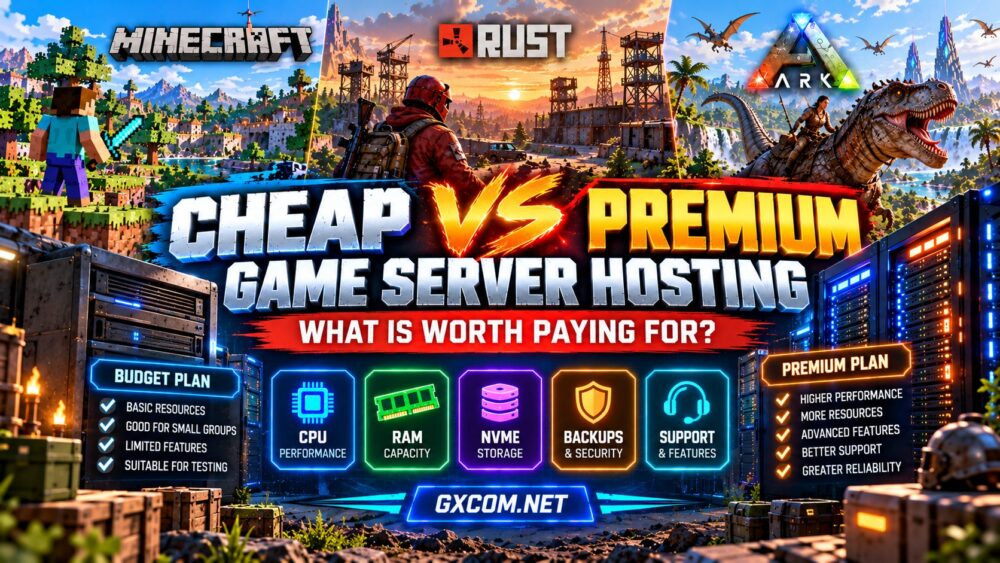
Cheap vs Premium Game Server Hosting: Key Differences
Budget and premium hosting are not standardized product categories. Providers may use different labels for similar hardware, while some premium packages emphasize management and support rather than raw performance.
| Feature | Budget Hosting | Premium Hosting |
|---|---|---|
| CPU resources | May use shared allocations | May offer stronger or more predictable resources |
| RAM | Smaller starting allocations | More capacity or upgrade flexibility |
| Storage | Basic SSD or limited NVMe space | Potentially greater storage capacity |
| Backups | May require manual setup or add-ons | May include more recovery features |
| Support | Often focused on standard issues | May include broader assistance |
| Scalability | Depends on available plans | May offer more expansion options |
These are common market patterns, not guaranteed differences. Always compare the specifications and service terms of the actual plans.
When Cheap Game Server Hosting Makes Sense
Affordable hosting can be an excellent starting point for a small, predictable community. If only a few friends play together, paying for extensive resources may deliver little practical benefit.
Budget plans are particularly reasonable for:
- Small vanilla Minecraft communities with limited modifications.
- Private servers used during scheduled gaming sessions.
- Short-term experiments and configuration testing.
- New communities without established peak-player demand.
- Administrators comfortable managing some tasks independently.
The key is choosing an affordable plan that still meets your game’s actual requirements. A low-cost server that constantly lags or runs out of memory is not a bargain.
For a broader overview of purchasing factors, see our game server hosting costs guide.
When Is Premium Game Server Hosting Worth Paying For?
Premium hosting becomes more attractive when resource limitations or operational problems begin affecting players.
A growing Minecraft community with demanding modpacks may benefit from additional RAM and stronger per-core CPU performance. A busy Rust server may need more consistent processing capacity, while an established ARK community can require substantial memory and storage headroom.
Premium features are most valuable when they solve a measurable problem:
- Stronger CPU performance: Helps address simulation bottlenecks when processor capacity is the constraint.
- Additional RAM: Supports larger worlds, modifications, and more demanding workloads.
- Better resource isolation: Can reduce interference from other hosting customers when genuinely provided.
- Reliable backups: Improves recovery options after corruption or administrative mistakes.
- Useful technical support: Reduces troubleshooting time for administrators.
Do not upgrade merely because a plan carries a premium label. Ask what specific capability improves and whether your community needs it.

CPU Performance: The Upgrade That Can Matter Most
Game servers often depend on responsive simulation processing. Advertised vCPU counts alone do not explain whether a hosting plan can sustain demanding workloads.
Minecraft is particularly sensitive to individual-core performance in important game-loop operations. Rust and ARK also need dependable processing resources as their worlds and communities grow.
Before paying extra for a premium CPU tier, investigate the processor generation, resource-sharing policies, and any limits on sustained CPU usage.
A premium package with more virtual cores is not necessarily faster than a cheaper plan using a newer processor. Performance should be evaluated against the actual game workload.
RAM and NVMe: Buy Enough, Not Simply More
Memory and storage are easier to compare numerically, but larger allocations are not always useful.
A lightly modified Minecraft server may perform well without an enormous memory budget. A large modpack, however, can require considerably more RAM.
Rust and ARK requirements vary with map size, entities, active players, game editions, and installed modifications. Administrators should reserve additional memory for updates and background processes.
NVMe storage can improve file operations, but disk speed alone will not fix CPU-related lag. Capacity matters too, particularly when storing large maps, modpacks, logs, and backups.
Our gaming VPS requirements comparison for Minecraft, Rust and ARK explains these differences in greater detail.
DDoS Protection, Backups, and Support: Which Extras Matter?
DDoS Protection
Public game servers may face disruptive traffic attacks. Suitable DDoS mitigation can be valuable, especially for competitive or established communities.
However, protection varies by provider, network, and supported protocol. A premium label does not establish how effective mitigation will be for your particular game.
Automatic Backups
Backups protect progress and reduce recovery risk. Before paying for an add-on, check backup frequency, retention, storage location, and restoration procedures.
A feature advertised as automatic backup may still have limits on recovery points or storage consumption. Test restoration before depending on it.
Technical Support
Support quality matters most when you need help. Check whether assistance covers only infrastructure availability or also game configuration, mods, plugins, and migration.
Paying more for broader support may be worthwhile if your time is limited. Experienced administrators may prefer lower costs and greater self-service control.
Hidden Costs That Make Cheap Hosting More Expensive
The initial subscription is only one part of total hosting cost. Optional features and changing requirements can increase spending over time.
Review these potential expenses before ordering:
- Renewal pricing after introductory promotions.
- Additional RAM, storage, or player-capacity upgrades.
- Backup storage and recovery services.
- Extra IP addresses or specialized networking features.
- Migration assistance and premium support.
- Software licensing or control-panel charges, where applicable.
Also review cancellation conditions and refund eligibility. A discounted first term is less useful if the renewal price or service limitations do not fit your budget.
For more information, read our game server hosting renewal costs guide.
Game Hosting Providers Worth Comparing
Rather than assuming one provider is universally the cheapest or best, compare available packages against the game, location, and features you need.
Sparked Host and ScalaCube
Sparked Host and ScalaCube are two options to investigate when comparing game-hosting plans. Evaluate current game support, resource allocations, mod compatibility, management tools, and renewal terms.
For smaller communities, focus on whether an entry-level package provides sufficient resources and an accessible upgrade path.
Godlike.Host and Host Havoc
Godlike.Host and Host Havoc are additional candidates for a hosting comparison. Examine the exact game-specific plans rather than assuming the same features apply across every title.
Compare server locations, backup policies, support scope, and available hardware information. The best choice depends on the workload and community requirements.
Survival Servers
Survival Servers is another provider to evaluate for supported survival-game hosting. Confirm current game editions, available regions, configuration options, and resource policies before purchasing.
For a wider provider shortlist, explore our best game server hosting providers comparison.
Cheap vs Premium Hosting by Community Type
| Community | Suggested Starting Approach | Upgrade Trigger |
|---|---|---|
| Small private Minecraft world | Affordable plan with adequate CPU and RAM | Persistent tick lag or memory pressure |
| Large modded Minecraft community | Higher-resource plan with CPU headroom | Modpack growth and sustained resource limits |
| Casual Rust group | Cost-conscious plan meeting world requirements | Increasing simulation or memory demand |
| Established Rust community | More predictable CPU and network resources | Peak-hour performance instability |
| Large ARK community | Memory-focused plan with expansion capacity | World growth, additional maps, or resource exhaustion |
These recommendations are directional, not guaranteed performance tiers. Monitor real usage before making major upgrades.

When Should You Move Beyond Managed Game Hosting?
Premium managed hosting is not the only upgrade path. Administrators who need operating-system access, specialized software, or several game instances may prefer a self-managed VPS or dedicated server.
These options introduce additional responsibility for security, installation, maintenance, and backups. They can also offer greater control over resource allocation.
Our gaming VPS vs dedicated server guide explains when infrastructure-level control may be appropriate.
Game Server Hosting Buying Checklist
- Identify your game edition, mods, and expected concurrent players.
- Compare CPU quality and resource-sharing policies.
- Choose enough RAM with reasonable operating headroom.
- Confirm storage capacity, backups, and restoration options.
- Check server locations and relevant network protection.
- Compare initial costs, renewal terms, and optional extras.
- Verify upgrade paths, cancellation rules, and support coverage.
Frequently Asked Questions
Is cheap game server hosting reliable?
It can be. Reliability depends on the actual infrastructure, resource allocation, network, and provider operations rather than price alone.
Does premium hosting always provide better performance?
No. Premium packages may emphasize management, storage, or support instead of CPU performance. Compare the features that affect your workload.
Should beginners choose budget or premium hosting?
Beginners can start with an affordable, manageable plan that meets their game’s requirements. Paying extra for useful support may be worthwhile when technical experience is limited.
When should I upgrade my game server plan?
Upgrade when monitoring reveals sustained resource bottlenecks, recurring gameplay problems, or operational needs that the current plan cannot address.
Final Verdict: What Is Worth Paying For?
The best decision in cheap game server hosting vs premium plans is to pay for capabilities that solve real problems. CPU consistency, sufficient RAM, reliable backups, suitable network protection, and responsive support can justify a higher cost.
Features that your community never uses offer little value, regardless of how impressive they appear in a product comparison.
Compare relevant offerings from Sparked Host, ScalaCube, Godlike.Host, Host Havoc, and Survival Servers, verify current terms, and choose a plan that balances performance, reliability, and sustainable long-term costs.