Bare metal servers have become an important infrastructure choice for businesses that need maximum performance, predictable resources, and direct access to physical hardware. Unlike virtual machines running on shared cloud infrastructure, bare metal servers provide an entire physical server dedicated to a single customer.
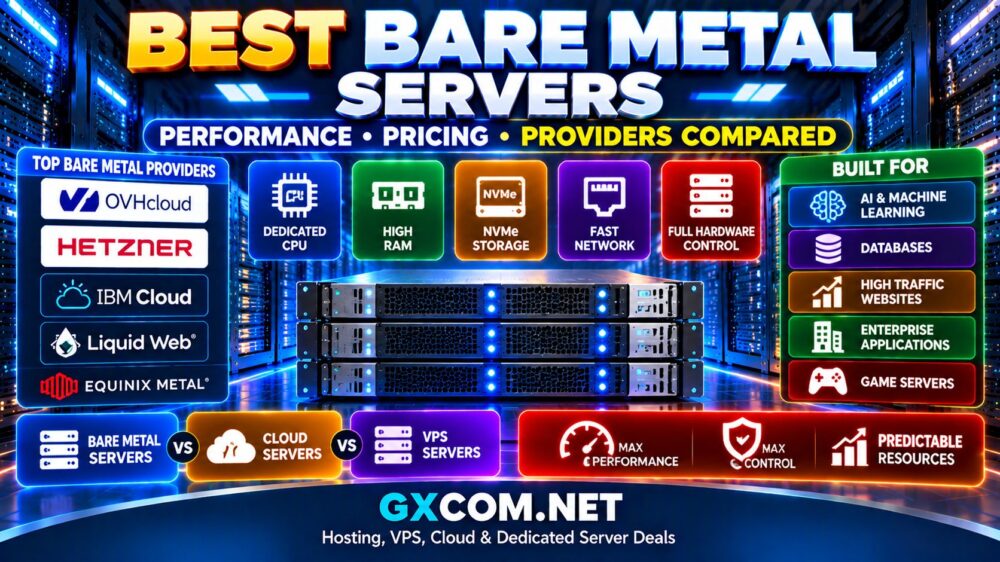
The best bare metal servers combine powerful CPUs, large memory capacity, fast NVMe storage, high-speed networking, and flexible deployment options. They are commonly used for artificial intelligence workloads, databases, enterprise applications, game servers, virtualization, high-traffic websites, and performance-sensitive software.
This Best Bare Metal Servers guide compares leading bare metal hosting providers, explains pricing factors, and helps you choose the right infrastructure based on performance, scalability, and workload requirements.
What Is a Bare Metal Server?
A bare metal server is a physical server rented exclusively by one customer without the virtualization layer commonly found in cloud VPS environments.
Instead of sharing CPU, memory, and storage resources with virtual machines, users receive direct access to the physical hardware.
A typical bare metal server includes:
- Dedicated physical CPU resources
- Dedicated RAM
- Local SSD or NVMe storage
- High-speed network connectivity
- Full operating system control
- Custom software installation
- Hardware-level performance consistency
Bare metal is particularly valuable when predictable performance matters more than rapid cloud scaling.
Bare Metal Server vs Dedicated Server
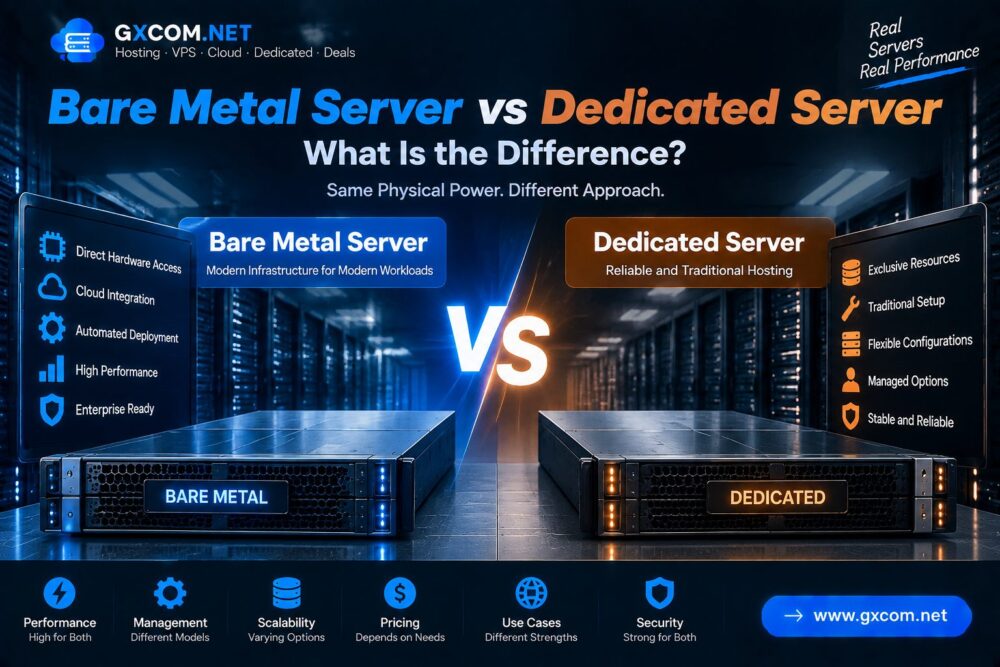
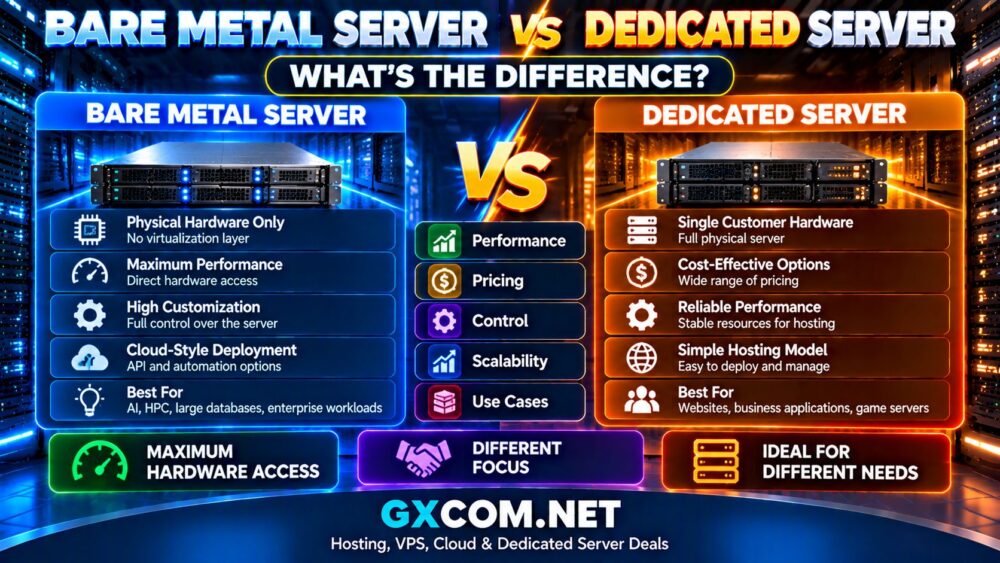
Bare metal servers and dedicated servers are closely related concepts, and many providers use the terms interchangeably.
| Feature | Bare Metal Server | Traditional Dedicated Server |
|---|---|---|
| Physical Hardware | Single customer | Single customer |
| Virtualization | Usually no virtualization layer | May support virtualization |
| Performance | Maximum hardware access | High performance |
| Main Users | Enterprise, AI, HPC | Websites, applications |
| Customization | Very high | High |
In practice, bare metal usually emphasizes high-performance infrastructure, while dedicated hosting often focuses more broadly on renting physical servers for general hosting needs.
For a broader comparison, see our Dedicated Server vs VPS guide.
Best Bare Metal Server Providers Compared
| Provider | Best For | Strength |
|---|---|---|
| OVHcloud | Enterprise bare metal and global infrastructure | Large hardware portfolio |
| Hetzner | Performance-focused budget bare metal | Excellent price-to-hardware ratio |
| IBM Cloud Bare Metal | Enterprise workloads | Business infrastructure |
| Liquid Web | Managed performance hosting | Premium support |
| Equinix Metal | Developer and cloud infrastructure | API-driven bare metal |
| Rackspace Bare Metal | Managed enterprise environments | Professional services |
1. OVHcloud Bare Metal Servers
OVHcloud is one of the largest bare metal providers, offering a wide range of physical servers for developers, businesses, and enterprise customers.
Its server portfolio covers affordable dedicated hardware through high-performance infrastructure designed for demanding applications.
Why Choose OVHcloud?
- Large global data center network
- Multiple CPU platforms
- NVMe storage options
- High-bandwidth networking
- DDoS protection
- Multiple server ranges
- Flexible operating systems
OVHcloud is particularly attractive for users who need global deployment options and a large selection of physical hardware.
2. Hetzner Bare Metal Servers
Hetzner is well known among developers and technical users for offering powerful hardware at competitive prices.
Its dedicated server inventory includes modern and previous-generation hardware, making it popular among customers who prioritize performance per dollar.
Advantages of Hetzner
- Competitive pricing
- Strong European infrastructure
- High-performance hardware
- Large storage options
- Simple deployment
- Server Auction availability
Hetzner is especially attractive for experienced administrators who prefer unmanaged infrastructure and maximum hardware value.
3. IBM Cloud Bare Metal Servers
IBM Cloud provides bare metal infrastructure designed primarily for enterprise workloads requiring dedicated physical resources.
Common use cases include:
- Enterprise applications
- Large databases
- Security-sensitive workloads
- Hybrid cloud environments
- High-performance computing
IBM focuses less on low-cost hosting and more on enterprise integration, compliance, and business infrastructure.
4. Liquid Web Bare Metal Servers
Liquid Web focuses on managed hosting and premium infrastructure services.
Its bare metal solutions are designed for customers who require strong performance while preferring additional technical support.
Suitable For:
- Business applications
- Ecommerce websites
- Managed infrastructure
- High-traffic websites
- Professional services
5. Equinix Metal
Equinix Metal provides automated bare metal infrastructure designed for developers, cloud-native applications, and distributed systems.
Its platform focuses on API-driven deployment and integration with modern infrastructure workflows.
Typical users include:
- Cloud platforms
- Developers
- Edge computing applications
- Distributed infrastructure projects
Bare Metal Server Pricing Explained
Bare metal pricing depends on significantly more than CPU core count.
The main cost factors include:
- CPU generation
- Number of cores
- RAM capacity
- NVMe or SSD storage
- Network speed
- Bandwidth allowance
- Data center location
- Management services
- Operating system licensing
Entry-level bare metal servers may start around affordable dedicated hosting prices, while enterprise configurations with high-end CPUs, large RAM, and NVMe storage can cost hundreds or thousands of dollars monthly.
CPU Selection for Bare Metal Servers
CPU choice is one of the most important decisions when selecting bare metal infrastructure.
Common processor options include:
- Intel Xeon
- Intel Core
- AMD EPYC
- AMD Ryzen
The best CPU depends on the workload.
High Frequency CPUs
Useful for:
- Gaming servers
- Interactive applications
- Single-thread workloads
High Core Count CPUs
Useful for:
- Virtualization
- AI workloads
- Data processing
- Large databases
RAM Requirements for Bare Metal Servers
Bare metal servers are often chosen because they can provide large amounts of physical memory.
| Workload | Typical RAM Needs |
|---|---|
| Small websites | 16GB–32GB |
| Business applications | 32GB–128GB |
| Databases | 64GB+ |
| Virtualization | 128GB+ |
| AI workloads | Depends on GPU configuration |
NVMe Storage: Why It Matters
Storage performance can significantly affect real-world application speed.
NVMe storage provides much higher throughput and lower latency compared with traditional HDD storage.
NVMe bare metal servers are especially useful for:
- Databases
- AI workloads
- Virtual machines
- Ecommerce platforms
- Large applications
Bare Metal Servers for AI and Machine Learning
AI workloads are one of the fastest-growing use cases for bare metal infrastructure.
Machine learning training and inference often require:
- High-performance CPUs
- NVIDIA GPUs
- Large memory capacity
- Fast NVMe storage
- High-speed networking
Bare metal provides direct hardware access, which can improve performance consistency for GPU-intensive workloads.
Bare Metal Servers for Databases
Large databases benefit from predictable CPU, memory, and storage performance.
Bare metal is commonly used for:
- MySQL
- PostgreSQL
- Microsoft SQL Server
- Oracle databases
- Analytics platforms
Dedicated hardware avoids resource competition from other virtual machines and provides greater control over storage architecture.
Bare Metal Servers for High Traffic Websites
High-traffic websites often require more predictable resources than entry-level VPS hosting can provide.
Bare metal can support:
- Large WordPress websites
- Ecommerce platforms
- Media websites
- SaaS applications
- API platforms
However, performance still depends on application optimization, caching, databases, CDN usage, and architecture.
Bare Metal vs Cloud Servers
| Feature | Bare Metal | Cloud Server |
|---|---|---|
| Hardware | Physical dedicated machine | Virtual infrastructure |
| Performance | Maximum consistency | Flexible performance |
| Scaling | Hardware migration | Fast scaling |
| Control | Very high | High |
| Best For | Performance workloads | Flexible applications |
Bare Metal vs VPS
A VPS remains an excellent choice for many websites and applications.
Choose VPS when you need:
- Lower cost
- Fast deployment
- Easy scaling
- Moderate resources
Choose bare metal when you need:
- Maximum hardware control
- Dedicated CPU resources
- Large RAM capacity
- High-performance storage
- Predictable performance
Managed vs Unmanaged Bare Metal
Most affordable bare metal servers are unmanaged.
This means customers handle:
- Operating system setup
- Security updates
- Monitoring
- Backups
- Application management
Managed bare metal adds technical support but increases monthly cost.
Read our Unmanaged Dedicated Server Guide to understand the responsibilities involved.
How to Choose the Best Bare Metal Server
- Identify your workload requirements.
- Select CPU based on application behavior.
- Estimate RAM requirements.
- Choose NVMe or SSD storage.
- Check network requirements.
- Compare provider locations.
- Calculate management costs.
- Review backup strategy.
- Consider future growth.
Who Should Use Bare Metal Servers?
Bare metal servers are ideal for:
- AI companies
- Enterprise applications
- Large databases
- High-traffic websites
- Game hosting companies
- Cloud infrastructure providers
- Developers requiring full hardware control
Final Thoughts
The best bare metal server is not always the one with the most CPU cores or the lowest monthly price.
The right choice depends on matching hardware to workload requirements.
OVHcloud provides broad global infrastructure, Hetzner delivers strong price-to-performance value, IBM Cloud targets enterprise deployments, Liquid Web focuses on managed performance hosting, and Equinix Metal provides developer-focused automated bare metal infrastructure.
Before choosing a provider, compare CPU generation, RAM, storage technology, network performance, management options, and total cost.
For applications that require maximum control and predictable performance, bare metal servers remain one of the most powerful hosting solutions available.