Kubernetes makes it easier to deploy and scale containerized applications, but operating a production cluster introduces infrastructure decisions that can be difficult to price. Worker nodes, persistent volumes, load balancers, and network traffic can all contribute to the final bill.
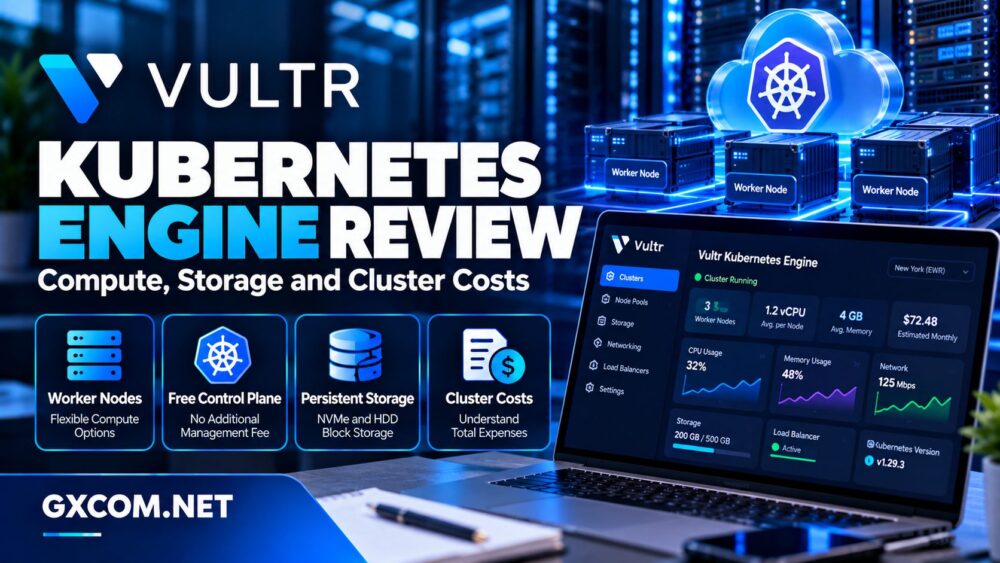
Vultr Kubernetes Engine (VKE) addresses part of that complexity by providing a managed Kubernetes control plane without an additional control-plane management fee. Customers still pay for the cloud resources their applications consume.
In this Vultr Kubernetes Engine Review, we examine compute options, persistent storage, cluster networking, scaling, reliability, and the expenses that influence long-term value. We also discuss infrastructure alternatives from Akamai Cloud, Kamatera, and Cherry Servers.
Editorial note: This review evaluates published product documentation. GXCOM has not independently benchmarked VKE clusters, measured application latency, or tested Vultr support response times.
What Is Vultr Kubernetes Engine?
VKE is Vultr’s managed Kubernetes service for deploying and operating containerized applications. Instead of building and maintaining the Kubernetes control plane manually, users create a cluster and provision worker nodes through Vultr’s platform.
The service integrates with Vultr Cloud Compute, Load Balancers, Block Storage, DNS, and networking features. Teams can manage applications using familiar Kubernetes tools, including kubectl and Helm.
VKE is particularly relevant to developers running microservices, API platforms, SaaS applications, and container-based deployment pipelines.
However, managed Kubernetes does not remove responsibility for application configuration, access control, resource sizing, or data protection.
VKE Compute: Worker Nodes and Resource Allocation
Worker nodes supply the CPU and memory used by application pods. Vultr allows customers to select supported cloud instance types and organize them into node pools.
Node selection should begin with the application’s actual requirements rather than the cheapest available virtual machine.
CPU and Memory Planning
CPU-intensive services, background processing jobs, and memory-heavy applications have different infrastructure needs. Kubernetes schedules workloads according to configured resource requests, limits, and available node capacity.
If resource requests are too low, workloads may compete for capacity. If requests are excessively high, the cluster can appear full even when applications are not using all allocated resources.
Buyers should examine CPU architecture, memory capacity, storage characteristics, and the availability of suitable instance types in their preferred region.
For additional context, see our cloud hosting versus VPS comparison.
Node Pools and Workload Separation
Node pools allow teams to group worker instances with similar configurations. This can help separate application services from background processing or other workloads with different resource profiles.
For example, a SaaS platform might place customer-facing APIs in one pool while assigning asynchronous jobs to another.
This structure can improve operational flexibility, but it may also increase costs if every pool maintains more idle capacity than necessary.
Vultr Kubernetes Engine Pricing Explained
One of VKE’s main commercial advantages is its free managed control plane. Vultr does not add a separate control-plane management charge under its published pricing model.
That does not mean a Kubernetes cluster is free. The recurring bill depends on the infrastructure deployed to support the applications.
Worker Node Charges
Compute instances represent a primary cost. Each provisioned worker contributes charges based on its selected plan and applicable billing period.
Consider a cluster with three continuously running worker nodes. Its baseline compute expense reflects all three instances, even when applications are relatively quiet.
Increasing the node count to accommodate traffic raises the compute bill. Removing unnecessary capacity can reduce spending, subject to billing rules and other resource dependencies.

Load Balancer Charges
Applications exposed through Kubernetes Services may require Vultr Load Balancers. These are separately provisioned infrastructure resources and should be included in cost calculations.
A cluster hosting several public applications may need additional network architecture, ingress configuration, or load-balancing capacity.
Do not assume that every public endpoint can be created without additional expense.
Storage and Network Charges
Persistent volumes, external backups, and applicable network usage can contribute further charges. Storage capacity may remain allocated even when the associated application is temporarily stopped.
For accurate budgeting, calculate infrastructure costs across an entire month rather than multiplying a single advertised compute price.
Persistent Storage: NVMe, HDD, and Kubernetes Volumes
Containers are often replaced during updates, scaling events, or recovery operations. Applications that require durable data therefore need storage designed to persist beyond an individual pod’s lifetime.
VKE integrates with Vultr’s Container Storage Interface, allowing Kubernetes workloads to request persistent storage through PersistentVolumeClaims.
NVMe Block Storage
Vultr offers NVMe-based Block Storage for applications requiring relatively low storage latency and stronger I/O capabilities.
Potential uses include transactional applications, databases, and services performing frequent reads and writes.
However, selecting NVMe does not guarantee a particular database throughput result. Performance also depends on volume configuration, application behavior, and available compute resources.
HDD Block Storage
HDD-based storage may be suitable for workloads that prioritize capacity over low-latency random access.
Teams should compare workload characteristics, volume availability, and regional support before choosing between storage classes.
Persistence Is Not Backup
Persistent volumes help data survive ordinary pod replacement, but they do not automatically protect against accidental deletion, corrupted databases, compromised credentials, or application-level failures.
Production deployments still require independent backups, tested recovery procedures, and appropriate retention policies.
Storage architecture should also account for volume attachment constraints and the application’s requirements for shared or replicated data.
Networking and Load Balancing
VKE integrates with Vultr networking and load-balancing services through Kubernetes-aware components.
This can simplify exposing applications and connecting cluster resources, but network design remains important.
Public and Private Connectivity
Applications often need different network access policies. A public web API may require an external endpoint, while internal services should remain accessible only to authorized components.
Use network restrictions, firewall controls, and suitable private connectivity where supported. Sensitive administrative interfaces should not be exposed unnecessarily.
Traffic and Regional Considerations
Cluster location influences user latency, service availability, and possible network expenses. Teams should select regions based on customers, dependent services, and data-handling requirements.
Before deployment, verify that the desired compute types, storage products, and networking features are supported in the selected region.
Autoscaling: Flexibility Versus Cost Control
VKE supports scaling node pools to accommodate changing workloads. Autoscaling can help applications respond to increased demand without manually provisioning every worker.
However, autoscaling is not automatically a cost-saving feature. Poorly configured resource requests, excessive minimum node counts, or workloads that fail to scale down can produce unnecessary charges.
Set realistic node-pool limits and monitor actual CPU, memory, and application utilization.
For predictable traffic, reserved baseline capacity combined with carefully configured scaling may offer better operational control than continuously oversized clusters.
High Availability and Production Reliability
Vultr documents high-availability options for VKE clusters, helping reduce dependence on individual control-plane components.
Yet control-plane resilience does not guarantee application availability. A production service also needs sufficient worker capacity, healthy replicas, suitable storage, and effective traffic routing.
Teams should configure readiness probes, resource limits, deployment strategies, and recovery procedures appropriate to their workloads.
Availability also depends on application architecture and operational practices, not simply whether an HA setting is enabled.
VKE Versus Self-Managed Kubernetes
Self-managed Kubernetes gives infrastructure teams greater responsibility for cluster installation, control-plane maintenance, networking, and upgrades.
That flexibility may appeal to organizations with unusual infrastructure requirements or established platform engineering teams.
VKE reduces some of that operational burden by managing Kubernetes infrastructure components, allowing developers to spend more time on applications.
For organizations evaluating broader infrastructure models, our managed cloud hosting comparison provides useful purchasing context.
Vultr Alternatives: Akamai Cloud, Kamatera, and Cherry Servers
Akamai Cloud: Another Managed Kubernetes Option
Akamai Cloud, formerly Linode, provides a managed Kubernetes offering worth comparing with VKE.
Evaluate node pricing, supported instance types, persistent storage, load balancing, and the operational features available in your intended region.
Kamatera: Customizable Cloud Infrastructure
Kamatera is relevant for teams considering configurable cloud servers and self-managed container infrastructure.
Its cloud compute options can be compared with VKE worker-node resources, but ordinary virtual machines should not be treated as equivalent to a fully managed Kubernetes service.
Self-management may provide greater control while increasing engineering and maintenance responsibilities.
Cherry Servers: Bare Metal Kubernetes Infrastructure
Cherry Servers is worth investigating for organizations that want dedicated physical resources beneath their container platform.
Bare metal can appeal to teams prioritizing hardware isolation or specialized compute configurations. However, operating Kubernetes on dedicated servers generally introduces additional cluster management work.
Read our bare metal server providers guide for the infrastructure tradeoffs.
How to Estimate Total Cluster Costs
A practical Kubernetes budget should account for the complete application environment rather than worker-node prices alone.
Begin with the number and size of always-on workers. Add expected scaling capacity, load balancers, persistent volumes, backups, and applicable network charges.
Then consider monitoring, security tools, deployment pipelines, and engineering time.
For example, a small application with modest traffic might need only a few workers, while a production SaaS platform may require additional replicas and capacity for maintenance or unexpected demand.
The cheapest individual instance does not necessarily produce the lowest cost per reliable application deployment.
Our cloud hosting offers guide provides another starting point for evaluating infrastructure spending.
Final Verdict: Is Vultr Kubernetes Engine Worth It?
VKE is a compelling option for developers who want managed Kubernetes without a separate control-plane management fee.
Its integration with Vultr compute, storage, networking, and load balancing provides a practical foundation for containerized applications.
The main limitation is that infrastructure costs still depend on resource planning. Oversized worker pools, persistent storage, and unnecessary public endpoints can make an otherwise straightforward cluster expensive.
Choose VKE when managed Kubernetes, familiar tooling, and transparent infrastructure-based billing align with your requirements. Compare Akamai Cloud for another managed Kubernetes approach, Kamatera for customizable cloud compute, and Cherry Servers for dedicated infrastructure.
Frequently Asked Questions
Is the VKE control plane free?
Vultr currently provides the managed control plane without an additional management fee. Worker nodes and other provisioned resources remain billable.
Does VKE support persistent storage?
Yes. VKE integrates with Vultr storage through Kubernetes CSI and supports persistent volume provisioning.
Can VKE scale worker nodes automatically?
VKE supports node-pool autoscaling. Actual behavior depends on configured limits, workload requests, and available capacity.
Does high availability eliminate downtime?
No. High availability improves resilience but does not replace application redundancy, backups, monitoring, or recovery planning.
What contributes most to VKE costs?
Worker-node compute, load balancers, persistent storage, network usage, and additional operational services are important cost components.