在以下两者之间做出选择: Wildcard SSL certificate and a Multi-Domain SSL certificate can be confusing, especially when you manage multiple websites, subdomains, or cloud applications.
Both certificates secure HTTPS connections, but they differ in hostname coverage, flexibility, and management requirements.
这个 Wildcard SSL vs Multi-Domain SSL guide compares their differences, explains certificate validation, and helps you choose the right option for your infrastructure.
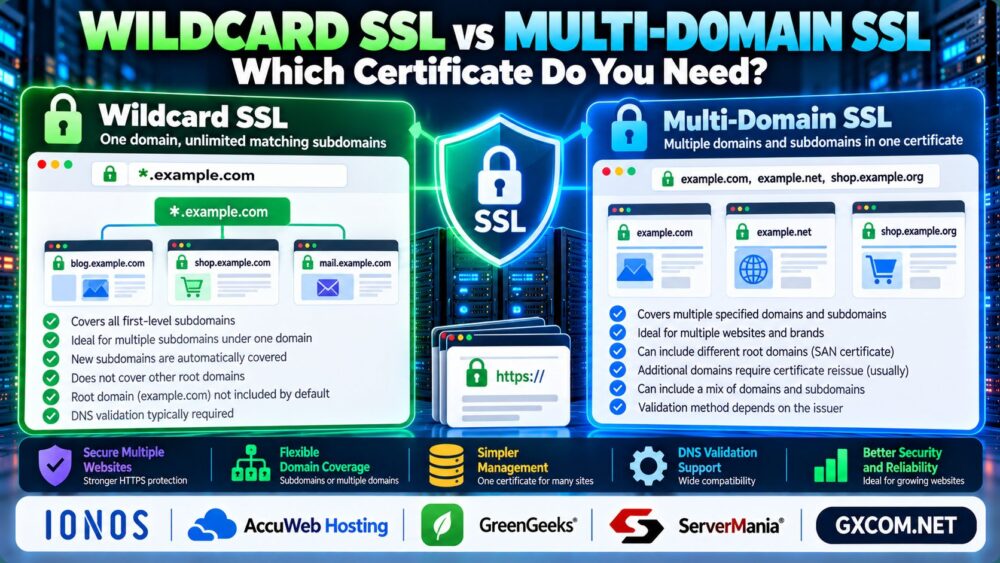
Wildcard SSL vs Multi-Domain SSL: Key Differences
| 功能 | Wildcard SSL | Multi-Domain SSL |
|---|---|---|
| 主要目的 | Secure subdomains under one domain | Secure multiple specified hostnames |
| Typical coverage | *.example.com | example.com, example.net, shop.example.org |
| New subdomains | Covered at the matching wildcard level | Usually require SAN changes |
| Different root domains | Not covered by one wildcard name | Supported when listed |
| 验证 | DNS validation commonly required | Depends on CA and issuance method |
| 最适合 | Subdomain-based services | Multiple websites and brands |
简答: Choose Wildcard SSL for many first-level subdomains of one domain. Choose Multi-Domain SSL when you need to protect several distinct domains or selected hostnames.
1. What Is a Wildcard SSL Certificate?
A wildcard certificate uses an asterisk in the hostname to cover multiple subdomains at a specific DNS level.
For example, a certificate containing:
*.example.comcan cover:
- blog.example.com
- shop.example.com
- mail.example.com
However, it does not automatically cover example.com or a deeper hostname such as api.dev.example.com.
To secure the root domain, include example.com as an additional certificate identifier when supported.
2. What Is a Multi-Domain SSL Certificate?
A Multi-Domain SSL certificate, commonly called a SAN certificate, contains multiple hostnames in its Subject Alternative Name extension.
例如:
example.com
example.net
shop.example.org
portal.example.com
One certificate can protect these listed hostnames, provided they are included during issuance.

This makes SAN certificates useful for organizations operating several brands, websites, or applications.
Additional hostnames may require certificate reissuance, depending on the provider and certificate management system.
3. Can One Certificate Combine Wildcard and Multi-Domain Coverage?
Yes. Some certificates contain both wildcard identifiers and individually specified hostnames.
例如:
*.example.com
example.com
example.net
*.example.org
Such certificates can combine broad subdomain coverage with support for different root domains.
Actual availability depends on the certificate authority, validation method, and product offering.
Before deployment, verify every hostname in the certificate's SAN list.
4. Wildcard SSL vs SAN SSL: Security and Management
Neither certificate type is inherently more secure simply because of its coverage model. Security depends on TLS configuration, private-key protection, certificate validation, and operational practices.
Wildcard certificates simplify deployment across related subdomains, but reusing the same private key across many servers increases the impact of a key compromise.
Multi-domain certificates can also create shared-key risks when one certificate is deployed across unrelated services.
For sensitive systems, consider separating certificates and private keys according to service boundaries.
5. Free Wildcard SSL with Let's Encrypt
Let's Encrypt supports wildcard certificates using DNS-based domain validation.
For ACME-based issuance, wildcard identifiers require the DNS-01 challenge rather than HTTP-01 validation.
DNS automation can simplify renewals, but your DNS provider must support a suitable integration or workflow.
For recurring certificate problems, see our Let's Encrypt SSL Auto-Renewal Troubleshooting Guide.
6. Which Certificate Is Better for WordPress and Hosting?
For a single WordPress website, a standard certificate covering the preferred domain and its www variant may be sufficient.
For several subdomains under one website, Wildcard SSL may simplify certificate coverage.
For multiple unrelated websites, a SAN certificate or separate certificates may be more appropriate.
Hosting providers such as IONOS 以及 GreenGeeks are relevant when evaluating website hosting environments with SSL management features.
For administrators handling custom VPS configurations or multiple hosted applications, AccuWeb 主机服务 is another provider to compare.
Always verify the certificate coverage, renewal automation, and support included with your hosting plan.
7. How to Choose the Right SSL Certificate
Before buying or issuing a certificate, answer these questions:
- Do you manage one root domain or several different domains?
- Will you frequently create new subdomains?
- Do you need to secure deeper subdomain levels?
- Can your DNS provider automate certificate validation?
- Will the certificate and private key be shared across servers?
- Do you prefer centralized management or separate certificates?
For organizations running dedicated infrastructure, ServerMania is relevant when comparing server deployment and administration requirements.
我们的 托管型与非托管型主机指南 explains how administration responsibilities affect ongoing maintenance.
8. Common SSL Certificate Configuration Mistakes
Common mistakes include assuming a wildcard covers every subdomain depth, forgetting the root domain, or deploying a certificate without the required SAN entries.
Another frequent problem is installing the correct certificate but configuring inconsistent HTTP-to-HTTPS redirects.
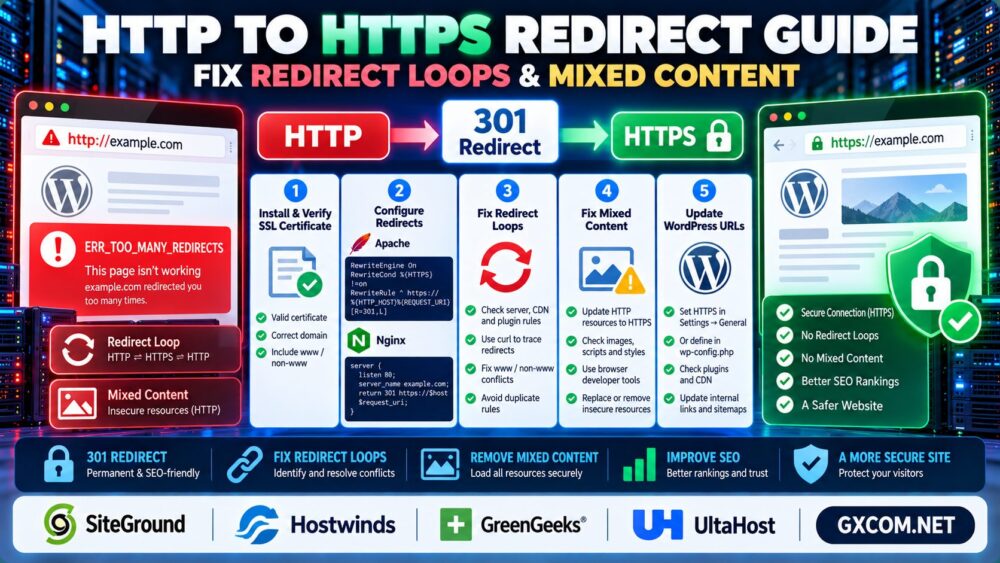
我们的 HTTP to HTTPS Redirect Guide explains how to resolve redirect loops and mixed content.
Certificate errors can also appear after server migrations when hostnames, TLS settings, or certificate files are not transferred correctly.

For migration planning, see our WordPress Migration Without Downtime Guide.
常见问题解答
Does Wildcard SSL cover unlimited subdomains?
It can cover many matching subdomains at one DNS level, but not arbitrary deeper levels or unrelated domains.
Does a wildcard certificate cover the root domain?
Not automatically. The root domain must be included separately in the certificate's identifiers.
Can a Multi-Domain SSL certificate include wildcard domains?
Yes, some SAN certificates can include wildcard identifiers, subject to issuer and validation requirements.
Is Wildcard SSL more expensive than Multi-Domain SSL?
Pricing varies by issuer, validation level, hostname limits, and management features. Free options may also be available.
Can Let's Encrypt issue Multi-Domain certificates?
Yes. Let's Encrypt supports certificates containing multiple validated identifiers, subject to its issuance limits and policies.
Which SSL certificate is best for multiple websites?
Use a SAN certificate for multiple specified domains, or consider separate certificates when operational isolation is important.
最终裁决
The choice between Wildcard SSL vs Multi-Domain SSL depends on your domain structure, certificate automation, and security requirements.
Wildcard SSL is useful for multiple subdomains under one domain. Multi-Domain SSL is better suited to several specified hostnames across different domains.
Match the Certificate to Your Domains, Not Just the Number of Websites.