AMD Instinct 与 NVIDIA GPU 对比 对于选择人工智能训练服务器、云GPU实例和专用基础设施的企业而言,这一比较正变得越来越重要。 AMD Instinct 加速器提供了高内存计算选项和 ROCm 软件生态系统,而 NVIDIA 数据中心 GPU 则得益于成熟的 CUDA 平台和种类繁多的 AI 开发工具。然而,最适合 AI 训练的 GPU 服务器不仅取决于硬件规格或每小时租赁价格。.
AI团队必须考虑模型兼容性、GPU内存、训练精度、互连性能、软件工程要求以及完成工作负载的总成本。如果应用程序兼容性问题或训练速度变慢导致项目完成时间延长,那么价格较低的GPU未必能提供更好的性价比。.
本指南从硬件架构、PyTorch 支持、软件部署、分布式训练、模型托管以及基础设施经济性等方面,对 AMD Instinct 和 NVIDIA GPU 服务器进行了对比分析。此外,还阐述了在选择 GPU 托管服务提供商之前应核实哪些事项。.
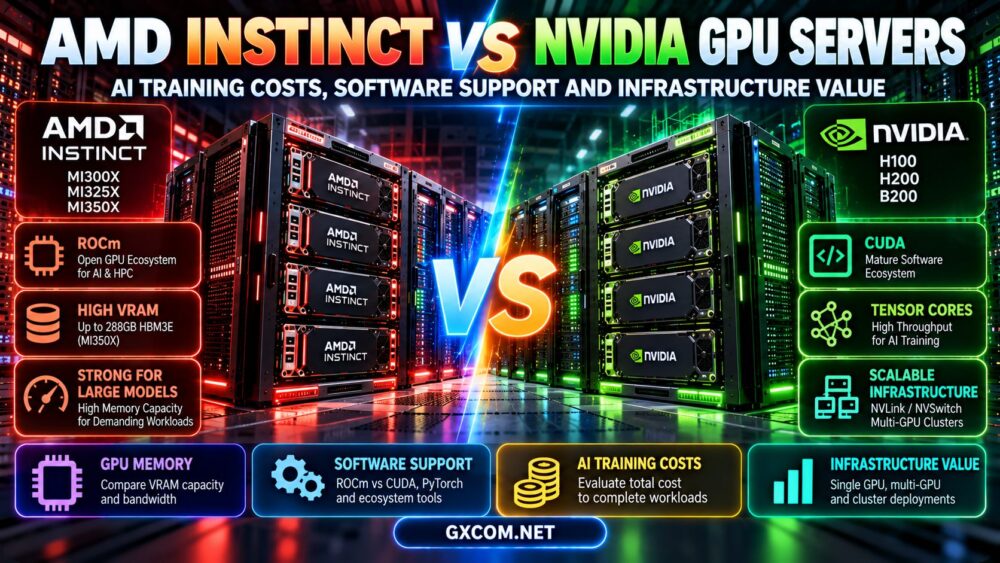
AMD Instinct 与 NVIDIA GPU:主要区别
AMD 和 NVIDIA 都开发用于处理高要求的人工智能和高性能计算工作负载的加速器。两者的产品在架构、内存配置、软件生态系统以及支持的系统设计方面各不相同。.
| 因子 | AMD Instinct GPU 服务器 | NVIDIA GPU 服务器 |
|---|---|---|
| GPU架构 | Instinct 加速器中的 CDNA 家族 | Hopper、Blackwell 及其他受支持的架构 |
| 主要软件平台 | ROCm 和 HIP | CUDA |
| PyTorch | 通过兼容的 ROCm 构建版本提供支持 | 通过兼容的 CUDA 构建版本提供支持 |
| GPU内存 | 部分 Instinct 机型提供大内存选项 | 在H100、H200、B200及其他产品中各不相同 |
| 训练精度 | 这取决于Instinct的生成方式和软件 | 这取决于 Tensor Core 的代数和软件 |
| 多GPU连接 | 针对特定架构和系统的 GPU 互连技术 | 支持的配置中的 PCIe、NVLink 和 NVSwitch |
| 部署挑战 | 验证整个应用程序堆栈对 ROCm 的支持情况 | 验证 CUDA、驱动程序和库的兼容性 |
| 最佳采购指标 | 每个成功完成的工作负载的成本 | 每个成功完成的工作负载的成本 |
这两种平台都没有绝对的优越性。要进行有效的比较,需要训练目标一致、软件兼容以及系统配置具有代表性。.
AMD Instinct GPU 架构用于人工智能训练
AMD Instinct 加速器专为高负载计算任务而设计,包括人工智能训练、推理和科学计算。.
不同代的产品采用不同的CDNA架构,并支持不同的内存技术、数值格式和系统互连功能。.
AMD Instinct MI300X
MI300X 是一款配备 192GB HBM3 内存的 CDNA 3 加速器。其巨大的内存容量使其特别适用于那些需要在单个加速器上容纳更大模型或更大批量的计算工作负载。.
然而,仅凭可用内存并不能决定训练性能。框架支持、核函数、带宽以及完整的服务器设计仍然至关重要。.
AMD Instinct MI325X
MI325X 基于 CDNA 3 系列打造,配备 256GB HBM3E 内存。.
对于内存密集型的人工智能工作负载而言,它或许颇具吸引力,但与 MI300X 相比,其实际优势取决于模型、软件优化以及系统配置。.
AMD Instinct MI350X 及更新一代产品
MI350X 属于 AMD 的 CDNA 4 代产品,配备 288GB 的 HBM3E 内存。.
对较新架构的支持和额外的内存固然很有价值,但企业必须确认其选定的 ROCm 版本和 AI 框架是否支持该特定加速器。.
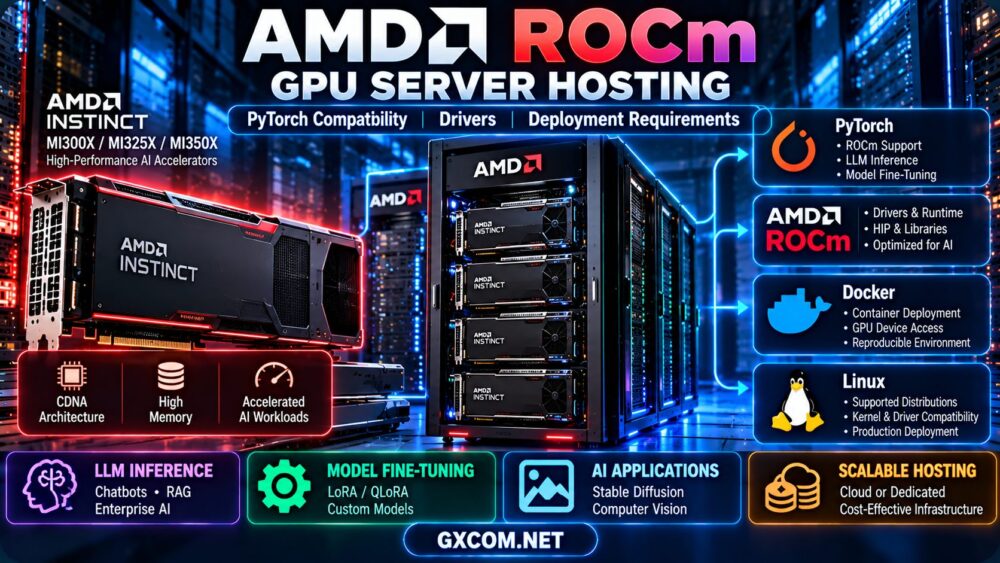
如需更详细的硬件对比,请参阅我们的 AMD Instinct MI300X、MI325X 与 MI350X 服务器对比.
NVIDIA 用于 AI 训练的 GPU 架构
NVIDIA 提供专为大规模 AI 工作负载设计的数据中心加速器,包括 H100、H200 和 B200。.
这些GPU在架构、内存容量、支持的精度格式以及系统级连接性方面各不相同。.
NVIDIA H100
H100 采用 NVIDIA 的 Hopper 架构,提供多种外形尺寸和配置。.
常见的 H100 配置提供 80GB 的 HBM 内存,但内存带宽、功耗和互连能力取决于具体产品。.
NVIDIA H200
H200 同样属于 Hopper 系列,其标准配置中配备了 141GB 的 HBM3E 内存。.
其额外的内存容量和带宽可为受 GPU 内存限制的工作负载带来益处,不过具体收益因应用而异。.
NVIDIA B200
B200 采用 NVIDIA 的 Blackwell 架构,在数据中心配置中,每块 GPU 配备 180GB 的 HBM3E 内存。.
Blackwell 平台引入了架构变更和支持的数值格式,这些变化和格式有助于优化 AI 工作负载。.
不过,买家应比较完整的系统,而不是假设任何一款 B200 服务器都能提供相同的连接性或性能。.
如需了解其他规格,请阅读我们的 NVIDIA H100、H200 与 B200 服务器对比.
AMD Instinct 与 NVIDIA GPU 内存对比
GPU内存容量可以决定一个模型是否能容纳在一个加速器上,是否需要分片处理,还是需要多GPU系统。.
| GPU 型号 | 记忆 | 建筑 |
|---|---|---|
| AMD Instinct MI300X | 192GB HBM3 | CDNA 3 |
| AMD Instinct MI325X | 256GB HBM3E | CDNA 3 |
| AMD Instinct MI350X | 288GB HBM3E | CDNA 4 |
| NVIDIA H100 | 常见配置为80GB | 霍珀 |
| NVIDIA H200 | 常见配置中的 141GB HBM3E | 霍珀 |
| NVIDIA B200 | 180GB HBM3E | 布莱克韦尔 |
这些数据描述的是具有代表性的加速器规格,并非完整的服务器配置。购买前必须核对产品型号、可用内存以及系统级特性。.
为什么更大的VRAM并不一定意味着训练速度更快
训练性能取决于 GPU 计算吞吐量、内存带宽、数值精度、内核优化、批量大小以及通信开销。.
内存更大的 GPU 或许可以减少对模型分区的依赖,但另一种加速器可能更快地完成较小的兼容工作负载。.
模型权重只是训练记忆的一部分
全参数训练还需要内存来存储梯度、优化器状态、激活函数值以及临时工作区。.
例如,一个以16位精度存储的700亿参数模型,仅参数值部分(采用十进制单位)就大约需要140GB的存储空间。.
该估算未包含其他训练内存需求,也不意味着该模型仅凭一块内存略高于140GB的GPU即可完成全部训练。.
ROCm 与 CUDA:软件支持对比
软件兼容性是 AMD Instinct 与 NVIDIA GPU 对比 决定。.
NVIDIA的CUDA平台和AMD的ROCm平台为加速计算提供了不同的软件生态系统。.
NVIDIA CUDA 生态系统
CUDA 包含编程接口、开发工具、库以及受支持的 GPU 应用程序所使用的运行时组件。.
许多人工智能项目都提供了以 CUDA 为核心的安装指南、经过优化的内核以及部署示例。.
不过,CUDA 的兼容性仍取决于具体的 GPU、驱动程序、框架版本以及应用程序的要求。.
AMD ROCm 生态系统
ROCm 提供了 AMD 的 GPU 计算软件栈,其中包括 HIP 以及相关支持库。.

兼容的 PyTorch 构建版本可在 AMD 加速器上执行受支持的工作负载。.
对于正在考虑采用 AMD Instinct 基础设施的组织而言,ROCm 已成为一种重要的替代方案,但必须验证其对各项扩展以及优化版 AI 内核的支持情况。.
CUDA 应用程序能在 AMD GPU 上运行吗?
并非自动。.
有些应用程序使用可移植的框架操作,通过兼容的构建版本即可在两个平台上运行。而另一些则依赖于 CUDA 专用的库、自定义内核或扩展,需要进行适配。.
HIP 可以协助完成某些移植工作流,但并不能保证每个 CUDA 应用程序都能在不做任何修改的情况下在 AMD 硬件上运行。.
软件兼容性检查表
- 该框架是否支持该特定的GPU架构?
- 所需的 PyTorch 构建版本是否可用?
- 自定义内核兼容吗?
- 该训练框架是否支持所需的数值精度?
- 是否支持量化与优化库?
- 该应用程序能否在预期的容器环境中运行?
- 分布式通信库之间是否兼容?
有关安装和部署的注意事项,请参阅我们的 AMD ROCm GPU 服务器托管指南.
PyTorch 兼容性:AMD 与 NVIDIA GPU 服务器对比
PyTorch 通过兼容的 CUDA 和 ROCm 构建版本支持 GPU 加速。.
对于 NVIDIA 部署,用户通常会选择一个与目标 CUDA 运行时和驱动程序环境兼容的 PyTorch 构建版本。.
对于 AMD 部署,用户必须选择一个受支持且启用了 ROCm 的构建版本,并验证 GPU、驱动程序和操作系统的组合是否兼容。.
PyTorch GPU 基础验证
一个简单的验证脚本可帮助确认 PyTorch 能否检测到可用的 GPU:
import torch

print("PyTorch 版本:", torch.__version__)
print("CUDA 构建版本:", torch.version.cuda)
print("ROCm/HIP 构建版本:", torch.version.hip)
print("GPU 可用:", torch.cuda.is_available())

if torch.cuda.is_available():
    print("设备:", torch.cuda.get_device_name(0))
    x = torch.randn(1024, 1024, device="cuda")
    y = torch.matmul(x, x)
    print("输出:", y.shape)
PyTorch的 torch.cuda 支持 ROCm 的构建也会使用该接口。因此,如果存在 torch.cuda 并不一定意味着是 NVIDIA 显卡。.
成功检测到设备仅仅是第一步。团队在将模型投入生产环境之前,应先运行实际模型、训练方法以及所需的扩展功能。.
AI训练性能:应以什么作为基准?
Comparing AMD and NVIDIA accelerators using theoretical TFLOPS alone can be misleading.
Training performance is influenced by the complete application and server configuration.
Measure Useful Training Throughput
Depending on the workload, useful metrics include:
- 每秒处理的训练令牌数。.
- Samples processed per second.
- Time required to complete an epoch.
- Time required to reach a defined validation target.
- GPU utilization and memory consumption.
- Communication overhead during distributed training.
Use Equivalent Test Conditions
A meaningful comparison should use the same model, dataset, training objective, precision policy, and acceptable output quality.
Batch size, optimizer configuration, gradient accumulation, and framework version should be controlled or documented.
Otherwise, apparent GPU performance differences may actually reflect different software settings.
Account for Software Optimization
A model may use highly optimized kernels on one platform but less mature implementations on another.
Application performance can improve as framework support changes, so benchmark results should include software versions and test dates.
AMD Instinct vs NVIDIA GPU for Distributed Training
Large training jobs may require multiple GPUs within one server or across multiple nodes.
Distributed training introduces communication, memory management, and orchestration requirements that go beyond the capabilities of an individual accelerator.
AMD Multi-GPU Infrastructure
AMD Instinct platforms can use supported high-bandwidth GPU interconnect technologies and distributed communication libraries.
However, the topology depends on the exact accelerator generation and server design.
Buyers should confirm whether the proposed system supports the required collective communication operations and framework configuration.
NVIDIA Multi-GPU Infrastructure
NVIDIA systems may use PCIe, NVLink, NVSwitch, and high-performance network technologies, depending on the platform.
NCCL is commonly used for supported distributed communication workloads.
Not every NVIDIA GPU server includes NVLink or NVSwitch, and these technologies should not be assumed from the accelerator name alone.
Multi-Node Networking
Distributed AI training can be limited by communication between nodes.
需要重点考虑的因素包括:
- Inter-node network bandwidth.
- Latency and congestion.
- RDMA support where required.
- GPU-to-GPU topology.
- Storage and checkpoint throughput.
- Distributed framework compatibility.
For infrastructure planning, see our 多GPU服务器托管指南.
AMD Instinct vs NVIDIA GPU: AI Training Costs
该 AMD Instinct 与 NVIDIA GPU 对比 cost comparison should focus on the total expense of completing a training workload rather than the lowest advertised hourly rate.
Cloud GPU pricing and dedicated server costs vary by provider, accelerator, region, availability, contract, and infrastructure configuration.
Calculate Cost per Completed Training Run
A practical formula is:
Total training cost = billable compute + storage + networking + software + recovery + attributable engineering and operations
For two GPU platforms, compare the total cost required to reach the same training objective and acceptable model quality.
Illustrative AMD vs NVIDIA Cost Example
Assume two hypothetical GPU server configurations complete an equivalent training workload.
| 公制 | Hypothetical AMD Server | Hypothetical NVIDIA Server |
|---|---|---|
| 每小时计算费率 | $2.50 | $3.50 |
| 培训完成时间 | 60 hours | 40 hours |
| 计算成本 | $150 | $140 |
These are hypothetical calculations, not real supplier prices, product benchmarks, or claims about AMD and NVIDIA performance.
In this illustration, the NVIDIA option has a higher hourly price but a lower total compute cost because it finishes the workload faster.
Different assumptions could produce the opposite result.
When Higher-Memory GPUs Can Improve Economics
A GPU with more memory may allow a workload to run with less model partitioning, reduced offloading, or a larger effective batch size.
These benefits can reduce operational complexity or improve throughput in some applications.
However, more memory does not guarantee lower total cost. The workload must be benchmarked.
Engineering Costs Matter
If a workload depends heavily on CUDA-specific extensions, adapting it to ROCm may require additional development and testing.
Conversely, an application already validated on ROCm may not incur those migration costs.
Include software porting, troubleshooting, framework updates, and maintenance when comparing infrastructure value.
Cloud vs Dedicated AMD and NVIDIA GPU Servers
Organizations can rent AMD or NVIDIA GPU infrastructure through different deployment models, subject to provider availability.
| 因子 | 云端 GPU | 专用GPU服务器 |
|---|---|---|
| 账单 | 通常基于使用情况 | 通常按月或按合同计费 |
| 配置 | May support flexible deployment | Depends on hardware availability |
| 驾驶员控制 | Depends on service model | May allow greater host control |
| GPU topology | Must verify instance configuration | Must verify physical server design |
| 最合适的入门搭配 | 实验与需求波动 | Sustained or customized workloads |
Cloud infrastructure can be attractive for experimentation, while dedicated GPU servers may be appropriate for sustained workloads requiring defined hardware allocation.
Neither model guarantees lower costs or better performance without examining utilization, workload completion time, and service terms.
GPU Hosting Providers to Compare
When comparing AMD Instinct and NVIDIA GPU servers, evaluate hosting providers based on verified hardware availability, software compatibility, infrastructure controls, and commercial terms.
The following providers represent different purchasing models. Inclusion does not establish that every provider currently offers both AMD Instinct and NVIDIA data center GPUs.
Cherry Servers:专用 GPU 基础设施
Cherry 服务器 is relevant for organizations evaluating dedicated GPU and bare-metal infrastructure.
Before ordering, confirm the exact accelerator, GPU memory, interconnect topology, operating system support, networking, and hardware management responsibilities.
For sustained training, compare the recurring cost against the useful training throughput of equivalent cloud alternatives.
RunPod: Cloud GPU Development and Testing
RunPod is relevant for developers comparing GPU cloud environments and flexible compute resources.
Check the current GPU catalog, software image compatibility, storage persistence, and allocation model.
For an AMD-versus-NVIDIA comparison, first verify whether the required AMD accelerator is actually offered in the selected product.
Vast.ai: GPU Marketplace Comparison
Vast.ai provides marketplace-based GPU compute options with varying hardware configurations and host conditions.
Buyers should compare exact GPU models, memory, host reliability, storage, network specifications, and software compatibility.
A low rental rate should not outweigh significant uncertainty about whether the application can complete successfully.
GPU Mart:GPU 服务器配置评估
GPU Mart can be considered when evaluating GPU server configurations and dedicated computing requirements.
Request written confirmation of the accelerator model, Linux and driver support, administrative access, and available storage and networking resources.
Do not assume that a general GPU hosting offer includes a specific AMD Instinct or NVIDIA data center product.
ServerMania: Dedicated Infrastructure Planning
ServerMania is relevant when investigating dedicated servers and customized infrastructure requirements.
For AI workloads, verify whether suitable GPU-equipped configurations are available and whether the server meets the required memory, networking, software, and support specifications.
Procurement rule: Verify exact GPU inventory, driver access, deployment location, service terms, and cluster features before purchasing. Product availability and pricing can change.
Which GPU Platform Is Better for Different AI Workloads?
| 工作量 | Primary Evaluation Priority | Suggested Approach |
|---|---|---|
| LLM微调 | VRAM, framework compatibility, optimizer support | Benchmark supported AMD and NVIDIA options |
| 大型模型推理 | Memory capacity, latency, throughput | Compare cost per completed request |
| Full model training | Compute, memory, communication, reliability | Evaluate complete multi-GPU systems |
| Research experimentation | Software flexibility, setup time, rental economics | Start with compatible cloud resources |
| Production enterprise AI | Security, reliability, operational support | Compare private, dedicated, and cloud options |
| 分布式训练 | GPU topology, networking, collective communication | Benchmark representative cluster configurations |
These are evaluation guidelines, not universal recommendations for one GPU manufacturer.
AMD vs NVIDIA GPU Server Buying Checklist
- 定义工作负载: Identify training, fine-tuning, inference, or mixed requirements.
- 估算 GPU 内存: Include model parameters, optimizer states, gradients, and activations.
- Verify software support: Confirm CUDA or ROCm compatibility for the actual application.
- Check framework versions: Validate PyTorch and required extensions.
- Review numerical precision: Ensure the accelerator supports the required formats.
- Inspect GPU topology: Confirm multi-GPU interconnect capabilities.
- Evaluate networking: Check distributed communication requirements.
- Benchmark the workload: Measure useful throughput and completion time.
- Include engineering effort: Account for migration and maintenance costs.
- Review hosting terms: Confirm availability, support, billing, and operational responsibilities.
- 计算总成本: Compare equivalent completed workloads.
- Test recovery: Validate checkpoints, backups, and restart procedures.
常见问题解答
Is AMD Instinct better than NVIDIA for AI training?
Neither platform is universally better. The right choice depends on GPU memory, model compatibility, software optimization, training throughput, infrastructure requirements, and total cost.
Are AMD Instinct GPUs cheaper than NVIDIA GPUs?
Not necessarily. Rental prices vary by provider, configuration, and availability. A lower hourly rate may not result in lower training costs if completion time or engineering overhead increases.
Does PyTorch support AMD Instinct GPUs?
Yes, PyTorch supports compatible AMD GPUs through ROCm-enabled builds. The exact accelerator, ROCm release, driver, operating system, and framework version must be supported.
Can CUDA software run directly on AMD GPUs?
Not universally. Some framework-level workloads can run on both platforms, while CUDA-specific applications or extensions may require porting or alternative implementations.
Why do AMD Instinct GPUs have so much memory?
High memory capacity can support large models, bigger working sets, and certain memory-intensive AI workloads. However, useful performance also depends on compute throughput, bandwidth, software, and communication.
Is NVIDIA CUDA more compatible with AI software than ROCm?
Many AI applications have extensive CUDA-focused tooling and optimized implementations. ROCm supports a growing range of AI workloads, but compatibility should be evaluated at the level of the exact application and software version.
Which GPU is better for LLM fine-tuning?
Choose based on the model size, training method, available VRAM, supported quantization libraries, optimizer compatibility, and measured cost per completed fine-tuning run.
Do AMD and NVIDIA GPU clusters use the same networking?
Both may use high-performance networking technologies, but GPU interconnects, communication libraries, and supported system architectures differ. Verify the complete cluster design.
Should businesses rent AMD or NVIDIA dedicated GPU servers?
Businesses should compare validated workload performance, operational control, provider support, software compatibility, and long-term infrastructure costs before choosing.
What is the best way to compare AMD and NVIDIA AI training costs?
Run equivalent training workloads and calculate the total cost to reach the same objective, including compute, storage, networking, recovery, and engineering effort.
Final Verdict: AMD Instinct vs NVIDIA GPU Servers
该 AMD Instinct 与 NVIDIA GPU 对比 decision is ultimately about infrastructure value, not brand preference.
AMD Instinct deserves consideration for compatible AI workloads that benefit from high GPU memory capacity and the ROCm software ecosystem.
NVIDIA GPU 服务器 remain important options for teams relying on CUDA-based applications, optimized libraries, and supported data center training platforms.
However, neither higher VRAM nor a larger theoretical performance figure guarantees better economics.
Organizations should validate the actual software stack, benchmark representative training workloads, inspect multi-GPU connectivity, and compare total completion costs.
Cherry Servers, RunPod, Vast.ai, GPU Mart, and ServerMania represent different GPU infrastructure options to investigate, subject to current product availability and technical requirements.
AI WORKLOAD → GPU MEMORY → CUDA OR ROCm → SOFTWARE COMPATIBILITY → TRAINING PERFORMANCE → TOTAL COST → INFRASTRUCTURE VALUE
The best GPU server is the one that reliably completes the intended AI workload with acceptable performance, operational complexity, and long-term cost.