What Makes Cloud Servers Highly Available?
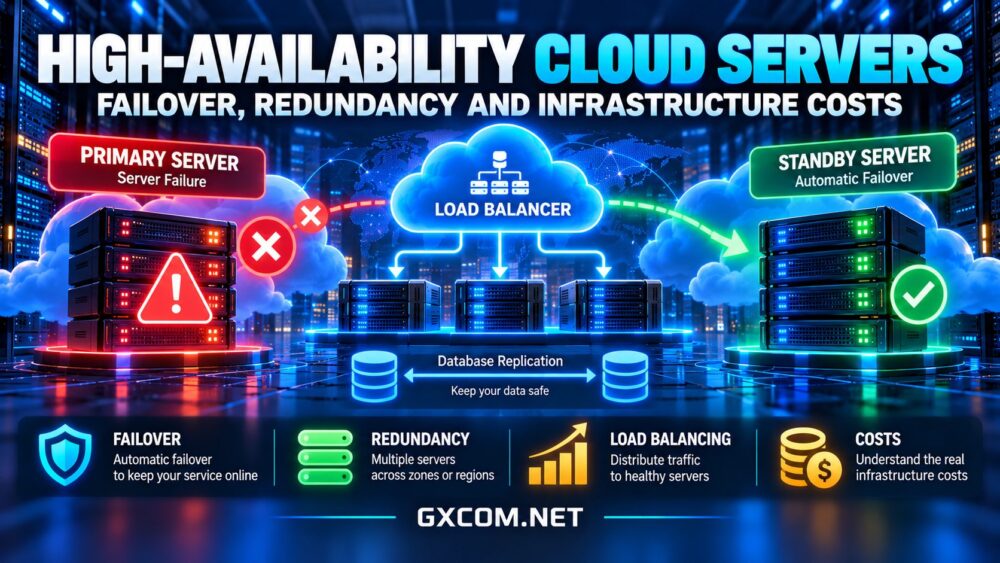
High availability cloud servers are designed to keep applications accessible when individual infrastructure components fail. Instead of relying on one virtual machine, a high-availability architecture uses redundant resources, health checks, and a defined recovery process. The goal is to reduce service interruption, not promise that failures will never occur.
A single cloud instance can still become unavailable because of operating-system problems, storage failures, network issues, or deployment mistakes. Businesses should evaluate the entire application path, including databases and DNS, rather than treating a provider’s uptime percentage as proof of end-to-end resilience.
High Availability vs Disaster Recovery
High availability focuses on maintaining service during localized failures. Disaster recovery focuses on restoring operations after more serious incidents, including data corruption, regional disruption, or accidental deletion. Both matter, but they solve different problems.
Define a recovery time objective (RTO), the maximum acceptable restoration period, and a recovery point objective (RPO), the amount of recent data the business can afford to lose. These targets determine whether simple backups, standby servers, or continuous replication are justified.
我们的 云VPS快照与备份指南 explains why recovery copies need independent retention and restore testing.
Failover: Active-Passive vs Active-Active
Active-Passive Failover
An active-passive design uses a primary server and a standby system. When monitoring detects a qualifying failure, traffic or service ownership moves to the standby. This can simplify application consistency, although the standby still requires capacity, maintenance, and periodic testing.
Failover is rarely instantaneous. Detection intervals, application startup, database promotion, and connection recovery all influence the real interruption experienced by customers.
Active-Active Redundancy
An active-active design runs multiple application instances simultaneously, commonly behind a load balancer. Healthy instances continue serving requests when another fails. This approach can also distribute routine traffic, but applications must manage sessions, shared state, and concurrent database operations correctly.
Active-active application servers do not eliminate a single database failure point. Redundant database architecture and tested promotion procedures may be necessary to meet strict recovery objectives.
Load Balancers and Failure Domains
A load balancer sends traffic to healthy application instances and can stop routing requests to failed nodes. However, the load balancer itself must be resilient. Verify whether the provider’s service has built-in redundancy and how health checks behave during partial outages.

Place redundant resources across distinct failure domains where supported. Separate physical hosts may protect against a hardware fault; separate availability zones may reduce exposure to a localized facility issue. Multiple regions can address broader disruptions, but introduce replication complexity, latency, and transfer expenses.
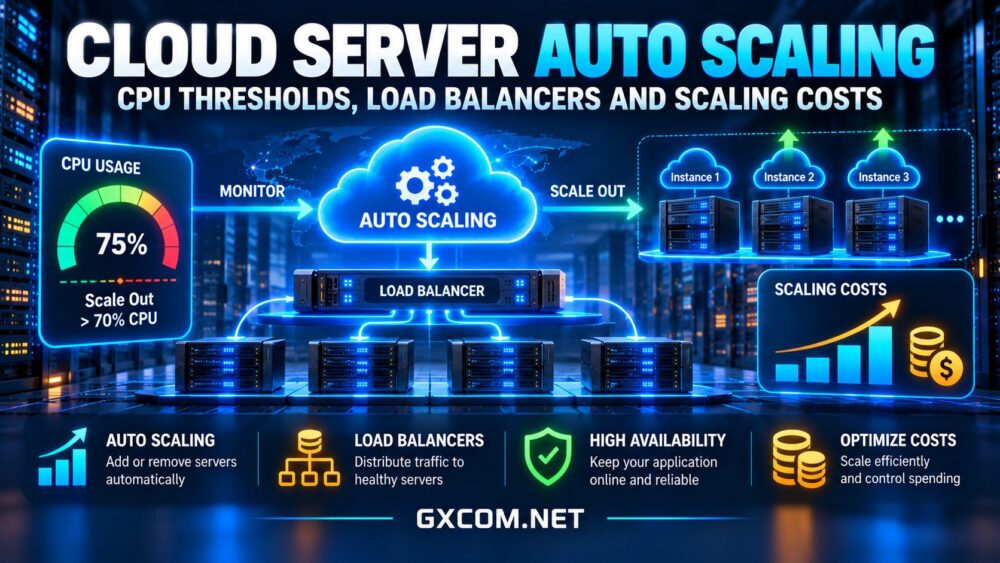
Automatic scaling serves a different purpose: adjusting capacity as demand changes. Read our cloud server auto scaling guide to compare scaling triggers with failover mechanisms.
Five Cloud Providers to Evaluate
Providers offer different combinations of virtual machines, networking, backups, and managed services. Confirm product-specific features and regional availability before designing an architecture around them.
Vultr: Developer-Managed Redundancy
Vultr is a candidate for teams building redundant application tiers with cloud compute and networking services. Compare available load balancing options, instance placement, storage behavior, and backup policies. Multi-instance deployment still requires application-level configuration.
Kamatera:可配置的云基础设施
卡马特拉 offers configurable cloud server resources that can support custom redundancy plans. Buyers should confirm networking options, backup arrangements, automation capabilities, and the cost of maintaining standby capacity.
Akamai Cloud: Cloud Compute and Networking
Akamai Cloud(原名 Linode) can support developer-managed application infrastructure. Evaluate load balancing, instance locations, database dependencies, and operational tooling against the specific recovery targets of the workload.
OVHcloud: VPS and Public Cloud Choices
OVHcloud offers different infrastructure product families. Compare the actual VPS or Public Cloud service, supported redundancy options, storage replication characteristics, and network terms. Do not assume every product includes the same availability features.
Cloudways: Managed Application Hosting
Cloudways may suit compatible web applications whose owners prefer managed server operations. Check whether the selected plan supports the required failover architecture, what support covers, and which recovery tasks remain the customer’s responsibility. Our 托管云主机对比 提供了更多的采购背景信息。.
What Does High Availability Actually Cost?
Redundancy usually increases baseline spending. A second application server, standby database, load balancer, monitoring service, replicated storage, and additional backups may each create recurring charges. Cross-zone or cross-region traffic can add costs even when customer demand remains unchanged.
Consider a hypothetical single-server deployment costing $40 monthly. Adding a second $40 server and a $15 load balancing service raises the simplified infrastructure total to $95. That excludes database redundancy, backup storage, transfer, engineering time, and support. These figures illustrate budgeting, not current provider quotations.
A standby server may be cheaper than a fully active duplicate under some designs, but it still needs testing and adequate capacity to handle production traffic. Conversely, an active-active configuration may deliver both resilience and usable capacity, potentially improving resource efficiency during normal operation.
请查看我们的 cloud VPS bandwidth costs guide before budgeting replication traffic. For purchasing comparisons, consult 云托管优惠 while checking the full architecture cost rather than introductory server prices.
Choose the Right Availability Level
Not every application needs the same redundancy budget. A low-traffic informational website may tolerate a documented restoration window, while a subscription platform processing customer transactions may require redundant application nodes and faster database recovery. Prioritize the business processes that create the greatest financial or reputational exposure during an outage.
Ask providers for written service-level terms and clarify what happens when a dependency fails outside their infrastructure. Service credits generally do not reimburse lost sales, engineering time, or damaged customer relationships. Monitor availability from outside the hosting environment so internal monitoring failures do not conceal an outage.
How to Test a Failover Plan
- Identify dependencies: Map application servers, databases, storage, DNS, and third-party services.
- Set recovery targets: Agree on RTO and RPO before selecting infrastructure.
- Simulate failure: Remove an instance from service and measure detection and recovery.
- Verify data consistency: Check transactions, replication lag, and database promotion.
- Test restoration: Recover from backups independently of the primary environment.
- Review costs: Measure standby resources, network transfer, monitoring, and operational labor.
最终裁决
High availability is an architectural outcome, not a checkbox on a cloud server plan. Businesses should invest in redundancy according to the cost of downtime and the recovery targets their applications require. Start by removing the most consequential single points of failure, rehearse failover regularly, and compare providers using complete infrastructure and operational costs. A simpler design with tested recovery may be more valuable than an elaborate system nobody knows how to restore.