这个 AMD Instinct MI350 cloud review examines the AMD Instinct MI350X, MI355X, and MI350P accelerators, ROCm software compatibility, high-bandwidth GPU memory, cloud availability, and practical deployment considerations for AI training and inference.
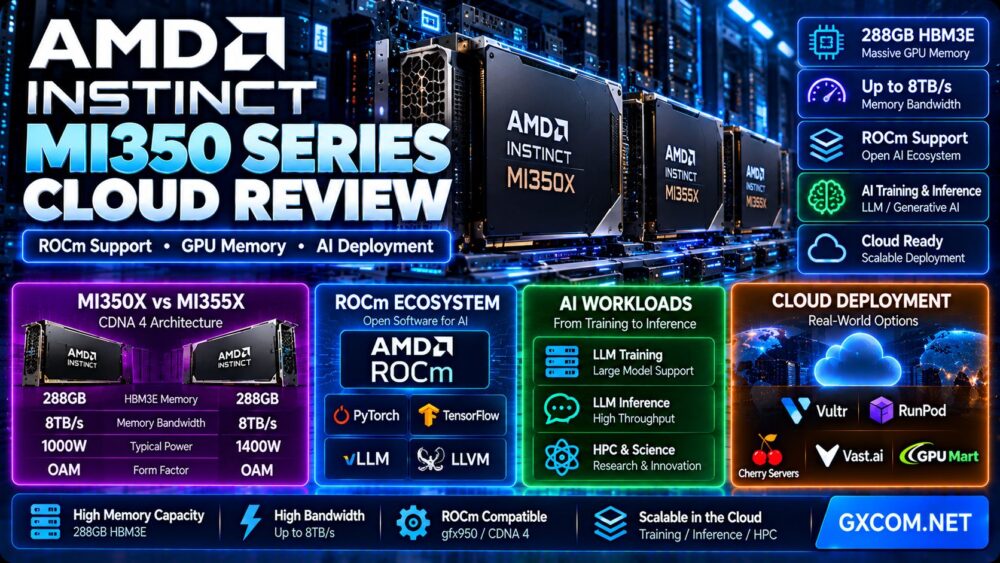
The AMD Instinct MI350 Series represents an important development in data-center GPU infrastructure. Built on AMD's CDNA 4 architecture, the MI350X and MI355X combine 288GB of HBM3E memory per accelerator with up to 8TB/s of theoretical memory bandwidth.
These specifications make the platform particularly interesting for large language models, memory-intensive inference, and high-performance computing.
However, choosing an AMD GPU cloud instance requires more than comparing accelerator specifications. Buyers must evaluate ROCm compatibility, framework support, multi-GPU communication, networking, workload performance, and actual cloud availability.
In this review, we examine AMD's hardware and software ecosystem, identify Vultr as a provider publicly advertising MI355X Cloud GPU infrastructure, and compare alternative GPU deployment approaches involving RunPod, Cherry 服务器, Vast.ai, ,以及 GPU Mart.
Editorial methodology: This article is based on official AMD architecture and ROCm documentation, publicly available cloud product information, and general GPU infrastructure evaluation principles. GXCOM.NET has not independently benchmarked MI350 Series hardware, measured Vultr MI355X performance, or verified real-time inventory. Specifications are not substitutes for workload-specific testing.
AMD Instinct MI350 Series Cloud Review: Quick Verdict
The AMD Instinct MI350 Series is a compelling option for organizations that need very large GPU memory capacity and are prepared to validate their AI software on ROCm.
The MI350X and MI355X each provide 288GB of HBM3E memory, significantly expanding the amount of model data that can reside on one accelerator compared with many earlier GPU generations.
The series also supports advanced low-precision compute formats designed for modern AI workloads.
However, high theoretical compute performance does not guarantee faster inference or lower costs for every application.
ROCm compatibility, kernel optimization, model architecture, batch size, interconnect design, and cloud pricing all influence the final result.
For buyers seeking confirmed commercial MI350 Series cloud offerings, Vultr publicly markets AMD Instinct MI355X Cloud GPU infrastructure. Other GPU hosting providers should be evaluated as alternatives without assuming that they offer the same accelerator.
| 评估领域 | 评估 |
|---|---|
| GPU family | AMD Instinct MI350 Series |
| 建筑 | AMD CDNA 4 |
| Primary accelerators | MI350X and MI355X |
| Additional form factor | MI350P PCIe accelerator |
| MI350X / MI355X memory | 288GB HBM3E per GPU |
| 峰值内存带宽 | Up to 8TB/s per MI350X or MI355X |
| Eight-GPU platform memory | Approximately 2.3TB aggregate HBM3E |
| 软件生态系统 | AMD ROCm |
| LLVM GPU target | gfx950 |
| Relevant workloads | LLM inference, training and HPC |
| Verified cloud product example | Vultr MI355X Cloud GPU |
| Main buying consideration | Software compatibility and measured cost per workload |
What Is the AMD Instinct MI350 Series?
The AMD Instinct MI350 Series is a family of data-center accelerators designed for artificial intelligence, machine learning, and high-performance computing.
It uses the fourth generation of AMD's CDNA architecture.
Unlike consumer Radeon graphics cards, Instinct accelerators are designed primarily for compute workloads rather than desktop graphics.
The MI350 family includes different deployment formats with distinct memory, power, and system integration characteristics.
AMD Instinct MI350X
The MI350X is an OAM accelerator designed for high-density AI server platforms.
It provides 288GB HBM3E memory and up to 8TB/s theoretical memory bandwidth.
AMD documents a typical board power of 1000W for the MI350X.
It is designed for demanding AI training and inference workloads, including multi-GPU server configurations.
AMD Instinct MI355X
The MI355X uses the same CDNA 4 family and provides 288GB HBM3E memory.
It offers higher peak compute specifications in selected formats and has a typical board power of 1400W.
Its high power density makes server cooling and rack infrastructure important deployment considerations.
AMD Instinct MI350P
AMD also documents the MI350P as a PCIe-based accelerator.
Its configuration includes 144GB HBM3E memory and up to 4TB/s theoretical memory bandwidth.
The MI350P is intended for a different system integration profile than the higher-power OAM accelerators.
Cloud customers should confirm which model and form factor are actually installed rather than treating every MI350 Series product as equivalent.
MI350X vs MI355X vs MI350P: Specifications Compared
| 规格 | MI350X | MI355X | MI350P |
|---|---|---|---|
| 建筑 | CDNA 4 | CDNA 4 | CDNA 4 |
| 外形尺寸 | OAM | OAM | PCIe |
| HBM3E capacity | 288GB | 288GB | 144GB |
| 峰值内存带宽 | 8TB/s | 8TB/s | 4TB/s |
| Typical board power | 1000W | 1400W | 600W, configurable to 450W |
| Deployment emphasis | High-density AI systems | Higher-power AI systems | PCIe server integration |
These are manufacturer specifications, not measured cloud application results.
Actual performance depends on software, precision, cooling, memory behavior, and server configuration.
Why 288GB HBM3E Matters for AI Workloads
GPU memory capacity is a major constraint in large-model deployment.
A model may have enough compute available but still fail to load because its weights and runtime state exceed GPU memory.
模型权重
A simplified dense-model weight estimate is:
Model weight memory = Parameter count × Bytes per parameter.
For example, a 70-billion-parameter dense model stored in 16-bit precision requires approximately 140GB for weights alone, using decimal units.
A 288GB accelerator may therefore accommodate substantial model weights while leaving memory for additional runtime requirements.
However, this calculation does not establish guaranteed compatibility with any particular model or serving framework.
KV缓存
Transformer inference commonly uses key-value caching.
Long context windows and multiple concurrent requests increase memory requirements.
Large HBM capacity can help support these workloads, but the memory needed depends on model architecture and serving configuration.
Batch Size
Larger batches may improve throughput when the application and hardware are configured appropriately.
However, batch size increases memory pressure and may affect response latency.
Training Activations
Training requires memory for activations, gradients, optimizer states, and other intermediate data.
Even 288GB per accelerator does not eliminate the need for memory-efficient training strategies.
HBM Bandwidth
MI350X and MI355X offer up to 8TB/s peak theoretical HBM3E bandwidth.
This is particularly relevant for memory-intensive operations, but effective application throughput can be lower because of access patterns, compute utilization, and software overhead.
Why Capacity and Bandwidth Must Be Evaluated Together
Large memory capacity determines what can fit, while memory bandwidth influences how quickly data can be supplied to the compute units.
Neither specification alone determines the performance of a production AI service.
ROCm Support: The Most Important Deployment Requirement
AMD ROCm is the software platform used to develop and run many compute workloads on AMD GPUs.
For MI350 Series cloud deployment, ROCm support should be treated as a primary purchasing requirement rather than an afterthought.
CDNA 4 and gfx950
AMD identifies the MI350 Series as CDNA 4 hardware with the LLVM target gfx950.

This matters because precompiled software packages and GPU kernels must support the target architecture.
ROCm Version Compatibility
AMD's compatibility documentation lists supported combinations of GPU architecture, operating system, kernel, driver, firmware, and ROCm components.
Do not assume that an application working on an older MI300 GPU will run unchanged on an MI350 accelerator.
支持的操作系统
Supported Linux distributions and versions depend on the ROCm release.
For production deployment, use an officially supported configuration rather than selecting the newest operating system without checking compatibility.
Driver and Firmware Alignment
ROCm depends on compatible driver, firmware, and user-space components.
A mismatch can lead to installation failures, device detection problems, or application instability.
PyTorch Compatibility
PyTorch is widely used for AI training and inference.
However, customers should verify that the selected PyTorch build supports the installed ROCm version and MI350 architecture.
TensorFlow Compatibility
TensorFlow support must also be checked against the current ROCm software matrix.
Framework support can differ between releases and deployment environments.
Custom CUDA Kernels
Applications built around NVIDIA-specific CUDA kernels may require code changes, alternative libraries, or compatible implementations.
ROCm should not be treated as a universal drop-in replacement for every CUDA application.
集装箱
Container images can simplify deployment when they include compatible ROCm runtime components and AI frameworks.
However, container images still depend on the host's GPU driver and supported hardware configuration.
ROCm Compatibility Checklist
- 请确认确切的显卡型号。.
- Verify CDNA 4 and gfx950 support.
- Select a supported operating system.
- Check driver and firmware requirements.
- Choose a compatible ROCm release.
- Verify PyTorch or TensorFlow support.
- Check custom kernel compatibility.
- Validate inference or training frameworks.
- Test representative models before production.
Deploying LLM Inference on MI350 Cloud GPUs
Large language model inference is one of the most relevant applications for high-memory accelerators.
The MI350 Series can be attractive when a model requires substantial memory and the inference stack supports ROCm efficiently.
Model Selection
Choose a model based on accuracy, parameter count, context requirements, licensing, and expected traffic.
Precision and Quantization
Reduced precision and quantization can decrease memory requirements.
However, actual support depends on the model, runtime, GPU architecture, and available kernels.
Inference Frameworks
Evaluate the current ROCm compatibility of the intended serving framework, including supported versions and model architectures.
Do not assume that all features available in an NVIDIA deployment are equally mature on AMD hardware.
获得首个代币所需时间
Time to first token measures how quickly a language model begins responding.
It is important for interactive chat and agent applications.
Output Token Throughput
Output throughput measures how quickly generated tokens are produced.
Higher throughput may improve serving capacity, but it must be considered alongside latency and model quality.
并发
Concurrent requests increase memory and scheduling requirements.
Large HBM capacity may help, but the serving system must efficiently manage request batching and KV cache allocation.
Model Loading Time
Large models can require substantial time to load from storage.
Persistent model-serving instances may reduce repeated initialization costs.
Inference Benchmark Checklist
- Use the same model and precision.
- Match input and output token lengths.
- Measure time to first token.
- Measure tokens per second.
- Test multiple concurrency levels.
- Record GPU memory utilization.
- Track failed or timed-out requests.
- 计算每次成功请求的成本。.
MI350 Series for AI Training and Fine-Tuning
The MI350 Series is designed for demanding training workloads as well as inference.
However, training performance depends on the complete system, not just the accelerator.
全模型训练
Full training requires substantial memory for parameters, gradients, optimizer states, and activations.
Multi-GPU systems are often necessary for large models.
参数高效微调
LoRA and related techniques can reduce trainable parameter and memory requirements.
They may make smaller configurations practical for selected fine-tuning workloads.
Data Pipeline Performance
Training jobs need efficient access to datasets.
CPU preprocessing, storage throughput, and network performance can prevent GPUs from reaching high utilization.
分布式培训
Distributed training requires coordinated communication between GPUs and sometimes between servers.
Interconnect bandwidth, latency, software support, and collective communication performance become important.
检查点机制
Large training jobs should use appropriate checkpointing and recovery procedures.
Storage and network costs may become significant when checkpoints are large or frequent.
Eight-GPU MI350 Platforms: Understanding 2.3TB HBM3E
AMD describes eight-GPU MI350X and MI355X platforms with approximately 2.3TB aggregate HBM3E memory.
These platforms use AMD Infinity Fabric connectivity between accelerators.
Aggregate Memory Is Not Automatically Shared Memory
Eight GPUs with 288GB each provide 2,304GB of total installed GPU memory.
However, applications must explicitly distribute models or data across the accelerators.
张量并行
Tensor parallelism distributes portions of model computation across GPUs.
Its efficiency depends on communication performance and software implementation.
管道并行性
Pipeline parallelism assigns different model stages to different devices.
It can help distribute large models but introduces scheduling and communication considerations.
数据并行
Data parallelism distributes training workloads across accelerators.
Synchronization overhead can influence scaling efficiency.
Scale-Up vs Scale-Out
Scale-up refers to communication within a multi-GPU system.
Scale-out connects multiple servers into a larger cluster.
Both approaches require careful network and software planning.
What to Ask a Cloud Provider
- 分配了多少个物理GPU?
- Is the allocation dedicated or shared?
- What is the inter-GPU topology?
- What scale-out networking is available?
- Are the required collective communication libraries supported?
- What storage throughput is provided?
- What happens when a GPU or node fails?
MI350 Cloud Availability: What Is Actually Confirmed?
Cloud availability should be verified at the exact GPU model level.
A provider offering AMD GPUs does not necessarily offer MI350X or MI355X instances.
Vultr MI355X Cloud GPU
Vultr publicly markets AMD Instinct MI355X Cloud GPU infrastructure.
Its product page highlights 288GB HBM3E memory, 8TB/s theoretical bandwidth, and ROCm support.
This makes Vultr a directly relevant provider for buyers researching MI355X cloud deployment.
However, available regions, reservation requirements, instance sizes, and pricing should be confirmed through Vultr's current ordering process.
RunPod
RunPod offers GPU cloud and serverless infrastructure for AI workloads.
It is relevant as an alternative deployment model, particularly for customers comparing elastic inference with persistent GPU instances.
However, this review does not establish that RunPod currently offers MI350X or MI355X inventory.
请阅读我们的 RunPod 无服务器 GPU 评测 to understand cold starts, autoscaling, and usage-based inference costs.
Cherry 服务器
Cherry Servers provides bare metal and infrastructure services.
It may be relevant for organizations comparing physical server control and custom infrastructure with cloud GPU instances.
Do not assume MI350 Series availability without confirming the exact product configuration.
Vast.ai
Vast.ai operates a GPU marketplace with host-specific hardware and availability.
Its model can be useful for evaluating alternative GPU rental options, but marketplace listings should be checked individually.
MI350 Series availability is not established by this review.
GPU Mart
GPU Mart offers dedicated GPU servers and related GPU hosting products.
Its publicly documented NVIDIA offerings provide a different hardware ecosystem for AI buyers to evaluate.
This review does not treat GPU Mart as a confirmed MI350 Series cloud provider.
For details about dedicated NVIDIA infrastructure, read our GPU Mart Dedicated GPU Server Review.
AMD MI350 vs NVIDIA Blackwell: What Should Buyers Compare?
AMD MI350 Series accelerators compete in the broader market for high-performance AI infrastructure.
NVIDIA Blackwell GPUs provide an alternative hardware and software ecosystem.
However, a meaningful comparison requires equivalent workload settings.
GPU Memory Capacity
MI350X and MI355X provide 288GB HBM3E per accelerator.
Selected NVIDIA Blackwell products offer different memory capacities and system configurations.
Large memory capacity can reduce the need for model partitioning, but the benefit depends on model size and workload characteristics.
软件生态系统
AMD uses ROCm for its GPU compute ecosystem.
NVIDIA uses CUDA and associated software libraries.
Framework compatibility and optimized kernels may have a greater impact on deployment difficulty than hardware specifications alone.
Precision Support
Both ecosystems support advanced AI compute formats, but exact datatype capabilities and kernel implementations differ.
Compare the formats used by the intended model and runtime.
Multi-GPU Networking
AMD Infinity Fabric and NVIDIA interconnect technologies have different system architectures.
Compare actual collective communication performance for the target application.
Performance per Dollar
The lowest hourly rental price does not necessarily provide the lowest cost per useful output.
Measure application throughput, utilization, and reliability under equivalent conditions.
For a deeper look at NVIDIA's competing architecture, see our NVIDIA Blackwell GPU Cloud Review.
AMD MI350 Cloud Pricing and Total Cost
Cloud GPU pricing depends on provider, GPU allocation, instance size, region, storage, networking, and contract terms.
Because availability and commercial terms change, this review does not use fixed promotional prices.
GPU Rental Cost
Confirm whether billing is hourly, monthly, reserved, or based on a negotiated capacity agreement.
CPU and System Memory
GPU instances may include different host CPU and RAM allocations.
These resources affect data preparation, request processing, and model loading.
存储
Large models, datasets, and checkpoints can require substantial storage capacity and throughput.
Network Egress
Review data transfer allowances and charges, particularly for distributed training or large dataset movement.
Software Migration
Moving CUDA-dependent applications to ROCm may require engineering work.
This migration cost should be included in the purchasing decision.
GPU 利用率
Low utilization can make expensive GPU capacity uneconomical.
Monitor active compute time and useful application throughput.
每百万代币的成本
For LLM inference, a useful metric is:
Cost per million output tokens = Total attributable infrastructure cost / Output tokens generated × 1,000,000.
The measurement period and workload conditions must be consistent across providers.
每次训练的成本
For training, evaluate the total cost of completing a defined job rather than comparing GPU hourly rates alone.
Include checkpointing, storage, networking, retries, and operational overhead.
AMD MI350 Series Cloud Deployment Checklist
- Identify the intended model and workload.
- 计算 GPU 内存需求。.
- Choose MI350X, MI355X, or MI350P based on actual deployment needs.
- Confirm cloud availability for the exact accelerator.
- Verify GPU allocation and instance topology.
- Check the supported operating system.
- Confirm ROCm, driver, and firmware versions.
- Verify framework and kernel compatibility.
- Test model loading and runtime initialization.
- Benchmark inference latency or training throughput.
- Measure GPU memory usage and utilization.
- Evaluate inter-GPU communication if applicable.
- Check CPU, RAM, and storage performance.
- Review networking and data transfer terms.
- 计算总工作量成本。.
- Plan monitoring, backups, and recovery.
- Validate production behavior before committing to long-term capacity.
AMD MI350 Series Cloud Pros and Cons
优点
- 288GB HBM3E memory on MI350X and MI355X.
- Up to 8TB/s theoretical memory bandwidth per accelerator.
- CDNA 4 architecture designed for AI and HPC.
- Support for advanced low-precision compute formats.
- High-memory configurations for large models.
- Eight-GPU platforms with approximately 2.3TB aggregate HBM3E.
- ROCm-based open software ecosystem.
- Commercial MI355X cloud offering publicly marketed by Vultr.
- Different form factors within the broader MI350 family.
限制
- ROCm compatibility requires careful validation.
- CUDA-specific applications may need migration work.
- Not every GPU cloud provider offers MI350 Series instances.
- Cloud availability may depend on region or reservation.
- Multi-GPU memory is not automatically unified.
- High-power accelerators require specialized infrastructure.
- Software optimization varies by workload.
- Peak theoretical specifications do not guarantee application performance.
- Large GPU instances may incur significant idle costs.
常见问题解答
What is the AMD Instinct MI350 Series?
The AMD Instinct MI350 Series is a family of CDNA 4 data-center GPUs designed for AI training, inference, and high-performance computing.

How much VRAM does the MI350X have?
The MI350X provides 288GB HBM3E memory.
How much VRAM does the MI355X have?
The MI355X also provides 288GB HBM3E memory.
What is the difference between MI350X and MI355X?
Both use CDNA 4 and 288GB HBM3E, but they differ in power requirements and selected peak compute specifications. The MI355X has a higher typical board power.
What is the MI350P?
The MI350P is a PCIe-based member of the MI350 family with 144GB HBM3E memory and a different deployment profile from the OAM models.
Does ROCm support MI350 Series GPUs?
Yes. AMD's compatibility documentation lists MI350 Series support under CDNA 4 and the gfx950 target. Supported software configurations depend on the ROCm release.
Can PyTorch run on MI350 GPUs?
PyTorch workloads can run on supported ROCm environments, but buyers must verify the specific framework build, driver, GPU architecture, and required kernels.
Can MI350 GPUs run large language models?
Yes. Their high memory capacity is relevant to large-model inference and training. Actual model compatibility depends on precision, runtime overhead, context length, and software support.
Does 288GB VRAM mean every large model fits?
No. Model weights, KV cache, activations, framework overhead, and concurrency all consume GPU memory.
Does an eight-GPU MI350 server have 2.3TB VRAM?
Eight 288GB accelerators provide approximately 2.3TB aggregate HBM3E memory. Applications must explicitly manage distributed execution across GPUs.
Which cloud provider offers MI355X?
Vultr publicly markets AMD Instinct MI355X Cloud GPU infrastructure. Availability and commercial terms should be confirmed directly.
Is AMD MI350 better than NVIDIA Blackwell?
Neither is universally better. The correct choice depends on model requirements, software compatibility, measured throughput, GPU memory, networking, and total workload cost.
Is AMD ROCm compatible with CUDA?
ROCm supports many AI development workflows, but CUDA-specific applications and kernels may require changes or compatible alternatives.
Final Verdict: Is AMD Instinct MI350 Cloud Worth It?
我们的 AMD Instinct MI350 cloud review finds that the MI350 Series is an important option for organizations evaluating high-memory AI infrastructure.
The MI350X and MI355X combine 288GB HBM3E memory with up to 8TB/s theoretical bandwidth, making them relevant to large-model inference, training, and memory-intensive compute workloads.
However, the strongest purchasing decision comes from matching the GPU to a verified software stack and measuring real application performance.
ROCm compatibility, deployment topology, model optimization, cloud availability, and total operating cost deserve as much attention as peak hardware specifications.
Vultr is a relevant commercial MI355X cloud option based on its published product information. RunPod, Cherry Servers, Vast.ai, and GPU Mart remain useful infrastructure alternatives, but their current hardware inventories must be evaluated separately.
For broader AMD infrastructure planning, see our AMD Instinct GPU Servers guide.
AI WORKLOAD → MODEL MEMORY → GPU ARCHITECTURE → ROCm COMPATIBILITY → CLOUD AVAILABILITY → PERFORMANCE TESTING → TOTAL COST → DEPLOYMENT DECISION