Finding an affordable virtual private server is easy. Understanding what the advertised CPU cores, SSD storage, and network specifications actually deliver is considerably harder. A low monthly price can be attractive, but shared processor resources, backup charges, and network limitations often matter more once a website or application enters production.
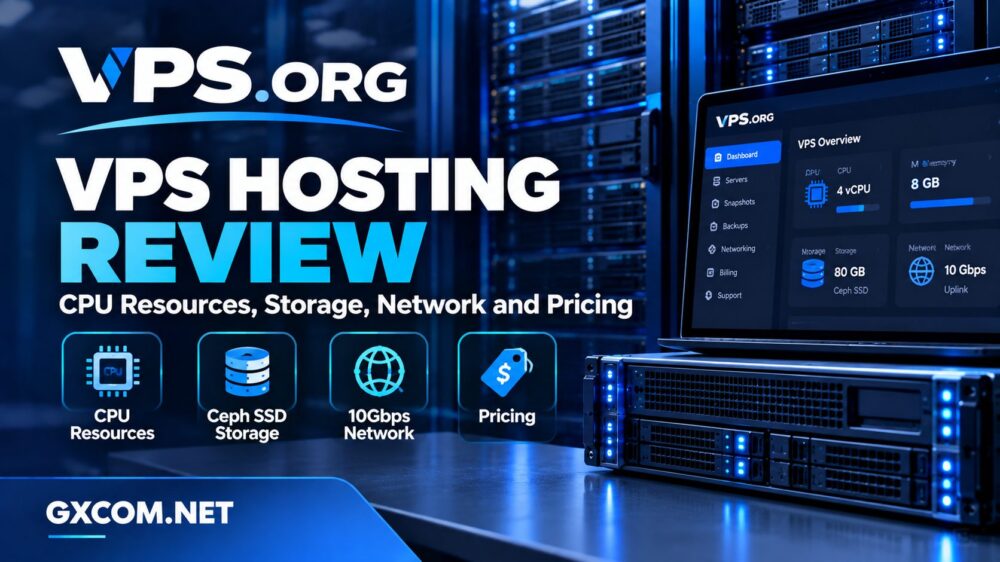
VPS.org offers Linux cloud VPS hosting with KVM virtualization, Intel Xeon processors, replicated Ceph SSD storage, and hourly billing. Its service is aimed at developers, website owners, and small teams that want root access without committing to a dedicated server.
在这篇 VPS.org VPS Hosting 评论, we examine CPU allocation, storage architecture, network connectivity, security responsibilities, and total hosting costs. We also compare VPS.org with AlphaVPS, Bacloud, and RackNerd to help buyers choose an appropriate infrastructure provider.
Editorial disclosure: This review is based on published technical documentation and service information, not independent hands-on performance testing. Specifications and commercial terms should be verified before ordering.
VPS.org Hosting Overview
VPS.org operates a cloud VPS platform built on Proxmox and KVM virtualization. Its virtual machines provide independent operating system environments, root access, and configurable resources.
The company currently advertises Linux servers hosted in New Jersey, United States. Customers can deploy supported operating systems, manage servers through a web interface, and use an API for automation.
- 虚拟化: KVM on a Proxmox cluster.
- Processors: Shared Intel Xeon vCPUs.
- 存储: Replicated Ceph SSD volumes.
- 网络: 10Gbps uplink per host node.
- 地点: New Jersey, United States.
- 管理: Root access, console, API, and usage graphs.
- 账单: Hourly usage with monthly caps.
This combination makes VPS.org worth investigating for development environments, smaller production applications, and self-managed websites. However, its infrastructure should not be confused with dedicated CPU hosting or a fully managed cloud platform.
CPU Performance: Shared vCPUs on Intel Xeon
CPU allocation is one of the most important details in any budget VPS comparison. VPS.org uses Intel Xeon processors, including Xeon Gold 6248, Gold 6150, and E5-2698 v4 hardware, according to its published performance documentation.
Its vCPUs are shared between virtual machines on the same physical host. A plan offering four vCPUs therefore provides four virtual processing units, not four exclusively reserved physical cores.
What Shared CPU Resources Mean
Shared vCPUs can work well for applications with intermittent processing demand. Blogs, development servers, small APIs, and lightweight databases may spend much of their time waiting for requests rather than continuously consuming CPU resources.
Problems can arise with sustained workloads. Software compilation, video encoding, large database queries, and busy application workers may experience inconsistent processing speed when neighboring virtual machines compete for physical CPU time.
VPS.org does not promise dedicated CPU performance, so buyers should evaluate sustained processing needs before selecting a plan.
How to Evaluate CPU Performance
After deployment, measure application response times, CPU utilization, and performance during sustained load. Compare results across different periods rather than relying on one short benchmark.
For broader provider selection, GXCOM’s 最佳VPS服务商对比 explains how infrastructure characteristics affect different hosting workloads.
Ceph SSD Storage: Replication Versus Local Disk Speed
VPS.org stores virtual machine disks on a replicated Ceph SSD cluster. Unlike a VPS whose virtual disk resides directly on storage inside one physical server, Ceph distributes storage management across a cluster.
Replication can improve resilience against certain hardware failures. However, it should not be mistaken for an independent backup or a guarantee of uninterrupted availability.
Storage Performance Considerations
Ceph performance depends on cluster load, network conditions, replication activity, and the underlying disks. VPS.org acknowledges that storage speed can vary and does not publish universal disk benchmark figures.

For applications with frequent small database operations, random I/O latency may be more important than headline sequential throughput. Large file transfers, meanwhile, can behave differently from transactional database workloads.
Buyers should test representative applications rather than assuming that SSD-backed storage always performs like local NVMe.
Capacity and Growth
VPS.org offers plans with different SSD capacities. Before choosing one, calculate space for the operating system, application files, databases, logs, temporary files, and future growth.
Keeping backups on the same VPS disk is not a substitute for off-site storage. Replicated disks can still be affected by accidental deletion, application corruption, or compromised credentials.
For database-intensive applications, storage latency and recovery arrangements deserve as much attention as advertised disk capacity.
Network Performance: What Does a 10Gbps Uplink Mean?
VPS.org states that its hypervisor nodes connect through 10Gbps uplinks using Cogent connectivity from New Jersey.
That figure describes the host’s network connection. It does not mean each virtual server receives a dedicated 10Gbps internet port or can continuously transfer data at that speed.
Actual throughput depends on shared network usage, routing, destination networks, packet loss, and application behavior.
Geographic Latency
New Jersey can be a practical location for applications serving users in the northeastern United States. However, applications targeting Europe, Asia, or the US West Coast should test latency from their intended audience locations.
For a globally distributed service, a provider offering multiple geographic regions may be more suitable than a single-location VPS platform.
Traffic and Security Limitations
VPS.org includes transfer allowances that vary by plan. Buyers should confirm what happens when the allowance is exhausted and whether additional usage creates charges or restrictions.
More importantly, VPS.org explicitly states that it does not provide built-in DDoS mitigation. Public-facing websites may require a separate protective proxy or security service.
The provider also does not advertise an uptime SLA. Businesses with strict contractual availability requirements should consider that limitation before deployment.
VPS.org Plans and Pricing Structure
VPS.org offers several configurations ranging from lightweight development servers to larger virtual machines. Its entry-level options prioritize affordability, while higher tiers provide more memory, CPU resources, storage, and transfer allowances.
Instead of comparing promotional prices alone, consider the resource structure:
| 配置 | Suitable Workload | 主要关切 |
|---|---|---|
| 1 vCPU, 512 MB RAM | Experiments and minimal Linux services | Memory and IPv4 limitations |
| 1 vCPU, 2 GB RAM | 小型网站与开发 | Single shared vCPU |
| 2 vCPU, 4 GB RAM | Small applications and databases | Shared CPU and storage latency |
| 4 vCPU, 8 GB RAM | Growing web applications | Sustained workload consistency |
These configurations are illustrative of published plan options, not performance guarantees.
Hourly Billing and Monthly Caps
Hourly billing allows users to deploy a server for testing without necessarily paying for a full month. Monthly caps provide a predictable ceiling for the server’s base usage charges.
However, the base server price is not always the complete cost.
The lowest advertised VPS.org tier is IPv6-only, with public IPv4 available as a paid add-on. Scheduled backups also cost extra, while daily and weekly retention policies differ.
Calculate total expenditure using server resources, IPv4 requirements, backup frequency, storage needs, and operational administration.
Readers prioritizing low entry costs can also explore GXCOM’s cheap VPS provider comparison 有关其他购买注意事项。.
Snapshots, Backups, and Security Responsibilities
VPS.org offers free manual snapshots and optional scheduled backups. Its published backup arrangements distinguish daily and weekly schedules with different retention periods.
Snapshots are useful before upgrades or configuration changes, but they should not replace independent backups stored outside the provider’s infrastructure.
VPS.org also states that disks are not encrypted at rest by default. Organizations handling sensitive information should implement appropriate encryption and access controls within their own systems.
Customers receive root access, which provides flexibility but also creates responsibility for operating system updates, firewall rules, application security, monitoring, and recovery procedures.
If maintaining Linux infrastructure is unfamiliar, review GXCOM’s managed versus unmanaged hosting guide before choosing a self-managed VPS.
VPS.org Alternatives: AlphaVPS, Bacloud, and RackNerd
VPS.org is one option in a competitive budget VPS market. Three alternative providers are worth evaluating for different infrastructure priorities.
AlphaVPS: Linux VPS and Infrastructure Choice
AlphaVPS is worth considering for buyers comparing Linux virtual servers and available deployment locations. Evaluate its current virtualization technology, CPU policies, storage configuration, and backup options against VPS.org.
It may be particularly relevant when the buyer’s preferred geographic location or resource mix differs from VPS.org’s New Jersey offering.
Bacloud: KVM VPS and European Hosting Options
Bacloud provides KVM VPS products and deserves consideration for organizations evaluating European infrastructure. Compare available data centers, CPU allocation, disk technology, support arrangements, and network policies.
For businesses serving European customers, location and routing quality may outweigh small differences in advertised monthly cost.
RackNerd: Budget KVM VPS Hosting
RackNerd offers KVM VPS plans with different resource combinations and network locations. It is a useful comparison for price-sensitive buyers who want to evaluate RAM, disk capacity, transfer limits, and IPv4 inclusion.

Check the exact offer’s billing cycle and renewal conditions. Promotional packages may differ from standard monthly plans.
These alternatives should be assessed according to workload requirements rather than assuming one provider offers the best performance for every application.
Who Should Choose VPS.org?
VPS.org is worth shortlisting for Linux users who want KVM virtualization, root access, hourly billing, and a straightforward way to deploy small servers.
It is less suitable for applications requiring guaranteed dedicated CPU performance, multiple geographic regions, built-in DDoS protection, or a contractual uptime SLA.
Developers should also distinguish VPS hosting from shared web hosting. Our VPS 与共享主机的对比 explains the additional flexibility and administration responsibilities.
Final Verdict: Is VPS.org Worth Considering?
VPS.org offers an accessible Linux cloud VPS platform with transparent descriptions of its shared CPU model, Ceph SSD storage, network architecture, and optional services.
Its strengths are flexible deployment, root access, hourly billing, and clearly documented infrastructure characteristics. Its principal limitations include shared processing resources, one advertised server region, no built-in DDoS mitigation, and no uptime SLA.
Choose VPS.org for development, testing, or production workloads that can tolerate these limitations and benefit from flexible billing. Compare AlphaVPS, Bacloud, and RackNerd when geographic choice, resource configurations, or alternative pricing structures matter more.
The best purchasing decision comes from testing your own workload, understanding backup responsibilities, and calculating the complete cost rather than relying on the lowest advertised price.
常见问题解答
Does VPS.org use KVM virtualization?
Yes. VPS.org advertises KVM virtual machines managed through a Proxmox-based infrastructure.
Are VPS.org CPU cores dedicated?
No. The provider describes its vCPUs as shared resources on Intel Xeon host servers.
Does VPS.org use NVMe storage?
VPS.org advertises SSD-backed Ceph storage. Buyers should not assume dedicated local NVMe performance without verification.
Does VPS.org include IPv4?
Public IPv4 is available, but the lowest-priced plan lists IPv4 as an additional paid option.
Does VPS.org guarantee uptime?
Its published documentation states that no uptime SLA is provided. Buyers with strict availability requirements should consider this before deployment.