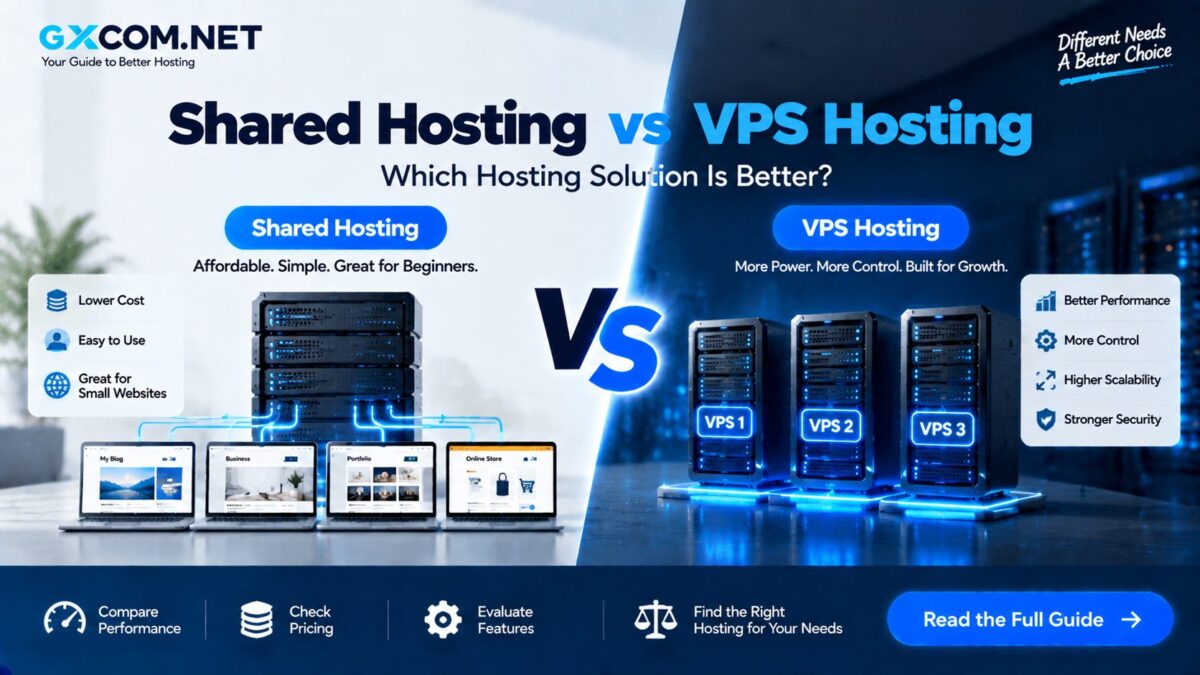
Shared hosting is one of the easiest and most affordable ways to launch a website. But as traffic grows, plugins become heavier or applications demand more resources, many website owners eventually ask the same question:
Should I stay on shared hosting or upgrade to a VPS?
The answer is not simply “VPS is faster.” Shared hosting and VPS hosting are designed for different workloads, budgets and levels of technical responsibility.
A well-optimized website can run successfully on shared hosting for years, while a poorly configured VPS can perform worse than a quality shared hosting platform.
在这篇 shared hosting vs VPS comparison, we examine performance, CPU and RAM, resource limits, control, security, scalability and real-world cost—and explain the signs that indicate it may be time to upgrade.
START SMALL → SHARED HOSTING
NEED MORE RESOURCES & CONTROL → VPS
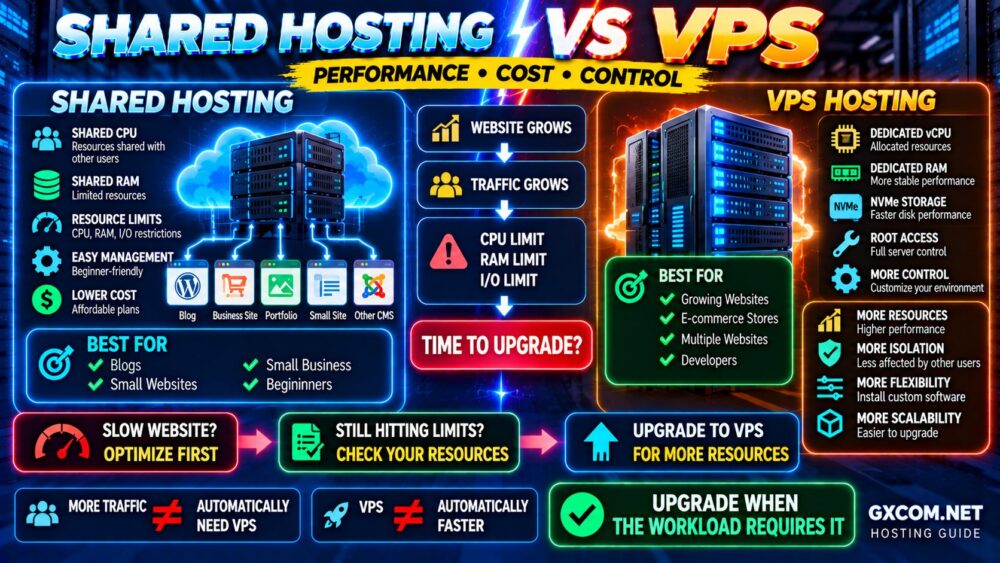
共享主机与VPS:快速对比
| 功能 | 共享主机 | VPS 主机 |
|---|---|---|
| 起始成本 | 较低 | 通常较高 |
| 易用性 | 非常简单 | Depends on management |
| 资源隔离 | 限量版 | 更大 |
| CPU & RAM | Shared and limited | Defined allocation |
| root 权限 | 不 | 通常有货 |
| 服务器自定义 | 限量版 | 高 |
| 可扩展性 | 取决于计划 | Generally stronger |
| 服务器管理 | 服务提供商 | User or provider |
| 最适合 | 小型网站 | Growing or demanding workloads |
理解两者区别的最简单方法是:
SHARED HOSTING = SHARE THE ENVIRONMENT
VPS = GET YOUR OWN VIRTUAL SERVER ENVIRONMENT
什么是共享主机?
Shared hosting places many customer accounts on the same underlying server infrastructure.
The provider manages the operating system, web server, security configuration and much of the technical environment, while customers typically manage their websites through a hosting control panel.
A shared hosting plan may include:
- 网站存储
- 数据库
- 电子邮件账户
- SSL 支持
- 备份
- 控制面板
- 一键安装 WordPress
The major advantage is efficiency.
Because infrastructure and administration costs are distributed across many customers, shared hosting can be inexpensive and easy to operate.
This makes it ideal for many:
- 个人网站
- 博客
- 作品集
- 着陆页
- 小型企业网站
- 访问量较低至中等的 WordPress 网站
什么是VPS主机?
A Virtual Private Server uses virtualization to create separate virtual server environments on physical infrastructure.
A typical VPS plan may advertise resources such as:
- 2 or 4 vCPU
- 4 GB or 8 GB RAM
- NVMe 或 SSD 存储
- 带宽分配
- 专用IP地址
- root 或管理员权限
This gives you considerably more control over the server environment.
Depending on the VPS, you may install your own:
- 操作系统
- Web服务器
- Database software
- PHP versions
- 控制面板
- 防火墙
- Redis
- Docker
- 定制应用程序
However, greater control can also mean greater responsibility.
1. Shared Hosting vs VPS Performance
A VPS can provide more predictable access to resources than conventional shared hosting, but VPS does not automatically mean faster.
Website speed depends on the complete stack:
CPU → RAM → STORAGE → NETWORK → WEB SERVER → DATABASE → CACHE → APPLICATION
A quality shared hosting platform may use optimized server software, caching and carefully managed infrastructure.
An unmanaged VPS may provide more resources but perform poorly if the server stack is incorrectly configured.
因此:
VPS ≠ AUTOMATICALLY FASTER.
BETTER RESOURCES + GOOD CONFIGURATION = BETTER PERFORMANCE.
2. CPU and RAM
This is one of the biggest differences between shared hosting and VPS hosting.
On shared hosting, CPU and RAM are part of a shared environment. Providers normally enforce account-level limits to prevent one customer from consuming excessive resources.
You may encounter restrictions involving:
- CPU 使用率
- 记忆
- PHP 工作者
- Entry processes
- Concurrent connections
- I/O
- IOPS
A VPS is more commonly sold with an explicit allocation:
2 vCPU + 4 GB RAM
或者:
4 个 vCPU + 8 GB 内存
This makes resource planning easier, but specifications still need context.
CPU model, virtualization, oversubscription and storage performance can differ substantially between providers.
4 vCPU ≠ 4 vCPU PERFORMANCE.
3. Resource Isolation
Shared hosting is intentionally multi-tenant.
Hosting companies use isolation technologies and resource limits to control how customer accounts interact with the underlying infrastructure.
A VPS provides a stronger logical boundary between individual virtual servers.
This can make performance more predictable for workloads that consistently require CPU, RAM or application resources.
However, VPS infrastructure can still share underlying physical hardware, especially CPU and network resources.
Do not confuse a VPS with a dedicated server.
4. Storage and Disk Performance
Storage matters because websites frequently read and write files, databases, logs and cached data.
Modern hosting platforms commonly advertise SSD or NVMe storage, but the storage label alone does not guarantee performance.
Actual results can depend on:
- 存储架构
- I/O limits
- IOPS 限制
- Disk contention
- 数据库工作负载
- Provider infrastructure
A shared hosting account may hit an I/O restriction even when it has plenty of storage space remaining.
A VPS can provide greater flexibility, but you should still examine storage limits rather than assuming “NVMe” automatically means unlimited disk performance.
5. Shared Hosting vs VPS Control
Shared hosting prioritizes convenience.
You typically control:
- 域名
- 网站
- 数据库
- 电子邮件
- PHP settings
- SSL
- 备份
But you usually cannot fundamentally change the server environment.
With an appropriate VPS, you may control:
- 操作系统
- Web服务器
- 防火墙
- System packages
- 数据库配置
- SSH settings
- Custom ports
- 运行时环境
If you need custom server software, containers or root access, VPS hosting is normally the stronger choice.
6. Ease of Use
Shared hosting clearly wins for beginners.
The typical process is:
BUY HOSTING
↓
CONNECT DOMAIN
↓
INSTALL WORDPRESS
↓
BUILD WEBSITE
An unmanaged VPS can require:
DEPLOY SERVER
↓
SECURE SSH
↓
CONFIGURE FIREWALL
↓
INSTALL WEB STACK
↓
CONFIGURE DATABASE
↓
DEPLOY WEBSITE
↓
MONITOR & MAINTAIN
If you are new to server administration, our VPS Server Setup Guide explains the basic deployment process.
7. Security
Shared hosting and VPS hosting can both be secure.
The major difference is who manages the security responsibilities.
With shared hosting, the provider normally handles much of the server-level security.
With an unmanaged VPS, you may need to handle:
- 操作系统补丁
- SSH 配置
- 防火墙规则
- 用户权限
- 软件更新
- 备份
- 监测
A VPS provides greater security control, but control is useful only when it is configured correctly.
If you upgrade to a self-managed VPS, follow our VPS 安全最佳实践.
8. Shared Hosting vs VPS Cost
Shared hosting is generally less expensive because infrastructure and management are shared across many customers.
But introductory pricing can be misleading.
务必进行比较:
- 起始价格
- 续费价格
- 备份费用
- Domain costs
- Email limits
- 资源限制
- 迁移成本
VPS pricing requires even more careful comparison.
The advertised VPS price may not include everything you need.
SERVER PRICE
+ Backup
+ Control Panel
+ Management
+ Software Licenses
+ Extra Storage
=
REAL VPS COST
A $5 VPS is not necessarily a $5 hosting solution.
9. Scalability
Shared hosting can scale farther than many beginners expect.
A provider may offer:
ENTRY SHARED PLAN
↓
BUSINESS SHARED PLAN
↓
PREMIUM HOSTING
Eventually, however, a growing workload may require greater isolation or control.
VPS hosting can provide a clearer infrastructure path:
2 vCPU / 4 GB
↓
4 vCPU / 8 GB
↓
8 vCPU / 16 GB
↓
LARGER VPS / CLOUD / DEDICATED
Exact scaling behavior depends on the provider, so investigate upgrade procedures before purchasing.
10. Shared Hosting vs VPS for WordPress
WordPress does not automatically require a VPS.
Many blogs, company websites and content sites can run successfully on quality shared or specialized WordPress hosting.
A VPS becomes more attractive when WordPress requires:
- 更强的CPU
- 更多内存
- More PHP workers
- 自定义服务器配置
- Persistent object caching
- Multiple demanding websites
- Greater traffic capacity
If you are deciding between general and specialized WordPress hosting first, read our WordPress Hosting vs Web Hosting 比较。.
How Much Traffic Can Shared Hosting Handle?
There is no universal visitor number.
Claims such as “shared hosting handles 10,000 visitors” or “you need VPS after 100,000 visitors” oversimplify the problem.
Ten thousand monthly visitors arriving gradually at cached pages can require far fewer resources than a few hundred simultaneous users generating dynamic requests.
Capacity depends on:
- 并发用户数
- 页面缓存
- PHP 执行
- 数据库查询
- Page weight
- 流量激增
- 插件
- 应用程序的行为
MONTHLY VISITORS ≠ SERVER LOAD.
7 Signs It May Be Time to Upgrade From Shared Hosting to VPS
1. You Regularly Hit CPU Limits
If your account repeatedly reaches CPU restrictions during normal traffic, investigate what is consuming the resources.
2. You Frequently Exhaust Memory
Complex applications, plugins and concurrent processes can increase memory requirements.
3. I/O Limits Are Affecting Performance
Database-heavy or file-intensive websites may encounter storage throughput restrictions.
4. You Need More PHP Workers or Concurrent Processes
Dynamic websites and e-commerce stores may require greater concurrency than an entry-level shared plan provides.
5. You Need Server-Level Software
If your application requires Docker, custom packages or specialized server services, shared hosting may simply be too restrictive.
6. Traffic Spikes Are Becoming Normal
A temporary viral spike is different from sustained growth. If higher traffic has become normal, infrastructure may need to scale with it.
7. Your Hosting Environment Is Limiting Growth
If you have already optimized the website but consistently encounter hosting limits, upgrading infrastructure becomes a logical next step.
Before Upgrading: Make Sure the Server Is Actually the Problem
Do not upgrade simply because a website feels slow.
A VPS cannot automatically fix:
- Oversized images
- JavaScript 过多
- Bad plugins
- Slow external scripts
- Poor database queries
- 缺少缓存
- Unoptimized application code
First identify the bottleneck.
我们的 Website Performance Guide explains the broader optimization process.
OPTIMIZE FIRST → MEASURE → UPGRADE WHEN NECESSARY.
托管型VPS与非托管型VPS
Once you decide to move away from shared hosting, the next question is whether you want to manage the server yourself.
UNMANAGED VPS
- Usually lower infrastructure cost
- 更大的行政责任
- 更多控制权
- Better suited to experienced users
MANAGED VPS
- 成本更高
- 减少服务器管理工作
- 服务提供商援助
- Better fit for businesses without server expertise
如需详细对比,请参阅我们的 托管型与非托管型VPS 指南。.
Hosting Options to Consider When Upgrading
Once shared hosting is genuinely limiting your workload, compare VPS providers based on more than the advertised amount of RAM.
DigitalOcean is worth comparing for developers and users who want straightforward cloud VPS infrastructure with flexible deployment options.
Vultr is another option to evaluate when location choice, cloud compute flexibility and multiple instance configurations matter.
If you prefer a more managed transition from conventional hosting, ScalaHosting is worth comparing when you want VPS resources without taking on the same level of server administration as a fully unmanaged deployment.
For highly price-sensitive VPS workloads, compare current offers carefully rather than choosing purely by headline specifications. CPU allocation, storage performance, bandwidth, backups and support can matter as much as RAM.
If price is your primary consideration, our latest VPS hosting deals page can help you compare current VPS offers and discounts.
Shared Hosting vs VPS for E-Commerce
A small online store can run successfully on quality shared hosting.
But e-commerce introduces more dynamic activity:
- 购物车
- 客户账户
- Checkout sessions
- 产品搜索
- Payment processing
- Database activity
- 后台任务
These workloads cannot always be cached as aggressively as ordinary content pages.
As transactions and concurrent users grow, VPS or managed infrastructure may provide more room to scale.
Shared Hosting vs VPS Decision Table
| 您的情况 | Better Starting Point |
|---|---|
| First website | 共享主机 |
| Personal blog | 共享主机 |
| 小型企业网站 | 共享主机 |
| 小型 WordPress 网站 | 共享 / WordPress 主机 |
| Need root access | VPS |
| Need Docker or custom software | VPS |
| Persistent resource limits | VPS |
| Growing dynamic website | VPS / 托管型VPS |
| No server administration skills | Shared Hosting / Managed VPS |
| Multiple demanding websites | VPS |
Common Shared Hosting vs VPS Mistakes
Upgrading Only Because VPS Sounds More Professional
A VPS adds complexity. If shared hosting handles your workload comfortably, there may be no reason to move.
Looking Only at RAM
RAM is important, but CPU performance, storage, network quality and configuration matter too.
Ignoring VPS Management
Someone needs to secure, update, monitor and maintain an unmanaged server.
Assuming “Unlimited” Shared Hosting Has Unlimited Resources
Hosting accounts still operate under CPU, memory, I/O, process or acceptable-use limits.
Choosing the Cheapest VPS Available
Extremely low prices can involve tradeoffs in CPU allocation, storage, support, network performance or other areas.
Migrating Before Optimizing
Do not spend more on infrastructure to compensate for a problem that should be fixed at the application level.
Shared Hosting vs VPS FAQ
VPS 比共享主机更好吗?
VPS hosting generally provides greater control, resource isolation and scalability, but shared hosting is often easier and cheaper. The better choice depends on your workload.
VPS 比共享主机更快吗?
It can be, particularly when shared hosting resource limits are a bottleneck. However, a poorly configured VPS can be slower than an optimized shared hosting environment.
When should I upgrade from shared hosting to VPS?
Consider upgrading when persistent CPU, RAM, I/O or concurrency limitations remain after you have optimized the website, or when you need server-level control that shared hosting cannot provide.
使用 WordPress 需要 VPS 吗?
No. Many WordPress websites perform well on shared or specialized WordPress hosting. VPS becomes useful when resource, control or customization requirements increase.
Can beginners use VPS hosting?
Yes, but unmanaged VPS hosting requires server administration knowledge. Beginners who need VPS resources may prefer managed VPS hosting.
VPS 需要多少内存?
It depends on the application, operating system, database, traffic and software stack. Choose resources based on measured workload rather than a universal RAM recommendation.
Can a VPS host multiple websites?
Yes. A VPS can host multiple websites as long as its CPU, RAM, storage and network resources are sufficient for the combined workload.
Is shared hosting secure?
Quality shared hosting can be secure when the provider maintains strong account isolation and server security. Website owners must still keep their applications, passwords and plugins secure.
Final Verdict: Shared Hosting or VPS?
For beginners, blogs and smaller business websites, shared hosting remains one of the most practical ways to get online.
选择 共享主机 when you want:
LOWER COST → EASY MANAGEMENT → SIMPLE DEPLOYMENT
选择 VPS 托管 when you need:
MORE RESOURCES → MORE CONTROL → MORE FLEXIBILITY → GREATER SCALABILITY
But do not upgrade simply because your website has reached an arbitrary number of monthly visitors.
Measure CPU, RAM, I/O, concurrency and application performance first.
If shared hosting is genuinely the bottleneck, VPS is a logical next step.
If the website itself is the bottleneck, fix the website first.
DON'T UPGRADE BECAUSE YOUR WEBSITE IS BIGGER.
UPGRADE WHEN YOUR WORKLOAD REQUIRES IT.