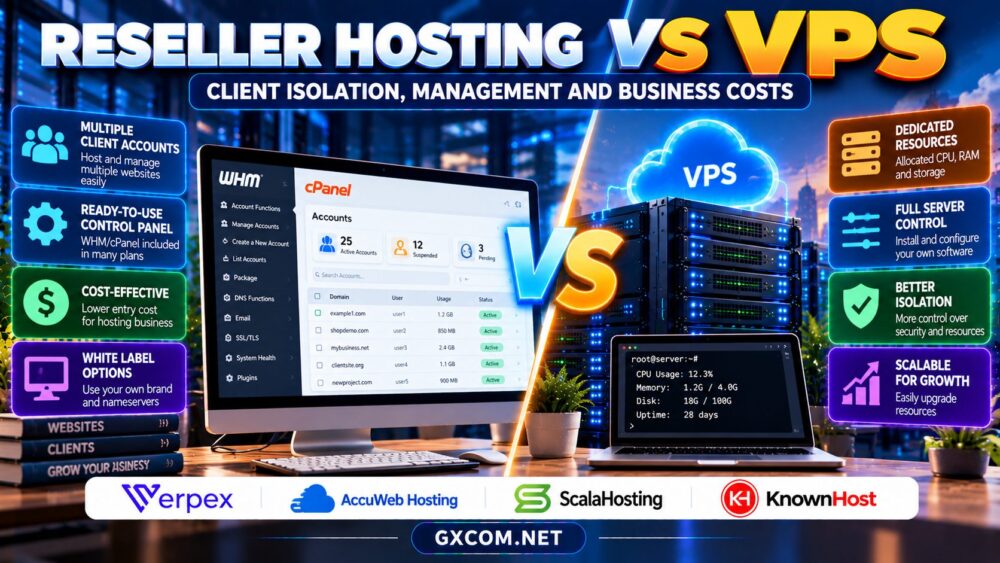
Reseller hosting vs VPS is a critical choice for agencies and entrepreneurs planning to host client websites. Both models can support multiple domains and recurring hosting revenue, but they differ in account management, technical responsibility, resource control, and long-term operating costs.
A reseller package usually provides a prepared environment for selling hosting accounts. A virtual private server offers more control over the server stack, although that flexibility can create additional work. Understanding these tradeoffs helps you choose a sustainable business model rather than simply the cheapest monthly plan.
Reseller Hosting vs VPS: The Core Difference
Reseller hosting lets you allocate hosting accounts within infrastructure maintained by a provider. Depending on the product, you may receive WHM, individual cPanel accounts, branded nameservers, and tools for assigning customer quotas. The provider typically handles the underlying server operating environment.
A VPS supplies an isolated virtual server environment with allocated resources and varying levels of administrative access. To resell hosting from a VPS, you generally need a control panel, account provisioning, security configuration, backups, monitoring, and a process for customer support.
Neither model guarantees unlimited websites or effortless scaling. Product terms and implementation details determine what you can actually deliver.
1. Client Isolation and Security Boundaries
Client isolation matters because one compromised website should not automatically expose another customer’s files or database credentials. A properly configured reseller platform can provide distinct customer accounts with separate permissions and management access. However, multiple websites placed inside one customer account may still share a security boundary.
A VPS gives you more configuration control, but you must establish and maintain separation between customers. Installing a control panel alone does not guarantee secure PHP execution, database privileges, or filesystem isolation.
Ask how accounts are separated, whether customers have individual system identities, and how the provider handles compromised sites. Review our shared hosting account isolation guide for the underlying risks.
2. Server Management and Technical Responsibilities
Reseller hosting generally reduces infrastructure administration. Providers may manage operating-system patches, server services, hardware issues, and platform maintenance, while resellers handle customer onboarding, billing, websites, and first-line support.
An unmanaged VPS requires considerably more technical work. You may be responsible for operating-system updates, firewall rules, mail reputation, DNS, backups, and incident response. Managed VPS services can transfer some tasks to the provider, but support scope varies.
Before purchasing, obtain a written responsibility matrix covering security patches, malware removal, migrations, and recovery. Our 面向代理商的托管主机指南 explains operational workflows for client portfolios.

3. Control Panels, WHMCS and Licensing
Reseller packages may include account-management tools and a specified number of control-panel accounts. Check whether cPanel, WHM, private nameservers, and account quotas are included. Billing automation through WHMCS or similar software may require a separate license.
On a VPS, control-panel licensing can become a significant recurring expense. Different panels have different account limits, features, and support models. You may also need commercial backup, security, or monitoring tools.
Calculate the cost per active client rather than assuming a larger server always creates higher margins. For a detailed look at branding and automation, see our white label reseller hosting guide.
4. Resource Allocation and Performance
Reseller hosting normally uses provider-defined resource policies. You can distribute storage and bandwidth allowances among clients, but underlying CPU, memory, and process limits may be less customizable. Ask whether quotas apply per reseller, per account, or both.
A VPS can offer greater control over CPU allocation, PHP settings, database configuration, and caching. However, virtual CPU performance depends on the infrastructure, and oversubscribing your own server can hurt every client.
Measure peak traffic, disk usage, inode counts, database activity, and backup windows. Avoid selling more capacity than you can reliably support, especially when several customers run resource-intensive WordPress sites.
5. Four Approved Providers to Compare
Verpex: Reseller Hosting Workflows
Verpex is relevant for agencies evaluating ready-made reseller hosting. Compare its current account limits, control-panel inclusion, support scope, backups, and upgrade policies. Confirm how the selected package handles customer isolation and branded services.
AccuWeb Hosting: Flexible Hosting Options
AccuWeb 主机服务 is worth examining when comparing reseller plans and VPS alternatives. Review the specific product’s operating system, account provisioning, resource limits, management coverage, and licensing charges rather than assuming features transfer between product lines.
ScalaHosting:托管型VPS的灵活性
ScalaHosting is a candidate for agencies seeking managed VPS resources and more server-level flexibility. Evaluate control-panel options, management boundaries, backups, and the cost of adding clients as your business grows.
KnownHost: Managed Hosting Support
KnownHost offers another comparison point for reseller and managed hosting requirements. Ask about support responsibilities, customer account separation, migration assistance, and renewal pricing for the exact plan under consideration.
Use current written product specifications when comparing these providers. Account limits, included licenses, and management features can change.
6. Calculate Business Costs and Profit Margins
Your monthly profit is customer revenue minus hosting, licenses, backups, payment fees, support labor, and other operating expenses. A low-cost reseller plan can be economical when the provider manages routine infrastructure tasks. A VPS may become attractive when custom configuration or predictable resource allocation justifies the added administration.
Consider a hypothetical reseller operation collecting $300 monthly from clients. If hosting costs $70, software $25, and support labor $100, the remaining $105 is before taxes and other overhead. These are illustrative figures, not provider quotations.
Model both twelve-month and thirty-six-month costs, including renewals and expected growth. Our managed hosting total cost guide provides a broader budgeting framework.
7. When Should an Agency Move to a VPS?
Stay with reseller hosting when standardized customer accounts, simpler administration, and predictable support matter most. Consider a managed VPS when you need custom server software, more configuration control, or resource policies that reseller packages cannot provide.
Before setting customer prices, calculate account costs, storage allocation, renewal expenses, and profit margins. Our reseller hosting pricing models guide explains how to build sustainable hosting packages.

Before migrating, test account transfers, DNS, email delivery, backups, billing integration, and rollback procedures. Do not assume moving to a VPS will automatically improve security or reduce costs.
探索我们的 网站托管优惠指南 for purchasing context, but verify product suitability before choosing a discount.
Compare Reseller Hosting and Managed VPS
Review account limits, client isolation, licensing, backups, and administration coverage before ordering.
Reseller Hosting vs VPS FAQ
Is reseller hosting easier to manage than a VPS?
Usually, because the provider administers more of the underlying platform. Exact responsibilities depend on the service agreement.
Can I sell hosting from a VPS?
Yes, provided your infrastructure, licensing, security configuration, and customer support arrangements are suitable for resale.
Which option offers better client isolation?
Neither automatically wins. Compare actual account boundaries, permissions, execution identities, and the quality of ongoing security management.
最终裁决
Reseller hosting vs VPS is ultimately a decision about control, responsibility, and sustainable margins. Compare Verpex, AccuWeb 主机服务, ScalaHosting, ,以及 KnownHost using documented client isolation, support scope, licensing, and three-year costs. Choose reseller hosting for operational simplicity or a suitably managed VPS when your requirements justify greater control.