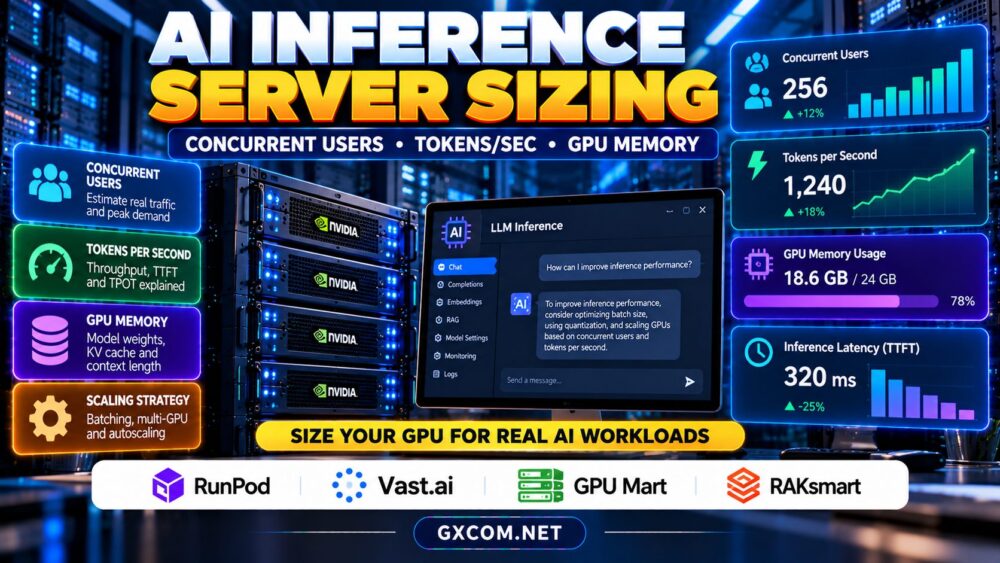
GPU hosting for RAG applications can accelerate document embeddings, reranking, and language model inference, but renting a GPU for every component is rarely necessary. Retrieval-augmented generation (RAG) combines searchable knowledge with an LLM, creating several workloads with different hardware requirements.
For teams building enterprise search, document assistants, or customer-support chatbots, the challenge is balancing response quality, latency, and infrastructure costs. This guide explains where GPU acceleration matters, how vector databases fit into the architecture, and how to compare hosting providers.
How Does a RAG Application Use GPU Resources?
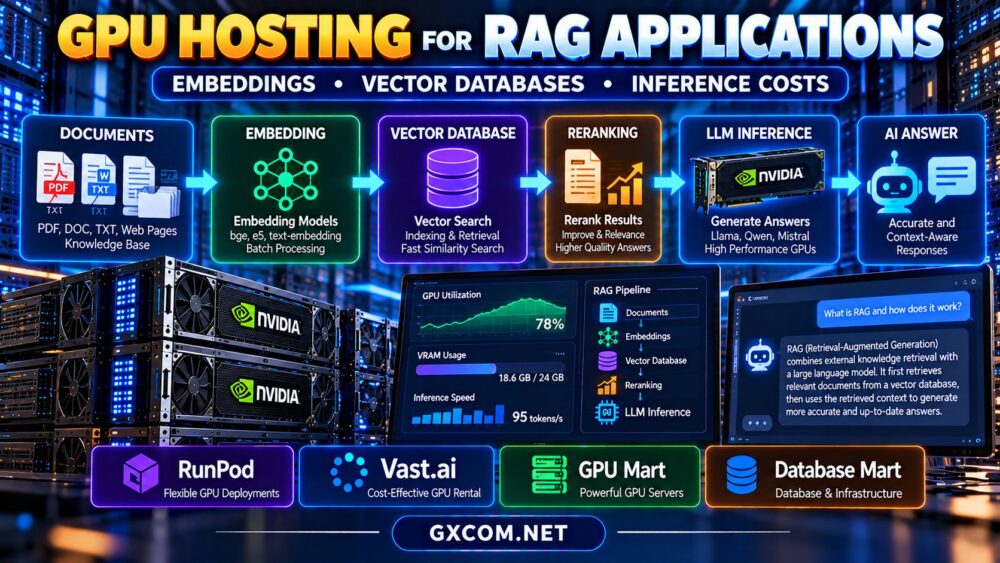
A typical RAG pipeline ingests documents, splits them into chunks, creates embeddings, stores vectors, retrieves relevant passages, and sends context to a language model. Some systems add a reranking stage before generation.
These stages should not automatically share one expensive GPU server. Document storage and many vector searches work efficiently on CPUs, while large embedding batches and generative inference can benefit from accelerators.
Separating services also allows teams to scale indexing independently from live user requests.
Do Embedding Models Need a GPU?
Embedding models convert text into numerical vectors for semantic search. Small models can run on CPUs, particularly when documents arrive slowly or the collection is modest.
GPU acceleration becomes attractive when indexing millions of chunks, refreshing large collections, or serving high-volume embedding requests. Throughput depends on model architecture, sequence length, batch size, and implementation.
For example, a company importing documents overnight might rent GPU capacity for scheduled embedding batches and release it afterward. A continuously updated knowledge base may justify a persistent embedding endpoint.
Measure documents processed per hour and cost per thousand chunks rather than assuming a faster GPU always delivers better economics.
Does a Vector Database Require GPU Hosting?
Not necessarily. Many vector databases perform approximate nearest-neighbor searches using CPU memory and optimized indexes. RAM capacity, index structure, storage latency, and query filters can matter more than GPU availability.
GPU-assisted indexing or search can help selected large-scale workloads, but support varies by database and deployment configuration. Verify the actual feature rather than assuming that installing a vector database on a GPU instance enables acceleration.
| RAG Component | Typical Starting Point | When GPU Helps |
|---|---|---|
| Document parsing | CPU server | Specialized vision or OCR models |
| Embedding generation | CPU or shared GPU | Large batches or high request volume |
| Vector database | CPU, RAM, and fast storage | Supported GPU-accelerated indexing/search |
| Reranking | CPU for modest traffic | Neural rerankers under load |
| LLM generation | GPU for larger local models | Low-latency, concurrent inference |
LLM Inference Is Often the Main GPU Expense
Once passages are retrieved, the generation model processes the user question and supporting context. Model weights, KV cache, concurrent requests, and output length determine much of the inference memory budget.

Long retrieved passages can increase prompt processing time and cache usage. Sending every matching document to the model may raise costs without improving answer quality.
请使用我们的 NVIDIA GPU VRAM requirements for LLM inference guide to estimate weight memory, quantization overhead, and context-dependent cache growth.
Then consult the AI 推理服务器配置指南 when planning simultaneous users and tokens-per-second capacity.
RAG Latency: Retrieval, Reranking, and Generation
End-to-end response time includes query embedding, vector retrieval, optional reranking, prompt processing, and token generation. Network calls between services can add overhead.
Track p50 and p95 latency for each stage. A faster inference GPU may provide little benefit if slow database queries dominate the request.
Start with a small, relevant retrieval set. Test chunk sizes, top-k values, and reranking quality against representative questions. Better retrieval can reduce unnecessary context tokens and improve the usefulness of generated answers.
Four Approved Hosting Providers for RAG Infrastructure
RunPod: GPU Inference and Embedding Workloads
RunPod is an option to evaluate for GPU-backed embedding services, rerankers, and LLM inference. Compare available accelerator configurations, deployment methods, storage persistence, and billing rules for the specific product.
我们的 RunPod GPU 云服务评测 provides additional provider context.
Vast.ai: Flexible GPU Rental
Vast.ai can suit teams benchmarking alternative GPUs or running periodic embedding jobs. Because marketplace offers differ, check GPU specifications, host reliability, network access, and storage conditions before deployment.
Keep important model artifacts and application data backed up outside temporary compute environments.
GPU Mart: Persistent Accelerator Infrastructure
GPU Mart is worth considering when your RAG system requires a persistent accelerated environment. Verify available GPUs, driver support, VRAM allocation, and server administration options for the selected plan.
Compare monthly utilization against flexible hourly alternatives before committing to a fixed configuration.
Database Mart: Database and Supporting Services
数据库集市 may be evaluated for supporting database or server infrastructure, subject to product compatibility. Do not assume its ordinary hosting products provide a managed vector database or GPU acceleration.
Check whether your chosen vector engine, indexing method, and operational requirements are supported before purchasing.
How Much Does GPU Hosting for RAG Cost?
Separate ingestion costs from serving costs. Indexing may happen once or periodically, while retrieval and generation run for every user question.
Consider an illustrative GPU rental rate of $0.60 per active hour. Forty hours of monthly embedding work costs $24 in compute time. Running the same instance continuously for 720 hours would cost $432, before storage, networking, and other charges.
These are hypothetical calculations, not provider quotes. Some services bill for reserved storage or other resources while compute is stopped.
For GPU purchasing context, compare 经济实惠的 GPU 服务器选项 and assess total cost per successful RAG answer.
Recommended Deployment Architecture
For an early-stage application, start with CPU-based document processing and vector retrieval, plus a separately scalable GPU inference service. Use scheduled GPU jobs for bulk embeddings when latency requirements permit.
As traffic grows, monitor embedding queue time, database search latency, GPU utilization, token throughput, and answer quality. Add dedicated reranking capacity only when measured improvements justify it.
Consider a GPU VPS versus dedicated GPU server comparison when deciding how much resource isolation your production deployment needs.
Compare GPU Hosting for Your RAG Pipeline
Match accelerator capacity to embedding throughput, reranking load, and LLM inference demand instead of renting one oversized server for every component.
常见问题解答
Can a RAG application run without a GPU?
Yes. Smaller embedding and language models can run on CPUs, and hosted model APIs can eliminate the need to operate your own GPU. Performance and cost depend on workload size.
Should embeddings and LLM inference share one GPU?
They can for prototypes, but separate services often make capacity planning easier. Batch indexing and interactive inference have different latency requirements.
Is more vector database RAM better than more GPU VRAM?
For CPU-based vector retrieval, sufficient system RAM and an appropriate index may matter more. GPU VRAM becomes critical for accelerated models and supported GPU search operations.
最终裁决
Effective GPU hosting for RAG applications starts with workload separation. Use CPU infrastructure where practical, accelerate embeddings or reranking when measurements justify it, and size LLM inference for real context and concurrency demands. Compare RunPod, Vast.ai, GPU Mart, and suitable 数据库集市 infrastructure against tested performance, reliability, and complete operating costs.