最好的 NVMe VPS deals offer more than a fast storage label. For database-backed websites, ecommerce stores, and busy applications, consistent input/output performance can matter more than headline disk capacity. Yet providers rarely measure storage speed under identical conditions.
Before renting a high-IOPS VPS, compare random operations, latency, CPU resources, and renewal costs. This guide examines Vultr, AlphaVPS, Hostinger, and Hetzner, then explains how to test storage value without overpaying for benchmark numbers.
What Does High IOPS Mean for VPS Hosting?
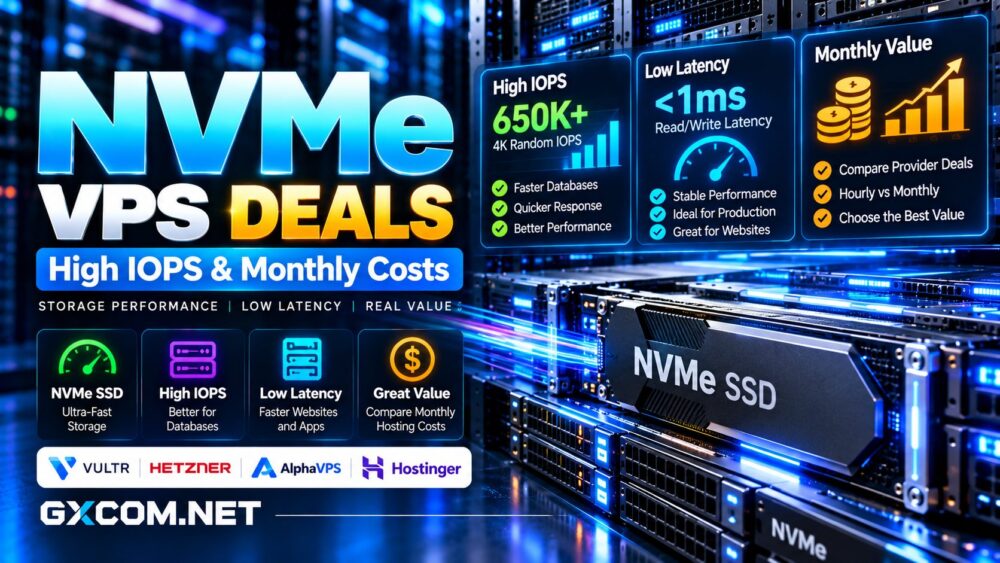
IOPS measures how many input/output operations storage completes per second. Random 4K operations are especially relevant to databases, metadata-heavy applications, and virtualized workloads. Sequential throughput, measured in MB/s, describes a different performance characteristic.
A server advertising impressive sequential speeds may still struggle with small, unpredictable reads and writes. Conversely, extremely high IOPS may bring little benefit to a cached website that rarely accesses disk.
Always evaluate latency alongside IOPS. Slow tail latency can cause occasional database queries to delay an otherwise responsive application.
值得比较的 NVMe VPS 服务商
Vultr: Performance-Oriented Cloud Storage
Vultr offers Optimized Cloud Compute with dedicated CPU resources and high-speed NVMe storage. Its VX1 family also supports NVMe-backed block storage with published provisioned IOPS and throughput characteristics.
This makes Vultr relevant for teams that want documented storage tiers and flexible cloud infrastructure. However, local NVMe and network-attached block storage are different products; their performance, durability, and billing should not be treated as interchangeable.
Verify the instance family, storage tier, location, and additional volume charges before comparing quotes.
AlphaVPS: EPYC Servers and NVMe RAID-10
AlphaVPS advertises AMD EPYC-powered KVM servers with enterprise NVMe RAID-10. It publishes fio benchmark settings and performance results for selected configurations, providing a useful starting point for technical buyers.
Those published figures are provider-reported, not a guarantee for every VPS size or location. Repeat the relevant tests on your own plan and compare results under sustained load.
AlphaVPS is worth considering for databases, development environments, and applications requiring an affordable combination of CPU, memory, and storage performance.

Hostinger: Accessible NVMe KVM VPS
Hostinger lists AMD EPYC processors and NVMe SSD storage across its KVM VPS lineup. Its plans combine predictable resource bundles with backups and administration tools.
For growing WordPress sites, ecommerce applications, and small business services, that combination may be more useful than an isolated IOPS claim.
Check the renewal rate, billing term, backup scope, and available disk capacity. Published NVMe specifications alone do not establish a guaranteed random-I/O performance level.
Hetzner: Infrastructure Cost and Storage Flexibility
Hetzner is another option for self-managed cloud infrastructure, particularly when buyers need to balance compute, storage, and network costs.
Review the exact cloud server generation and storage architecture before ordering. Attached volumes and local disks can behave differently, so avoid assuming all configurations deliver identical NVMe performance.
For broader vendor selection, consult our 最佳VPS服务商对比.
How to Compare High-IOPS VPS Deals
Start with four measurements: random read IOPS, random write IOPS, average latency, and p95 or p99 latency. Record sequential throughput separately.
Results depend heavily on block size, queue depth, thread count, read/write mix, filesystem, and caching. A 4K random test at queue depth 64 cannot be compared fairly with one at queue depth one.
我们的 NVMe VPS 性能指南 explains why SSD interfaces and storage architecture matter.
Benchmark Storage Without Misleading Results
On Linux, fio can generate repeatable workloads. Test a dedicated file in an appropriate directory, using direct I/O where supported, and document the exact command and environment.
Never run destructive raw-device benchmarks against production disks. Use a disposable test instance or carefully isolated test file, and monitor application impact.
Run tests more than once, including during peak periods. Compare sustained behavior instead of relying on the highest short burst. For databases, include a representative application benchmark because synthetic IOPS alone cannot predict query performance.
Monthly NVMe VPS Costs: What Changes the Price?
Storage capacity is only one cost component. CPU allocation, RAM, backup retention, snapshots, traffic allowances, and management services can materially affect monthly spending.
Consider two hypothetical plans: a $12 monthly VPS with sufficient storage and a $24 plan offering higher benchmark IOPS. If the application is CPU-bound, doubling the storage budget may not improve user experience.
For a twelve-month comparison, calculate total contract payments, expected renewal charges, and required extras. Divide that cost by useful workload output rather than advertised maximum IOPS.
Compare related offers in our 经济实惠的云VPS优惠 指南。.
Which Applications Actually Need High IOPS?
High random-I/O performance can help transactional databases, search indexes, busy ecommerce platforms, and applications performing frequent small writes.
Static websites, lightly used blogs, and cache-heavy services may benefit more from additional RAM, better CPU performance, or improved caching.
For WordPress, measure uncached page generation and database latency before upgrading storage. A faster disk cannot repair inefficient queries or overloaded PHP workers.
Shared CPU, RAM, and Storage Bottlenecks
NVMe performance is part of a larger system. Shared CPU contention, insufficient memory, or filesystem configuration may limit the benefits of fast drives.

Monitor disk wait time, memory pressure, CPU utilization, and application response times together. If the database working set fits in RAM, storage benchmarks may have little relationship to typical request latency.
请参阅我们的 AMD EPYC VPS deals comparison for shared versus dedicated processing considerations.
Buying Checklist: Avoid Paying for Unused IOPS
- Confirm whether storage is local NVMe or network-attached.
- Ask about sustained IOPS limits and burst policies.
- Compare p99 latency using identical test settings.
- Check usable disk space, backups, and restore options.
- Calculate renewal and add-on costs before checkout.
- Test real applications during the refund or evaluation period.
Final Verdict: Best NVMe VPS Value
Vultr suits buyers seeking configurable cloud infrastructure and documented storage options. AlphaVPS appeals to technical users interested in EPYC, NVMe RAID-10, and published benchmark methodology. Hostinger offers accessible KVM VPS bundles, while Hetzner merits comparison for self-managed infrastructure.
最好的 NVMe VPS deal is not the one with the largest IOPS claim. Choose the plan that delivers consistent latency, enough capacity, and predictable monthly costs for your actual workload.
For additional budget choices, browse our 便宜的VPS服务商指南.