Choosing a hosting plan is not only about CPU, RAM, storage and bandwidth. One of the most important decisions is deciding who will manage the server.
With managed hosting, the provider handles more of the technical work required to operate the hosting environment. With unmanaged hosting, you receive greater administrative control—but you are responsible for much more of the configuration, security, maintenance and troubleshooting.
Neither option is automatically better.
The right choice depends on your technical skills, workload, budget, business requirements and how much time you want to spend managing infrastructure.
在这篇 managed hosting vs unmanaged hosting comparison, we examine cost, performance, security, support, control, backups and server administration to help you decide which model fits your website or application.
WANT CONVENIENCE → MANAGED HOSTING
WANT CONTROL → UNMANAGED HOSTING
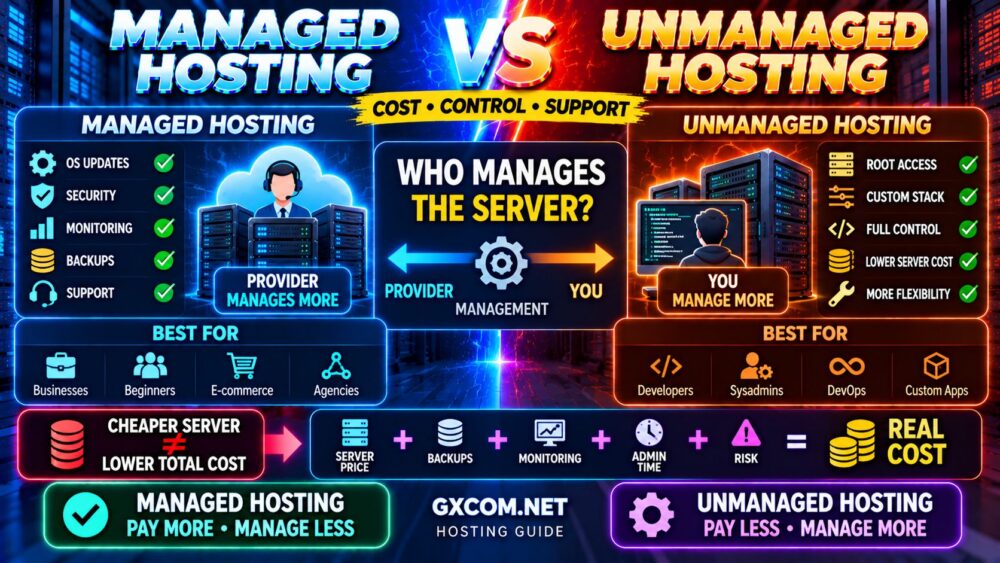
Managed Hosting vs Unmanaged Hosting: Quick Comparison
| 功能 | 托管主机 | 非托管主机 |
|---|---|---|
| 服务器管理 | 服务提供商处理更多任务 | Customer handles most tasks |
| 所需的技术技能 | 较低 | 更高 |
| 控制 | May be more limited | 更大 |
| Operating System Updates | Often managed | Usually your responsibility |
| 安全管理 | More provider assistance | Mostly your responsibility |
| 监测 | 通常包含 | You configure it |
| 备份 | Often included or available | Usually self-managed or optional |
| 故障排除 | Greater provider assistance | Mostly self-service |
| 成本 | 更高 | 通常较低 |
| 最适合 | Businesses and non-admins | 开发人员和系统管理员 |
The fundamental tradeoff is simple:
MANAGED HOSTING = PAY MORE → MANAGE LESS
UNMANAGED HOSTING = PAY LESS → MANAGE MORE
But the exact definition of “managed” varies significantly between providers, so always examine what a hosting plan actually includes.
什么是托管主机?
Managed hosting is a service model in which the hosting provider takes responsibility for some or most server administration tasks.
根据服务提供商和套餐的不同,托管服务可能包括:
- 初始服务器配置
- 操作系统更新
- 安全补丁
- 服务器监控
- 防火墙配置
- 备份管理
- Web 服务器配置
- 控制面板管理
- 性能支持
- 技术故障排除
The goal is to reduce the amount of infrastructure work the customer must perform.
This can be particularly valuable for businesses that depend on their websites but do not employ an experienced system administrator.
什么是非托管主机?
Unmanaged hosting provides the infrastructure while leaving most server administration to you.
For example, an unmanaged VPS provider may deploy a virtual server with your selected operating system and network configuration.
From there, you may be responsible for:
- 创建用户
- Securing SSH
- Installing a web server
- Installing databases
- Configuring PHP or other runtimes
- Setting firewall rules
- 安装安全更新
- Configuring backups
- 资源监控
- Troubleshooting failures
This provides freedom and control, but it also means that when something breaks, the provider may only support the underlying infrastructure rather than your software stack.
Managed Does Not Mean the Same Thing Everywhere
This is one of the most important points in this comparison.
There is no universal definition of managed hosting.
One provider may manage only:
OS UPDATES + BASIC MONITORING
Another may provide:
OS + SECURITY + WEB STACK + BACKUPS + MONITORING + MIGRATION + TROUBLESHOOTING
Before purchasing, check the provider's management scope and support policy.
“MANAGED” ≠ “WE MANAGE EVERYTHING.”
1. Managed vs Unmanaged Hosting: Ease of Use
Managed hosting is usually easier for customers without server administration experience.
A managed workflow may look like:
BUY HOSTING
↓
MIGRATE WEBSITE
↓
MANAGE WEBSITE
An unmanaged environment may look like:
DEPLOY SERVER
↓
SECURE SSH
↓
CONFIGURE FIREWALL
↓
INSTALL WEB STACK
↓
CONFIGURE DATABASE
↓
SET UP BACKUPS
↓
MONITOR SERVER
↓
MAINTAIN EVERYTHING
If that second workflow sounds unfamiliar, unmanaged hosting may create more work than the lower monthly price initially suggests.
2. Control and Flexibility
Unmanaged hosting usually provides the greatest flexibility.
With appropriate administrative access, you can choose:
- 操作系统
- Web服务器
- Database software
- PHP versions
- 运行时环境
- 防火墙规则
- Monitoring software
- 集装箱
- 定制服务
Managed environments may restrict certain configurations because the provider needs to maintain a stable, supportable platform.
For most ordinary websites this is not necessarily a disadvantage.
If you need unusual software, custom networking or complete control over the operating environment, unmanaged infrastructure is generally more suitable.
3. Managed vs Unmanaged Hosting Performance
Neither management model is automatically faster.
An unmanaged server gives an experienced administrator the freedom to optimize every layer of the stack.
But that does not mean the server will actually be optimized.
A well-managed environment may outperform a poorly configured unmanaged server because the provider has already tuned caching, databases, web-server settings and resource management.
性能取决于:
HARDWARE → RESOURCES → CONFIGURATION → CACHE → DATABASE → APPLICATION
Management determines who is responsible for optimizing those layers—not how fast they automatically become.
4. Security
Security is one of the strongest reasons businesses choose managed hosting.
Operating a server securely requires ongoing work, including:
- Installing security patches
- Managing SSH access
- 配置防火墙
- Removing unused services
- 监控日志
- Managing permissions
- Responding to vulnerabilities
- 维护备份
With unmanaged hosting, these tasks are primarily your responsibility.
Managed hosting can reduce this operational burden, although customers still need to secure their websites, applications, accounts and passwords.
MANAGED SECURITY ≠ ZERO SECURITY RESPONSIBILITY.
If you operate your own server, our VPS 安全最佳实践 guide covers the essential hardening steps.
5. Updates and Maintenance
Servers are not “set and forget” systems.
Operating systems and software packages need maintenance.
An unmanaged environment may require you to monitor and install:
- 操作系统补丁
- Web server updates
- Database updates
- Runtime updates
- 安全修复
- 控制面板更新
Managed hosting may handle some or all of these tasks depending on the service agreement.
For a business owner, this can convert technical maintenance time into time spent operating the business.
6. Backups and Recovery
A backup is useful only if you can successfully restore it.
Managed hosting plans frequently include backup systems or offer them as an integrated option.
With unmanaged infrastructure, you may need to design your own strategy covering:
- 备份频率
- 留存率
- 异地副本
- 数据库一致性
- 加密
- 恢复流程
- 恢复测试
The important question is not:
“DO YOU HAVE BACKUPS?”
它是:
“CAN YOU RECOVER?”
7. Monitoring and Troubleshooting
When a server becomes slow or unavailable, someone needs to determine why.
可能的原因包括:
- CPU 饱和
- 内存耗尽
- 磁盘I/O
- 数据库瓶颈
- Network problems
- 应用程序错误
- 流量激增
Managed hosting can provide valuable assistance when diagnosing these problems.
With unmanaged hosting, you may need to monitor the infrastructure and investigate failures yourself.
我们的 服务器运行缓慢故障排除指南 explains how CPU, RAM, disk and network bottlenecks affect server performance.
8. Managed vs Unmanaged Hosting Cost
Unmanaged hosting generally has a lower advertised price because you are buying primarily infrastructure rather than infrastructure plus administration.
However, compare the total cost.
An unmanaged server may require:
SERVER
+ Control Panel
+ Backup Service
+ Monitoring
+ Security Tools
+ Administrator Time
=
REAL OPERATING COST
Managed hosting bundles more of that operational work into the service price.
Therefore, a $10 unmanaged VPS is not necessarily cheaper for a business than a more expensive managed service if someone must spend hours maintaining it.
LOWER SERVER PRICE ≠ LOWER TOTAL COST.
9. Support
The difference between managed and unmanaged hosting becomes especially important when something goes wrong.
With unmanaged hosting, infrastructure support may cover problems such as:
- Physical server failure
- Virtualization problems
- 网络连接
- Platform availability
But application-level problems may remain your responsibility.
Managed support can extend further into operating-system and hosting-stack troubleshooting.
Always check the support scope before buying. Do not assume a provider will debug custom application code simply because the plan is described as managed.
Managed Hosting vs Unmanaged VPS
Many searches for managed vs unmanaged hosting are actually about VPS hosting.
The distinction is particularly important with VPS because a virtual server can give you extensive administrative control.
An unmanaged VPS is often ideal for developers and system administrators who want maximum flexibility at a lower infrastructure price.
A managed VPS is often better for website owners and businesses that need VPS resources without wanting to maintain the entire server stack themselves.
For a VPS-specific breakdown, read our 托管型与非托管型VPS 比较。.
Managed Hosting vs Managed WordPress Hosting
Managed hosting is a broad service model, while managed WordPress hosting focuses specifically on WordPress.
A managed WordPress platform may handle:
- WordPress 更新
- WordPress caching
- 分阶段
- 备份
- WordPress 安全
- Application-specific support
If WordPress is your only workload, a specialized platform may provide a simpler experience than a general managed server.
If you are still deciding whether specialized WordPress hosting is necessary, see our WordPress Hosting vs Web Hosting 指南。.
哪些人应该选择托管主机服务?
Managed hosting is generally a strong fit when:
- You do not have server administration experience
- 您的网站能带来商业收入
- You want technical support for infrastructure
- You do not want to manage OS updates
- You need integrated backups and monitoring
- Your time is more valuable than the additional hosting cost
- You operate multiple client websites
It is particularly attractive for:
- 小型企业
- E-commerce stores
- 机构
- WordPress 网站的扩展
- Business-critical applications
哪些人应该选择非托管主机?
Unmanaged hosting makes sense when:
- You understand Linux or Windows server administration
- 您需要获取root权限
- You want complete control
- 您需要定制的服务器软件
- You can configure security and backups
- You can troubleshoot infrastructure problems
- You want to minimize infrastructure cost
It is particularly suitable for:
- 开发者
- 系统管理员
- DevOps 团队
- 测试环境
- 定制应用程序
- Infrastructure labs
Managed and Unmanaged Hosting Providers to Consider
Once you know which management model fits your workload, compare providers based on what they actually manage rather than the word “managed” alone.
For users who prefer a managed transition from conventional hosting to VPS-level resources, ScalaHosting is worth comparing when server management and an easier operational experience are priorities.
For developers who prefer greater infrastructure control, DigitalOcean is worth evaluating for cloud VPS workloads where you are comfortable managing the software stack yourself.
Vultr is another option to compare for self-managed cloud compute, particularly when deployment locations and multiple instance configurations are important.
For general website owners who do not actually need server-level control, providers such as Hostinger may also be worth comparing before moving to a VPS, since a managed website hosting environment can sometimes solve the requirement without adding server administration complexity.
The correct question is not “Which provider has the most features?”
请问:
WHICH PROVIDER MANAGES THE TASKS I DON'T WANT TO MANAGE?
Before Choosing Managed Hosting, Check What Is Actually Included
Ask these questions before purchasing:
- Are operating system updates managed?
- Are security patches managed?
- Is firewall configuration included?
- 是否包含备份?
- 备份会保留多长时间?
- Does the provider test restores?
- Is monitoring included?
- Does support troubleshoot the web server?
- Does support troubleshoot databases?
- Are migrations included?
- 是否包含控制面板?
- What is explicitly excluded from support?
This checklist is more useful than relying on the word “managed” in the product name.
Managed vs Unmanaged Hosting Decision Table
| 您的情况 | Better Starting Point |
|---|---|
| First website | 托管主机 |
| No server administration skills | 托管主机 |
| Business-critical website | 托管主机 |
| E-commerce store | 托管主机 |
| Agency without sysadmin staff | 托管主机 |
| Experienced Linux administrator | 非托管主机 |
| Need complete root control | 非托管主机 |
| Custom application stack | 非托管主机 |
| Development environment | 非托管主机 |
| Want VPS resources without administration | 托管型VPS |
Common Managed Hosting Mistakes
Assuming Managed Means Everything Is Managed
Always read the provider's support scope. Application development, custom code and third-party software may be excluded.
Choosing Unmanaged Hosting Only Because It Is Cheaper
Factor in administrator time, backup services, monitoring, control panels and the cost of mistakes.
Paying for Management You Do Not Need
Experienced administrators may prefer an unmanaged server when they already have their own monitoring, deployment and security systems.
Assuming Managed Hosting Is Automatically Faster
Management and performance are different concepts. Compare resources and infrastructure separately.
忽略备份
Never assume that “managed” automatically means complete off-site backups and guaranteed restoration.
Managed Hosting vs Unmanaged Hosting FAQ
What is the main difference between managed and unmanaged hosting?
The main difference is responsibility. Managed hosting includes more provider assistance with server administration, while unmanaged hosting leaves most configuration, security, maintenance and troubleshooting to the customer.
Is managed hosting worth the extra cost?
It can be worthwhile when you lack server administration expertise, operate a business-critical website or value the time saved by outsourcing infrastructure management.
Is unmanaged hosting faster?
Not automatically. Experienced administrators can optimize an unmanaged server extensively, but performance ultimately depends on infrastructure, resources, configuration and application efficiency.
Is unmanaged hosting safe?
It can be secure when properly configured and maintained. However, the customer is responsible for much more of the security process.
Do I need Linux knowledge for unmanaged VPS hosting?
For a Linux VPS, practical knowledge of SSH, package management, users, permissions, firewalls, updates, logs and backups is highly recommended.
Does managed hosting include backups?
Some managed plans include backups while others charge separately or provide limited retention. Always verify the backup and restore policy.
Can I switch from unmanaged to managed hosting?
Usually yes, although the migration process depends on the providers and server configuration. Check whether the new provider includes migration assistance.
Should a small business choose managed hosting?
For many small businesses, managed hosting makes sense when there is no in-house system administrator and website availability is important to business operations.
Final Verdict: Managed or Unmanaged Hosting?
选择 托管主机 when you want:
LESS ADMINISTRATION → MORE SUPPORT → EASIER OPERATIONS
选择 非托管主机 when you want:
MORE CONTROL → MORE FLEXIBILITY → LOWER INFRASTRUCTURE COST
For developers and experienced administrators, unmanaged hosting can provide excellent value and freedom.
For businesses and website owners without server expertise, managed hosting can reduce operational risk and save valuable time.
The real decision is not simply about monthly price.
SERVER COST + MANAGEMENT TIME + RISK + SUPPORT = REAL HOSTING COST.
Choose the management model that matches your skills, workload and business priorities—not simply the cheapest server on the pricing page.