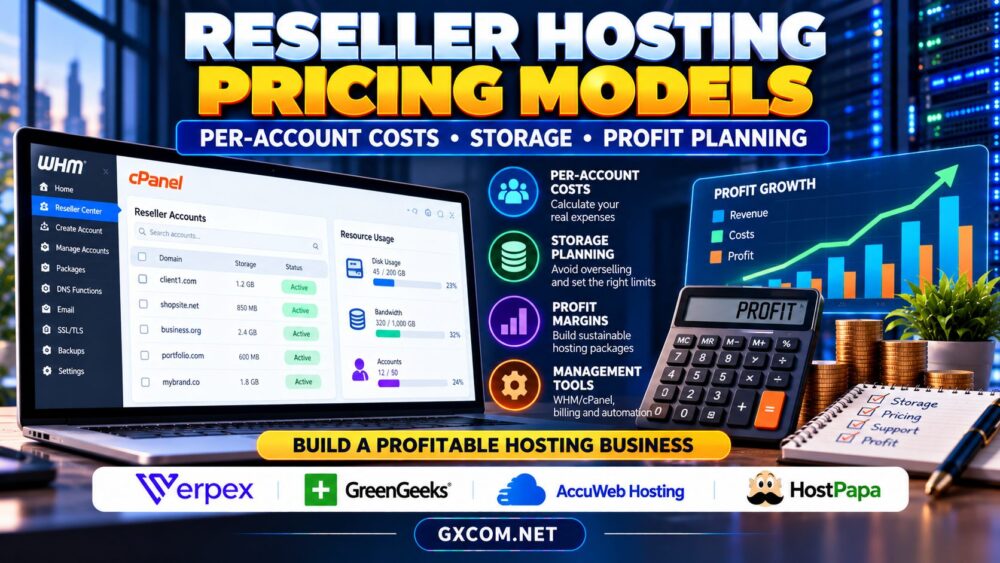
Reseller hosting pricing models determine whether a hosting business generates sustainable recurring profit or quietly loses money as customers grow. Advertised monthly rates are only the starting point. Account caps, storage consumption, billing software, renewal pricing, and support time all influence the actual cost of serving each client.
For web agencies, freelancers, and entrepreneurs, the best plan is not necessarily the one advertising the most websites. This guide explains how to calculate per-account expenses, design realistic packages, and protect margins without compromising service quality.
How Reseller Hosting Pricing Models Work
Most reseller providers sell a pool of resources that you divide among customer accounts. Packages may be limited by cPanel accounts, total storage, transfer allowances, or combinations of these factors. Some plans include management tools; others charge separately for billing automation or premium backups.
Resellers then set their own retail prices. A fixed monthly wholesale fee creates predictable baseline expenses, but actual profitability changes as accounts fill and customers require support. Understand both provider limits and customer behavior before publishing retail packages.
1. Calculate the True Cost Per Client Account
Start with the monthly reseller subscription and divide it by active paying accounts, not the maximum advertised capacity. A hypothetical $60 plan supporting 30 accounts costs $6 per active client when only ten customers are paying. At 20 paying clients, the hosting allocation falls to $3 each.
That calculation excludes software, payment processing, backups, and labor. A more useful formula is total monthly operating expenses divided by active paying customers. Keep inactive trial accounts separate because they consume resources without generating revenue.
Also distinguish account count from website count. One customer may host several domains inside one control-panel account, creating different security and support implications. Our white label reseller hosting guide covers account structure and billing workflows.
2. Storage Allocation, Overselling and Resource Limits
Storage quotas are not the same as physical usage. You might sell ten packages offering 10 GB each while customers collectively use only 35 GB. However, relying on unused allocations introduces risk when customers begin filling their quotas.
Monitor actual disk consumption, inode limits, database growth, email storage, and backup retention. Check whether backups count against your quota and whether storage upgrades require moving to a higher account tier. Do not market unlimited storage when the upstream contract imposes practical restrictions.
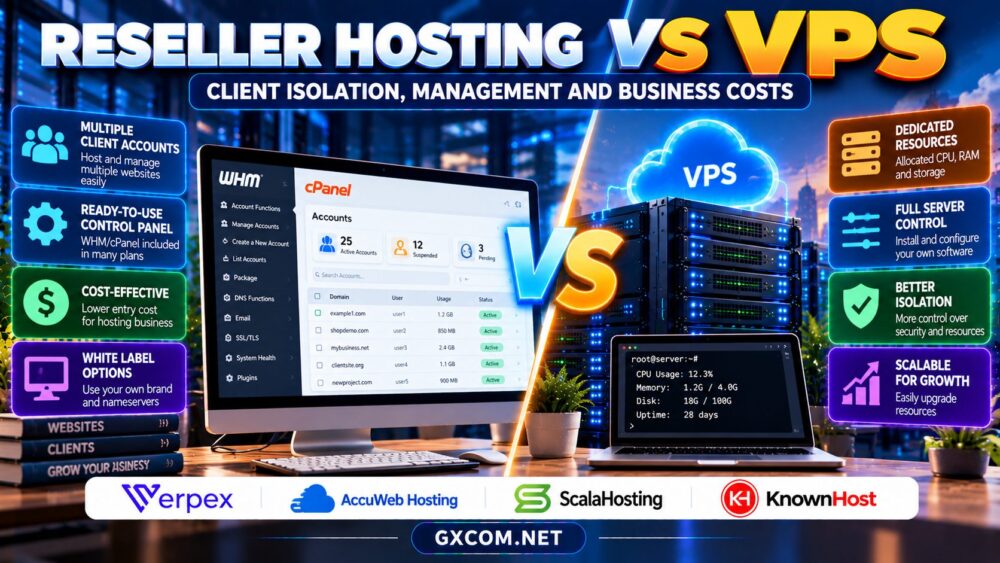
CPU, memory, processes, and disk input/output can become bottlenecks before storage runs out. A portfolio of busy online stores may need a different platform from dozens of small brochure websites. See our reseller hosting vs VPS comparison for resource-control tradeoffs.

3. Compare Four Approved Reseller Hosting Providers
Verpex: Account-Based Capacity Planning
Verpex publishes reseller tiers organized around maximum cPanel account counts and storage allocations. This makes it useful for estimating when the next upgrade becomes necessary. Confirm renewal pricing, the exact account allowance, and whether your billing platform requires an additional license.
GreenGeeks: Storage and Account Quotas
GreenGeeks publishes reseller plans with defined cPanel account counts, disk allowances, and transfer limits. Compare how much storage is available per expected paying client, rather than simply dividing capacity by the advertised maximum. Review the renewal rate and support arrangements.
AccuWeb Hosting: Small-Portfolio Economics
AccuWeb 主机服务 offers reseller options that can be evaluated for smaller client portfolios. Examine the number of included accounts, billing interval, disk capacity, and location-specific plan details. Check whether expanding beyond the initial tier changes your unit economics.
HostPapa: Bundled Business Tools
HostPapa’s reseller offerings highlight account management and billing-related tools on selected packages. Compare the exact software inclusions, account limits, renewal terms, and support coverage. A bundled license can be valuable, but only when it replaces an expense your business would otherwise incur.
Always use current provider documentation and checkout totals; promotional terms, features, and capacity limits can change.
4. Build Profitable Retail Hosting Packages
Create clear entry, business, and premium packages based on measurable requirements. Differentiate them through storage, support scope, backup retention, migration assistance, and performance expectations rather than vague claims of unlimited resources.
For example, an agency could hypothetically charge $15, $25, and $45 monthly for three service levels. Those prices are illustrations, not recommended market rates. Calculate the expected support time and resource usage for each tier before deciding whether its margin is acceptable.
Separate hosting from website maintenance when possible. Plugin updates, content edits, security cleanup, and emergency development can consume hours that a basic hosting fee cannot cover. Define included services and charge separately for work outside the agreement.
5. Model Gross Margin, Break-Even and Cash Flow
Consider a hypothetical business with 20 customers paying $25 monthly, generating $500 revenue. Suppose reseller hosting costs $80, software $35, payment fees $20, and support labor $140. Total monthly expenses are $275, leaving $225 operating contribution before taxes and other overhead.
Its contribution margin is 45%: $225 divided by $500. With the same average customer price and assumed fixed expenses, calculate break-even carefully because payment fees and support workload may rise with customer volume. A simple spreadsheet should separate fixed and variable costs.
Cash flow matters too. Annual customer prepayments do not eliminate your future service obligations. Reserve funds for refunds, renewals, unexpected migrations, and support incidents. For a wider framework, consult our managed hosting total cost analysis.
6. Renewal Pricing and Scaling Triggers
Introductory discounts can make first-year margins appear unusually strong. Forecast at least 36 months using renewal rates, likely account growth, additional storage, software licensing, and realistic staff costs. Compare monthly billing against longer commitments without assuming that prepayment guarantees savings.
Set upgrade triggers before capacity becomes critical. Examples include approaching the account cap, sustained storage growth, recurring resource throttling, or support demand exceeding your team’s capacity. Test migration procedures and communicate planned changes before customers are affected.
我们的 面向代理商的转售型主机指南 discusses agency workflows, while our web hosting deals page offers a separate route for researching current purchasing options.
7. Choose a Model That Supports Retention
Low prices can attract customers, but unclear limits and slow support can damage retention. Publish understandable package specifications, service boundaries, renewal notices, and cancellation terms. Track revenue per account, churn, support tickets, and storage growth monthly.

Evaluate whether each new client improves overall contribution after onboarding costs. Profitable reseller hosting depends on consistent service delivery, not simply filling every available control-panel slot.
Compare Reseller Hosting Plans
Review account limits, storage allowances, renewal terms, and included business tools before selecting your platform.
Reseller Hosting Pricing FAQ
What is the best way to calculate cost per account?
Divide total recurring operating expenses by active paying accounts, then track support and resource costs separately for customers with unusual workloads.
Can I oversell reseller hosting storage?
Only if provider terms permit it and you monitor actual usage, contractual quotas, and growth risk. Avoid promises you cannot fulfill.
Should I choose the cheapest reseller plan?
Not automatically. Compare renewal costs, account caps, backup policies, software licenses, and the labor required to support customers.
最终裁决
Effective reseller hosting pricing models balance per-account economics, resource headroom, predictable renewals, and customer support. Compare Verpex, GreenGeeks, AccuWeb 主机服务, ,以及 HostPapa against your expected customer mix. Build packages around measurable costs, monitor margins monthly, and upgrade infrastructure before service quality suffers.