Finding the best AMD EPYC VPS deals requires more than comparing processor names and advertised vCPU counts. Two virtual servers with four AMD EPYC vCPUs can deliver noticeably different performance when one uses shared CPU resources and the other provides dedicated vCPUs.
For website owners, developers, and businesses running production applications, that difference affects response times, workload stability, and long-term hosting costs.
This guide compares shared and dedicated AMD EPYC VPS hosting, examines relevant providers, and explains how to identify genuine value before purchasing.
What Makes AMD EPYC VPS Hosting Attractive?
AMD EPYC processors are designed for server workloads, offering substantial core counts, memory bandwidth, and virtualization capabilities. Modern EPYC platforms can support web applications, databases, containers, and demanding business services.
However, the EPYC name alone does not guarantee superior VPS performance. Processor generation, clock speed, hypervisor configuration, storage quality, and CPU allocation policies all matter.
Before choosing a plan, ask whether its vCPUs are shared, dedicated, or subject to sustained-use restrictions.
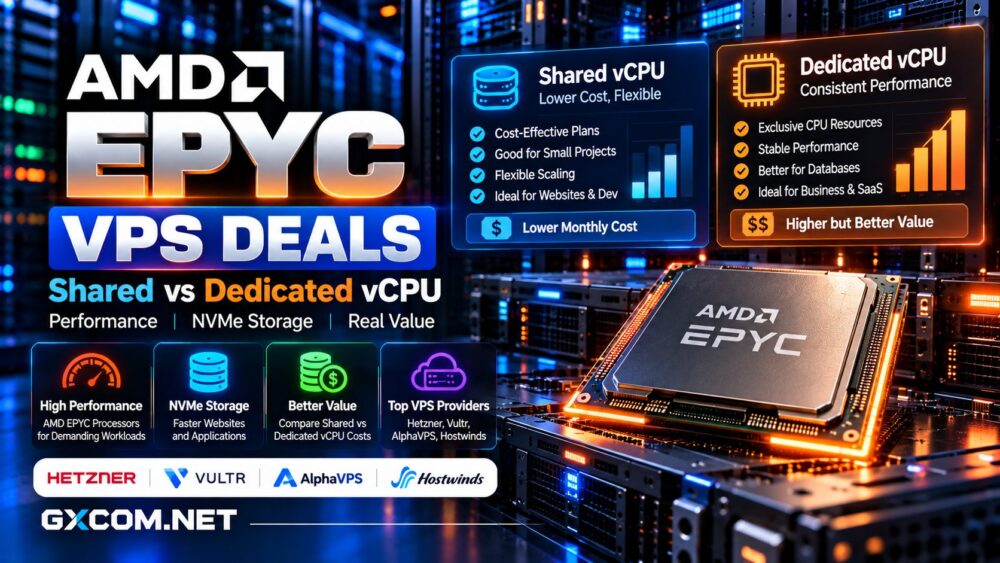
Shared vs Dedicated vCPU: Key Differences
A shared vCPU represents processing capacity scheduled alongside other virtual machines on the same physical server. Providers can offer attractive prices because not every customer uses maximum CPU resources simultaneously.
A dedicated vCPU provides an exclusive allocation of CPU execution resources under the provider’s virtualization model. It generally offers more predictable sustained performance, although it does not necessarily mean ownership of an entire physical core.
| 因子 | 共享 vCPU | 专用虚拟CPU |
|---|---|---|
| 每月费用 | 通常较低 | 通常较高 |
| CPU 分配 | Shared scheduling | Exclusive allocation |
| Sustained Workloads | Policy-dependent | 更可预测 |
| Typical Applications | Websites, testing, light APIs | Databases, CI/CD, busy applications |
| Best Buying Priority | Low cost and flexibility | Consistency and sustained capacity |
For broader VPS selection advice, read our 最佳VPS服务商对比.
Best AMD EPYC VPS Providers to Compare
Hetzner: Shared and Dedicated Cloud Resources
Hetzner offers cloud instances with shared resources alongside General Purpose servers featuring dedicated vCPUs. Its AMD EPYC infrastructure makes the platform relevant to buyers comparing both allocation models.

Shared plans suit development, moderate website traffic, and applications with intermittent CPU demand. Dedicated-resource plans are more appropriate when predictable processing capacity is essential.
Hetzner is particularly worth comparing for Linux applications, databases, and infrastructure projects where users manage their own servers.
Check the selected region, processor generation, included traffic, storage, and IP-related charges before ordering.
Vultr: Flexible Cloud Compute and Optimized Instances
Vultr provides shared-vCPU Cloud Compute and dedicated-vCPU Optimized Cloud Compute options, including AMD EPYC-powered configurations.
Shared instances are attractive for applications with variable utilization. Optimized instances target sustained workloads requiring more consistent processing resources.
Vultr also offers multiple deployment regions, which can help businesses position applications closer to customers.
Compare instance families carefully: memory allocation, storage performance, and CPU generation can differ even when advertised vCPU counts appear similar.
AlphaVPS: AMD EPYC and NVMe VPS Hosting
AlphaVPS advertises high-performance KVM VPS plans using AMD EPYC 7002/7003 processors, enterprise NVMe storage, and ECC memory.
It is worth evaluating for developers who prioritize cost-efficient virtual servers with root access and modern storage.
However, an AMD EPYC-based VPS should not automatically be classified as dedicated CPU hosting. Confirm the applicable CPU-sharing policy and acceptable sustained utilization before purchasing.
For storage-related comparisons, see our NVMe VPS 性能指南.
Hostwinds: VPS Management as an Alternative Priority
Hostwinds offers managed and unmanaged VPS services for buyers with different administration requirements.
Its value proposition may involve support and operational convenience rather than a specific EPYC CPU allocation. Confirm the processor model and resource policy for any shortlisted plan.
Businesses without dedicated system administrators should consider whether management assistance outweighs a lower self-managed VPS price.
How Much Is Dedicated CPU Performance Worth?
Dedicated vCPU plans generally cost more because providers reserve processing resources rather than relying on shared utilization.
Consider a hypothetical shared VPS costing $12 monthly and a dedicated alternative costing $28. The dedicated option costs $16 more, but that premium may be worthwhile if it prevents slow database queries or delayed background jobs.
The correct comparison is not simply monthly price divided by vCPU count.
Instead, evaluate completed transactions, average response time, and sustained workload throughput per dollar.
我们的 便宜的VPS服务商指南 covers additional budget-oriented alternatives.
Why Four vCPUs Do Not Always Equal Four vCPUs
A vCPU usually represents a virtual execution thread rather than a guaranteed physical processor core.
Performance depends on host CPU architecture, simultaneous multithreading, scheduling policies, and competing workloads.
On shared infrastructure, heavy activity from neighboring virtual machines can increase CPU scheduling delays. Linux users can examine steal time as one diagnostic signal, although low steal time alone does not prove dedicated allocation.
For CPU-intensive applications, run benchmarks during several periods rather than relying on a single favorable test.
Benchmark AMD EPYC VPS Performance Before Committing
Use representative application tests alongside tools such as sysbench, fio, and database-specific benchmarks.
Measure single-thread responsiveness, sustained multi-thread throughput, storage latency, and network behavior. Repeat tests during busy and quiet periods.
For production websites, examine uncached requests and database-heavy pages instead of measuring only static homepage loading.
Document the results and compare them with the additional monthly cost of dedicated resources.
Which Workloads Actually Need Dedicated vCPUs?
Shared AMD EPYC VPS hosting is often sufficient for personal websites, staging environments, small APIs, development servers, and applications with occasional traffic spikes.
Dedicated vCPUs become more compelling for busy databases, continuous background processing, build pipelines, high-traffic applications, and latency-sensitive services.
However, dedicated CPU resources cannot compensate for insufficient RAM, slow storage, or poorly optimized software.
Before upgrading, identify the actual bottleneck through monitoring rather than assuming CPU allocation is responsible.
Check the Total VPS Cost, Not Just the Discount
Review renewal rates, billing commitments, backup fees, operating system licensing, additional IP addresses, bandwidth limits, and management charges.
A cheap introductory plan can become expensive when essential services are added.
Also confirm whether CPU usage restrictions apply, whether upgrades require migration, and how the provider handles sustained workloads.
For related purchasing options, explore our 经济实惠的云VPS优惠.
Final Verdict: Shared or Dedicated AMD EPYC VPS?
Choose shared AMD EPYC VPS hosting when affordability, flexible scaling, and moderate CPU demand are the main priorities.
Choose dedicated vCPUs when consistent throughput, predictable latency, and sustained processing capacity directly affect business operations.
Hetzner and Vultr provide clear shared-versus-dedicated comparisons. AlphaVPS deserves attention for EPYC-based VPS value, while Hostwinds may suit buyers prioritizing management services.
最好的 AMD EPYC VPS deal is the plan that delivers dependable application performance at a sustainable total cost, not necessarily the one advertising the most vCPUs.