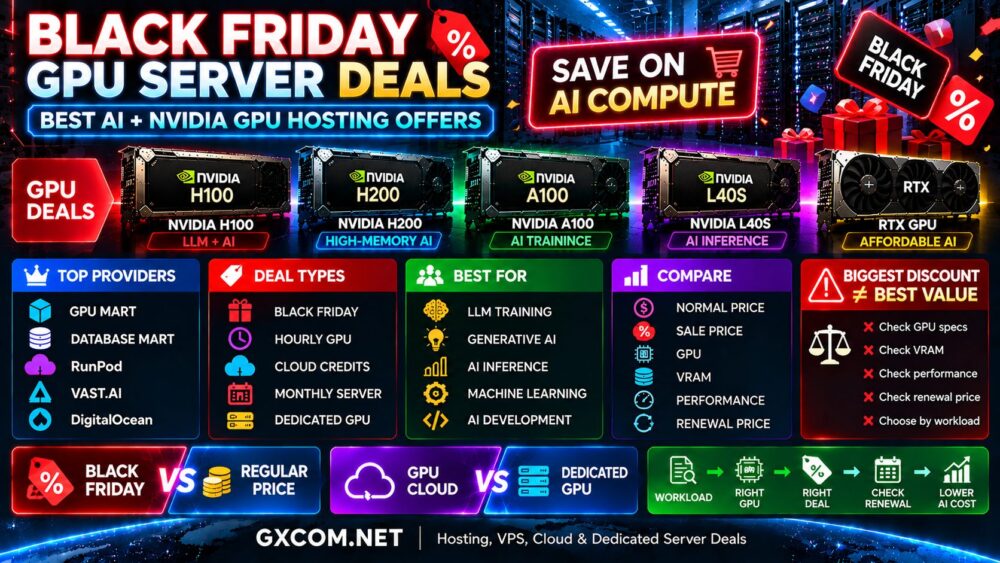
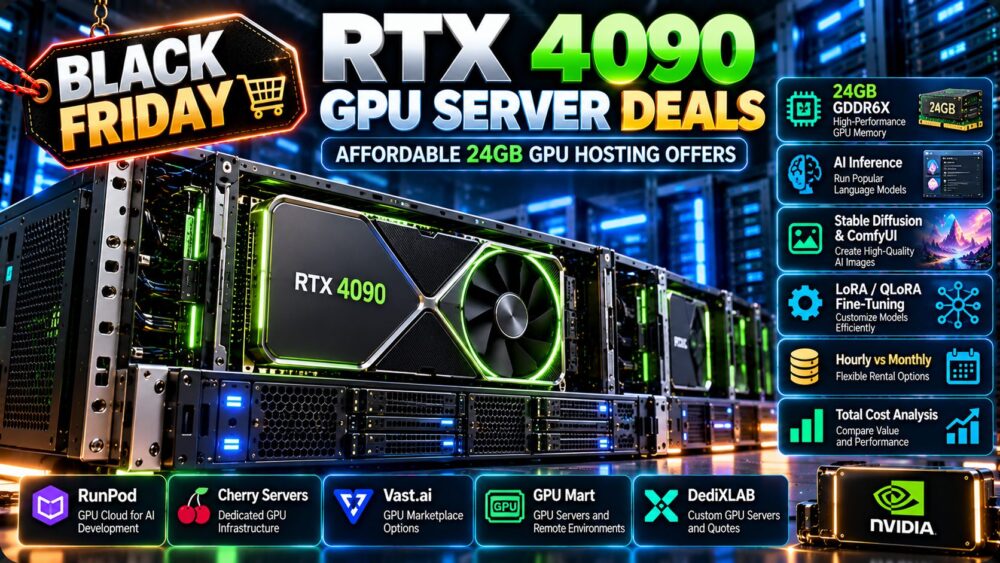
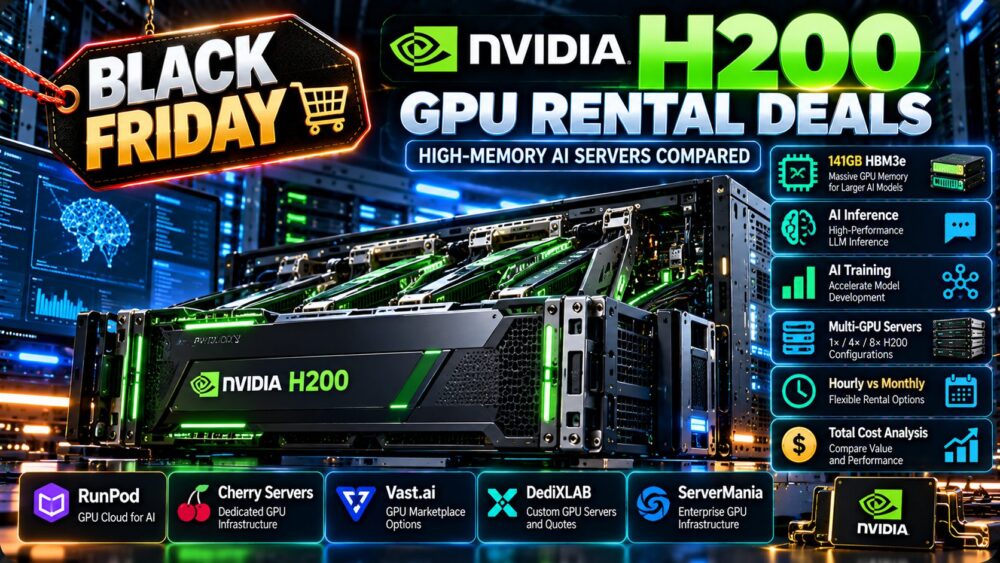
H200 GPU rental deals are worth comparing when AI workloads require large GPU memory, high memory bandwidth, and the ability to process demanding models without constantly moving data between GPU and system memory. However, renting an NVIDIA H200 is not automatically the most cost-effective choice for every AI project.
The NVIDIA H200 Tensor Core GPU offers 141GB of HBM3e memory and approximately 4.8TB/s of memory bandwidth in its SXM configuration, making it particularly relevant for memory-intensive large language model inference, selected training workloads, and enterprise AI infrastructure. Actual server performance depends on the GPU form factor, CPU, system memory, interconnects, software stack, and workload.
This guide compares NVIDIA H200 rental options, explains hourly versus monthly pricing, examines cloud and dedicated GPU hosting models, and shows how to evaluate the real cost of running high-memory AI workloads.
Deal verification note: GPU rental prices, available configurations, geographic regions, and promotional offers change frequently. This article does not claim that a particular H200 discount or inventory allocation is currently available. Always verify the exact GPU model, memory configuration, billing terms, and availability with the provider before purchasing.
Best H200 GPU Rental Deals: What Should You Compare?
最好的 H200 GPU rental deals are not simply the listings with the lowest advertised hourly rate. The right rental should provide enough usable GPU memory, suitable compute performance, reliable networking, and a total cost that makes sense for the intended workload.
Evaluate the following factors before selecting an H200 server:
- GPU model and form factor: Confirm the exact NVIDIA H200 configuration and its supported capabilities.
- GPU 分配: Determine whether the customer receives a full physical GPU or a partitioned resource.
- VRAM: Confirm the usable GPU memory and whether any partitioning limits apply.
- CPU 和内存: Ensure the host can handle tokenization, preprocessing, data loading, and application services.
- 存储: Check local NVMe capacity, persistent volumes, and storage throughput.
- 人际网络: Evaluate bandwidth, latency, and multi-node communication requirements.
- 账单: Understand hourly charges, minimum commitments, idle time, and cancellation conditions.
- Data transfer: Identify storage and outbound traffic fees that may not appear in the GPU price.
- Availability: Confirm whether the required number of GPUs can be provisioned in the desired region.
- 支持: Understand the difference between self-managed GPU instances and managed infrastructure.
For high-value AI projects, reproducible performance and reliable capacity can be more important than a small difference in hourly rental price.
NVIDIA H200 GPU Specifications for AI Hosting
The NVIDIA H200 belongs to the Hopper architecture family and expands the memory capabilities available for demanding AI workloads.
| 规格 | NVIDIA H200 SXM | 为何这很重要 |
|---|---|---|
| 建筑 | NVIDIA Hopper | Supports modern AI compute features |
| GPU内存 | 141GB HBM3e | Supports larger model weights and working sets |
| 内存带宽 | Approximately 4.8TB/s | Important for memory-bound AI operations |
| Compute platform | Tensor Core GPU | Accelerates supported AI workloads |
| 多GPU连接 | Platform-dependent NVLink/NVSwitch options | Can improve communication in supported systems |
| 部署 | Compatible server platforms | Actual rental specifications vary |
These are reference characteristics of the H200 SXM product, not guaranteed specifications of every rental listing. Other H200 form factors and provider configurations may differ.
Why 141GB of GPU Memory Matters
GPU memory determines how much model data, intermediate computation, and inference state can remain on the accelerator.
For large language models, memory requirements include more than model weights. Runtime buffers, activations, key-value cache, batching, and framework overhead also consume VRAM.
A larger memory pool can reduce the need for aggressive quantization or offloading, although the exact benefit depends on the model and deployment framework.
Why Memory Bandwidth Matters
Many large language model inference operations are sensitive to memory bandwidth, especially during token generation.
The H200's high-bandwidth memory subsystem can be valuable for workloads that repeatedly move substantial amounts of model data.
However, end-to-end throughput also depends on batching, kernel efficiency, context length, compute utilization, and networking.
H200 SXM vs Other H200 Configurations
Not every server advertised as H200 hosting necessarily uses the same hardware implementation.
Before comparing prices, ask the provider to identify the precise GPU model, form factor, memory allocation, interconnect topology, and supported software environment.
A cheaper configuration may be suitable for single-GPU inference but less appropriate for tightly coupled multi-GPU training.
NVIDIA H200 vs H100 vs B200: Which GPU Should You Rent?
H200 rental value becomes clearer when compared with other high-end NVIDIA accelerators.
| GPU | Memory Reference | Primary Purchasing Consideration |
|---|---|---|
| NVIDIA H100 SXM | 80GB HBM3 | Established Hopper compute with a smaller memory pool |
| NVIDIA H200 SXM | 141GB HBM3e | Higher memory capacity and bandwidth for demanding workloads |
| NVIDIA B200 | 180GB HBM3e per GPU | Blackwell architecture, larger memory, and different platform economics |
Specifications refer to representative accelerator configurations. Performance and pricing must be evaluated at the complete server or platform level.
When H100 May Be Better Value
H100 can remain a sensible option when a model comfortably fits within the available GPU memory and the rental rate is meaningfully lower.
If the workload is compute-bound rather than memory-capacity-bound, paying more for H200 may not produce a proportional improvement.
When H200 Makes Sense
H200 is particularly attractive when additional VRAM allows a larger model, longer context, greater batch size, or reduced offloading.
Its memory bandwidth can also benefit suitable inference workloads.
When B200 Deserves Consideration
B200-based systems may be relevant for buyers seeking newer Blackwell architecture capabilities and larger GPU memory.
However, server configurations, software compatibility, availability, and rental economics can differ substantially.
For a deeper technical comparison, read our NVIDIA H100、H200 与 B200 服务器对比.
H200 GPU Rental Providers: Five Options to Investigate
When shopping for H200 GPU rental deals, distinguish between cloud GPU platforms, marketplace infrastructure, and dedicated server providers.
The following companies are relevant candidates for GPU hosting or dedicated infrastructure research. Their inclusion does not establish current H200 inventory, pricing, or promotional eligibility.
1. RunPod: GPU Cloud for AI Development and Inference
RunPod is a relevant platform to investigate for GPU cloud workloads, including model development, experimentation, and inference deployments.
For an H200 requirement, verify whether the desired GPU is currently listed, the exact allocation model, available regions, storage persistence, network capabilities, and billing behavior when workloads stop.
Cloud-style deployment can be attractive for teams that need computing capacity for specific jobs rather than a continuously operating server.
最适合用于评估的是: AI developers and teams prioritizing flexible GPU cloud deployment.
2. Cherry Servers: Dedicated GPU Infrastructure
Cherry 服务器 is a relevant candidate for organizations evaluating dedicated physical infrastructure and GPU server requirements.

For H200-class workloads, request confirmation of the available accelerator models, number of GPUs per server, CPU and RAM configuration, storage, networking, and contract options.
A dedicated configuration may be attractive when workloads run continuously or require consistent access to the same hardware.
最适合用于评估的是: Businesses considering long-running GPU infrastructure and dedicated server procurement.
3. Vast.ai: GPU Marketplace Economics
Vast.ai provides a marketplace-oriented model for sourcing GPU compute resources.
Marketplace offers can differ in host characteristics, availability, reliability, storage, network performance, and pricing.
For H200 rentals, verify the actual GPU listing, host specifications, reliability indicators, rental conditions, and whether the environment meets security and data-handling requirements.
最适合用于评估的是: Price-sensitive experimentation and flexible AI workloads where host selection and operational conditions can be evaluated carefully.
4. DediXLAB: Dedicated Hardware Procurement
DediXLAB can be considered when researching dedicated server configurations or requesting specialized infrastructure quotations.
For H200 requirements, confirm whether the accelerator can actually be supplied, the deployment lead time, interconnect topology, power and cooling arrangements, and contract terms.
Do not assume that a general dedicated server catalog includes H200 GPUs.
最适合用于评估的是: Teams requesting tailored physical server configurations.
5. ServerMania: Enterprise GPU Infrastructure Planning
ServerMania is relevant for organizations evaluating dedicated server infrastructure and specialized hardware requirements.
When discussing H200-class deployments, ask about actual GPU availability, single-server and multi-server options, network architecture, operating system support, provisioning, and ongoing service responsibilities.
最适合用于评估的是: Enterprises planning sustained AI workloads or customized dedicated infrastructure.
重要提示: These providers represent different purchasing models. A provider should only be included in a live H200 deal table after the exact H200 product, available region, price, and rental conditions have been verified.
H200 GPU Cloud vs Dedicated H200 Server
The best rental model depends on workload duration, operational requirements, and the level of infrastructure control needed.
| 因子 | Cloud H200 Rental | Dedicated H200 Server |
|---|---|---|
| 账单 | May offer hourly or usage-based charges | 通常按月或按合同约定 |
| 部署 | May support rapid provisioning | 取决于硬件的供应情况 |
| 硬件控制 | Defined by cloud platform | Potentially greater server-level control |
| Workload duration | Useful for intermittent demand | Useful for sustained utilization |
| 缩放 | Depends on available instances | Depends on hardware and contract |
| 存储 | May involve separate persistent storage charges | Depends on server configuration |
| Best comparison metric | Total completed workload cost | Total completed workload cost |
A dedicated server is not automatically cheaper, and a cloud instance is not automatically more flexible under every contract or availability condition.
Hourly vs Monthly H200 GPU Rental: Cost Comparison
Hourly billing is useful when the GPU is needed for occasional jobs, experiments, or short development cycles.
Monthly billing can become attractive when the workload runs consistently and a provider offers a suitable long-term rate.
Break-Even Calculation
A simplified monthly break-even calculation is:
Break-even GPU hours = monthly rental price / effective hourly rental price
This calculation assumes equivalent hardware and excludes differences in storage, bandwidth, taxes, support, and other fees.
Hypothetical H200 Rental Example
Consider two fictional offers for equivalent H200 resources:
| 因子 | Hourly Rental | 月租金 |
|---|---|---|
| Illustrative rate | $4.00 per GPU-hour | $1,800 per GPU-month |
| 100 GPU-hours | $400 | $1,800 |
| 300 GPU-hours | $1,200 | $1,800 |
| 450 GPU-hours | $1,800 | $1,800 |
| 600 GPU-hours | $2,400 | $1,800 |
All prices are hypothetical and are not quotations, current market rates, or verified deals from any named provider.
In this simplified example, the break-even point is 450 GPU-hours per month.
However, a monthly contract may require full advance payment, while hourly rental may incur separate storage and idle resource charges.
Do Not Confuse Allocated Hours With Productive Hours
GPU time can be consumed by environment setup, downloading models, preprocessing data, failed experiments, idle periods, and debugging.
Track both billable GPU-hours and productive workload-hours to understand the true cost of a project.
H200 GPU Rental Deals for Large Language Model Inference
One of the most compelling reasons to evaluate H200 hosting is the combination of substantial GPU memory and high memory bandwidth.
模型权重存储
As a rough calculation, an unquantized 70-billion-parameter model stored with two bytes per parameter requires approximately 140 billion bytes for model weights alone.
That figure does not include runtime buffers, activations, key-value cache, or other memory overhead.
Therefore, a 141GB H200 should not be assumed to hold and serve every 70B model in FP16 or BF16 on a single GPU without memory-saving techniques.
Quantization and Model Fit
Lower-precision weight formats can reduce memory requirements, although actual savings and output quality depend on the quantization method and model.
H200's larger memory pool may enable more flexible deployment configurations or additional inference capacity compared with lower-memory GPUs.
Batch Size and Context Length
Serving more simultaneous requests can increase memory consumption, particularly when the inference engine maintains substantial key-value caches.
Long context windows also affect memory and compute requirements.
When comparing rental offers, benchmark the actual model with representative input lengths, output lengths, and concurrent requests.
For related deployment decisions, see our AI推理服务器托管指南.
Is H200 Worth Renting for AI Training?
H200 can be relevant for AI training and fine-tuning, especially when memory capacity and bandwidth are important.
However, training performance depends on more than the accelerator's memory specification.
Full Training vs Fine-Tuning
Full training requires memory for model weights, gradients, optimizer states, activations, and framework overhead.
Fine-tuning techniques such as parameter-efficient adaptation can reduce the amount of trainable state and make smaller GPU configurations practical for some tasks.
Before renting H200 hardware, determine whether the project genuinely benefits from the larger memory capacity or whether an alternative accelerator would be more economical.
Multi-GPU Training Requirements
Distributed training introduces communication between GPUs and, potentially, between servers.
Interconnect bandwidth, topology, collective communication performance, and network reliability can strongly influence scaling efficiency.
For these workloads, compare the complete server or cluster rather than multiplying single-GPU benchmark results by the GPU count.
我们的 NVIDIA GPU servers for AI training guide covers the broader infrastructure requirements.
Single H200 vs 4-GPU and 8-GPU H200 Servers
A single H200 can be appropriate for workloads that fit within one GPU's memory and compute capacity.
Multi-GPU configurations become relevant when the workload requires additional compute, model parallelism, larger effective memory capacity, or higher throughput.
| 配置 | Aggregate Nominal GPU Memory | Typical Evaluation Priority |
|---|---|---|
| 1 × H200 SXM | 141GB | Single-GPU inference and development |
| 4 × H200 SXM | 564GB | Parallel inference or distributed workloads |
| 8 × H200 SXM | 1,128GB | Large-scale training and multi-GPU inference |
Aggregate memory is the sum of installed GPU memory. It does not behave as one automatically unified memory pool; effective use depends on software partitioning, model parallelism, and hardware interconnects.
Why Interconnect Topology Matters
Two servers with the same number of H200 GPUs may deliver different performance when their GPU-to-GPU communication paths differ.
For tightly coupled training, ask about NVLink, NVSwitch, PCIe topology, and relevant networking capabilities.
多节点网络
When a workload spans multiple servers, network latency and throughput can become significant bottlenecks.
High-speed network interfaces alone do not guarantee efficient distributed training. Software configuration and cluster architecture also matter.
Hidden Costs in H200 GPU Rental Deals
The advertised GPU rate may represent only part of the total cost.
持久化存储
Large models, datasets, checkpoints, and container images can require substantial storage capacity.
Determine whether storage remains billable when GPU compute is stopped.
Data Transfer and Egress
Moving training data, checkpoints, and inference outputs between regions or external networks may introduce additional charges.
Check both inbound and outbound transfer policies.
Idle GPU Time
An allocated GPU can continue generating charges while waiting for data, downloading dependencies, or running no productive workload.
Use automation and scheduling where appropriate to reduce idle allocation.
CPU, RAM and Disk Performance
A powerful GPU can remain underutilized if the host CPU, system memory, or storage subsystem cannot supply data quickly enough.
Compare the entire instance specification, not just the GPU model.
Setup and Migration Work
Changing providers may require moving large datasets, rebuilding software environments, adapting deployment scripts, and retesting performance.
These operational costs can outweigh modest differences in advertised hourly rates.
How to Measure H200 Cost Efficiency
For commercial AI workloads, cost per useful output is usually more meaningful than cost per GPU-hour.
Inference Cost per Million Tokens
一个简化的计算方法是:
Infrastructure cost per million output tokens = total infrastructure cost / output tokens generated × 1,000,000
For example, if a fictional inference deployment costs $120 in infrastructure charges and produces 30 million output tokens, its infrastructure cost is $4 per million output tokens.
This example excludes engineering labor, model development, monitoring, and other business costs.
Training Cost per Completed Run
For training, compare the total cost required to reach the same target model quality.
A more expensive GPU can be economical if it reduces the time required to complete a useful training run.
Conversely, a cheaper accelerator may provide better value when performance differences are small.
Measure Real Utilization
Track GPU utilization, memory use, tokens per second, batch throughput, training step time, and end-to-end job duration.
Do not rely on synthetic peak-performance specifications alone.
When Should You Choose a Cheaper GPU Instead of H200?
Not every workload needs a 141GB accelerator.
For smaller models, lightweight fine-tuning, computer vision, or intermittent development, lower-cost GPU configurations may deliver better economics.
24GB GPUs for Smaller Workloads
GPUs with 24GB of memory may be suitable for selected quantized models, smaller inference tasks, and development environments.
They can be worth comparing when the workload does not require H200-class memory capacity.
48GB-Class GPUs
Higher-memory workstation or data center GPUs may provide a useful middle ground for selected inference, rendering, and AI workloads.
Compare software support, compute performance, memory capacity, and rental cost.
Spot or Interruptible GPU Instances
Interruptible GPU capacity may be attractive for checkpointable training jobs and batch processing.
However, unexpected interruptions can increase completion time and require robust checkpointing.
For more details, read our spot GPU instances vs on-demand servers comparison.
H200 GPU Rental Buying Checklist
- 定义工作负载: Identify the model, precision, context length, batch size, and expected throughput.
- Estimate memory requirements: Include weights, runtime buffers, and key-value cache.
- Confirm the GPU: Verify the exact H200 model, form factor, and allocation.
- Inspect the host: Check CPU, RAM, NVMe storage, and operating system options.
- Review interconnects: Understand GPU topology for multi-GPU workloads.
- Check the network: Evaluate throughput, latency, and data transfer charges.
- 确认可用性: Verify region, quantity, and deployment timing.
- Compare billing: Calculate hourly, monthly, and committed-use costs.
- Account for idle time: Include setup, downloads, and unused allocation.
- Evaluate security: Review data isolation, access controls, and compliance requirements.
- 对工作负载进行基准测试: Measure tokens per second or completed training jobs.
- Verify the deal: Confirm any promotion, coupon, and expiration date directly.
常见问题解答
How much GPU memory does the NVIDIA H200 have?
The NVIDIA H200 SXM provides 141GB of HBM3e memory. Verify the precise product configuration in a rental listing.
Is H200 better than H100 for AI inference?
H200 offers more GPU memory and higher memory bandwidth than the H100 SXM reference configuration. Whether it provides better rental value depends on model size, throughput, software efficiency, and price.
Can one H200 run a 70B language model?
It depends on model precision, inference software, context length, and memory overhead. Quantized deployments may fit more easily, while FP16 or BF16 weights alone can approach the available memory capacity.
Are H200 GPU rental deals available hourly?
Some GPU infrastructure services use hourly billing, while dedicated server contracts may use monthly or longer terms. Confirm the current provider offering and billing rules.
Is monthly H200 rental cheaper than hourly rental?
Monthly rental can be more economical at high utilization, but the break-even point depends on the actual rates, contract terms, and additional charges.
Can H200 GPUs be used for model fine-tuning?
Yes, H200 hardware can support compatible AI training and fine-tuning workloads. The required GPU count depends on model size, optimization technique, and memory requirements.
Do multiple H200 GPUs combine their memory automatically?
No. Multi-GPU systems require software techniques to distribute model data or workloads across separate GPU memory pools.
Is an H200 dedicated server better than a GPU cloud instance?
Dedicated servers may be attractive for sustained workloads and infrastructure control, while cloud instances may suit variable demand. Compare the complete cost and operational requirements.
What is the biggest hidden cost of GPU rentals?
Common overlooked costs include idle allocation, persistent storage, data transfer, additional CPU resources, and time spent managing the environment.
Which H200 rental provider is the cheapest?
There is no permanently cheapest provider. Prices and availability change, and listings may differ in hardware allocation, host quality, storage, network access, and support. Compare verified offers for equivalent configurations.
Final Verdict: NVIDIA H200 GPU Rental Deals
最好的 H200 GPU rental deals provide the right combination of high-memory GPU capacity, dependable infrastructure, appropriate networking, and transparent total costs.
RunPod and Vast.ai are relevant options to investigate for flexible GPU sourcing, while Cherry Servers, DediXLAB, and ServerMania are candidates for dedicated infrastructure discussions. Exact H200 availability and commercial terms must be confirmed individually.
For memory-intensive inference and selected AI training workloads, the H200's 141GB memory capacity can be valuable. However, smaller accelerators may offer better economics when the application does not benefit from additional VRAM or bandwidth.
Before purchasing, benchmark a representative workload, compare hourly and monthly costs, and account for storage, data transfer, idle time, and deployment requirements.
MODEL REQUIREMENTS → GPU MEMORY → COMPUTE PERFORMANCE → INTERCONNECT → UTILIZATION → TOTAL COST → REAL AI VALUE