Windows dedicated SQL Server licensing can cost more than the physical server itself. A powerful Xeon or AMD EPYC machine may look affordable until SQL Server edition, processor cores, Client Access Licenses (CALs), and Windows Server licensing are included.
For businesses running databases, SaaS applications, or internal systems, licensing should influence hardware selection from the beginning. This guide explains SQL Server 2025 licensing models, physical core calculations, CAL requirements, and dedicated hosting costs.
SQL Server 2025 Licensing Models Explained
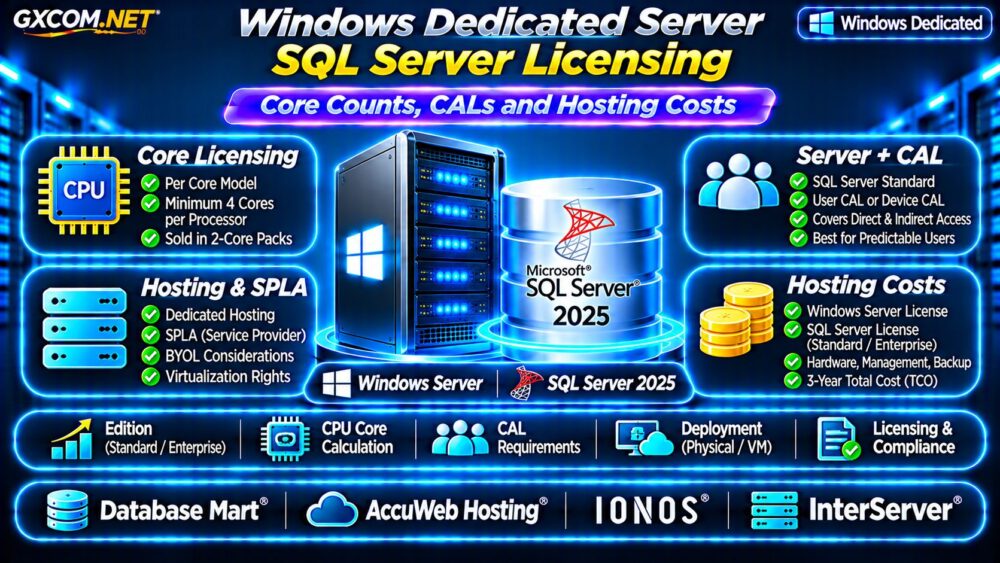
Microsoft SQL Server 2025 offers two main commercial editions: Standard and Enterprise. Standard supports Per Core and Server + CAL licensing, while Enterprise uses the Per Core model.
Standard is often appropriate for smaller business databases, subject to edition-specific resource and feature limits. Enterprise targets demanding workloads requiring advanced capabilities.
Check Microsoft’s official SQL Server licensing guidance before purchasing, because licensing rights depend on the agreement and deployment environment.
Per-Core Licensing on Physical Dedicated Servers
Under physical Per Core licensing, count the physical cores in every processor on the licensed server. Microsoft generally requires at least four core licenses per physical processor, even when that processor has fewer than four cores.
Core licenses are commonly purchased in two-core packs. Hyper-threading does not double the physical core count for this calculation.
Single-CPU and Dual-CPU Examples
| Physical Configuration | Required Core Licenses | Two-Core Packs |
|---|---|---|
| 1 CPU × 4 cores | 4 | 2 |
| 1 CPU × 8 cores | 8 | 4 |
| 2 CPUs × 6 cores | 12 | 6 |
| 2 CPUs × 16 cores | 32 | 16 |
These examples assume physical-core licensing for an eligible edition and deployment. A dual-socket server can therefore increase database licensing costs substantially.
Do not buy additional cores without measuring SQL Server CPU demand, memory pressure, and storage latency.
SQL Server Standard: Server + CAL Licensing
The Server + CAL model requires an eligible SQL Server Standard server license plus CALs for users or devices accessing the software.
CAL requirements also apply to qualifying indirect access. Placing a website, application server, or connection pool between customers and SQL Server does not automatically eliminate CAL obligations.
This model may suit an internal business application with a known, limited user population. Public websites and SaaS platforms with numerous or difficult-to-count users often warrant Per Core licensing instead.

Compare both models using your actual access pattern and contractual rights, not merely the number of database connections.
SQL Server Licensing for Virtual Machines
Virtualization changes the licensing calculation. Eligible Per Core licensing of individual virtual machines generally requires licensing assigned virtual cores, subject to a four-core minimum per VM.
For SQL Server 2022 and later, individual-VM Per Core licensing under commercial licensing generally requires active Software Assurance or qualifying subscription licenses.
Enterprise licensing with qualifying rights may support broader virtualization, but unlimited virtualization is not automatically included with every Enterprise purchase.
Confirm the licensing agreement before running multiple SQL Server virtual machines on dedicated hardware.
Windows Server and SQL Server Are Separate Costs
A Windows dedicated server quotation may include the operating system without including SQL Server. Windows Server has its own licensing requirements, which should be calculated independently.
Other potential expenses include Windows Server CALs where applicable, backup software, database administration, monitoring, and disaster recovery.
我们的 Windows Dedicated Server Licensing Guide explains operating system and RDP costs separately.
SPLA, Hosting Providers and Bring Your Own License
Commercial hosting introduces additional licensing considerations. Microsoft offers the Services Provider License Agreement (SPLA) for eligible providers delivering hosted software services.
However, customers should not assume an existing SQL Server license can automatically be transferred to any hosting provider. Outsourcing, license mobility, subscription eligibility, and dedicated versus shared hardware may affect the permitted arrangement.
Request written confirmation of who supplies the SQL Server license, which edition is covered, and whether customer-provided licenses are accepted.
See Microsoft’s SPLA program information for service-provider licensing context.
How CPU Selection Changes Hosting Costs
Consider two hypothetical dedicated servers: an eight-core modern processor and a 32-core older platform. The larger machine may offer more parallel capacity, but physical Per Core licensing requires four times as many core licenses.
For applications constrained by single-threaded queries or storage I/O, extra cores may deliver little benefit.
Benchmark representative queries before purchasing. Favor adequate RAM, modern CPU architecture, and fast NVMe storage over unnecessary core counts.
我们的 面向 SaaS 应用的专用服务器 comparison covers hardware selection in greater detail.
四家Windows专用主机服务商对比
The following approved providers are infrastructure candidates, not verified SQL Server license-inclusive offers. Confirm current configurations and licensing terms individually.
Database Mart: Database-Focused Configurations
数据库集市 is worth evaluating for Windows database hosting requirements. Request the exact SQL Server edition, licensing method, storage configuration, and backup options in the quotation.
AccuWeb Hosting: Windows Management Requirements
AccuWeb 主机服务 is another comparison candidate for Windows infrastructure. Ask whether SQL Server installation, patching, monitoring, and database support are included or separately billed.
IONOS: Enterprise Infrastructure Budgeting
IONOS can be evaluated for dedicated hardware and longer-term infrastructure planning. Compare processor counts, Windows licensing, SQL Server arrangements, and management responsibilities.
InterServer: Hardware and License Cost Comparison
InterServer offers another dedicated infrastructure comparison point. Verify the selected CPU model, Windows configuration, SQL Server licensing availability, and total recurring charges.
Always obtain a written, itemized quotation rather than assuming that a Windows hosting plan includes database software.
Calculate Three-Year SQL Server Hosting Costs
Build a total-cost model covering server rental, Windows Server, SQL Server licensing, storage, backups, management, and future upgrades.
For illustration, a $200 monthly server plus $100 monthly operating-system and management expenses equals $300 monthly, or $10,800 over 36 months before SQL Server licensing.
SQL Server may involve separate upfront, subscription, or service-provider charges. Add those using actual quotations rather than assumed license prices.
请查看我们的 专用服务器与云服务器的对比 when evaluating alternative infrastructure economics.
SQL Server Licensing Buying Checklist
- Choose Standard or Enterprise based on required features.
- Confirm physical cores, processor sockets, and virtualization plans.
- Compare Per Core against Server + CAL eligibility.
- Verify hosting, SPLA, outsourcing, and BYOL conditions.
- Separate Windows Server and SQL Server license costs.
- Request complete three-year quotations and renewal terms.
常见问题解答
Does SQL Server Require a License for Every CPU Thread?
No. Physical Per Core licensing counts physical cores rather than hyper-threaded logical processors, subject to applicable minimums.
Can SaaS Applications Use Server + CAL Licensing?
Eligibility depends on the edition, users, access model, and applicable agreement. Indirect access still matters, making Per Core licensing worth evaluating.
Does a Windows Dedicated Server Include SQL Server?
Not necessarily. SQL Server is a separate product and must be explicitly included or properly licensed.
最终裁决
Windows dedicated SQL Server licensing should be planned before selecting hardware. Compare CPU cores, Standard versus Enterprise features, CAL obligations, virtualization rights, and provider licensing arrangements.
Evaluate Database Mart, AccuWeb Hosting, IONOS, and InterServer using written quotations. The best configuration balances database performance, compliant licensing, and predictable long-term costs.