Choosing managed hosting sounds straightforward until you compare the services included in different plans. One provider may handle operating system updates, monitoring, and backups, while another offers technical assistance only for selected infrastructure tasks.
理解 fully managed vs semi-managed hosting helps businesses avoid paying for unnecessary services or assuming important maintenance tasks are covered when they are not.
This guide compares management responsibilities, technical support, security, backups, and costs so you can choose the right hosting model for your website or application.
What Is Fully Managed Hosting?
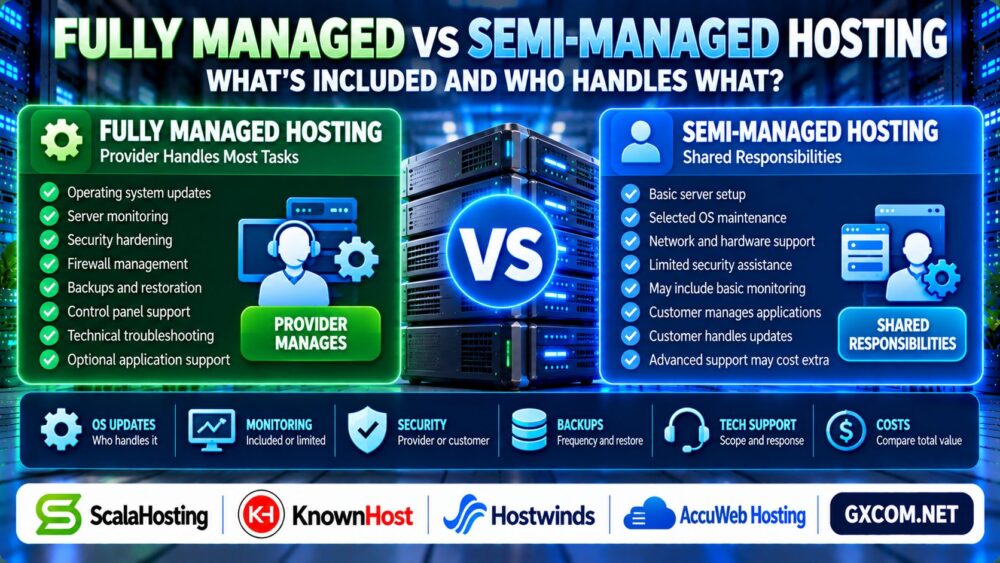
Fully managed hosting generally refers to a service in which the provider assumes a broader range of server administration responsibilities.
Depending on the contract, these may include operating system maintenance, security patching, infrastructure monitoring, control panel support, and backup administration.
Some plans also provide application-level assistance, while others limit management to the operating system and hosting environment.
The term “fully managed” does not automatically mean the provider will develop your website, repair custom code, optimize every plugin, or resolve problems caused by external services.
Always review the written management scope before purchasing.
What Is Semi-Managed Hosting?
Semi-managed hosting typically provides selected management services while leaving additional administration tasks to the customer.
A provider may manage hardware and virtualization infrastructure, assist with operating system issues, or offer limited troubleshooting while requiring customers to handle application configuration, updates, and security.
However, semi-managed is not a standardized industry-wide service level. The responsibilities can vary significantly between hosting providers.
For businesses with some technical expertise, semi-managed hosting may offer a balance between support and operational control.
Fully Managed vs Semi-Managed Hosting: Key Differences
| Management Area | 全托管主机服务 | Semi-Managed Hosting |
|---|---|---|
| 操作系统更新 | Often provider-managed | May be shared or customer-managed |
| 服务器监控 | 通常包含 | Coverage varies |
| 安全加固 | May include baseline server security | Often limited or shared |
| 备份 | 可能包含在内,也可能为可选项 | Frequently requires separate verification |
| 控制面板支持 | Often supported on eligible plans | May be limited |
| 应用程序维护 | Not necessarily included | Usually customer-managed |
| Technical responsibility | More tasks assigned to provider | More tasks retained by customer |
| 定价 | May carry higher management costs | May have lower management fees |
This comparison describes common service patterns rather than guaranteed features. The actual agreement takes precedence over marketing terminology.
1. Operating System Updates and Server Maintenance
Operating system maintenance includes security patches, package updates, service configuration, and compatibility checks.
Fully managed plans may include scheduled maintenance and provider-assisted troubleshooting.
Semi-managed plans may require customers to perform some or all operating system administration tasks.
Before buying, ask who handles emergency security patches, major operating system upgrades, reboot coordination, and problems introduced by updates.
Also verify whether the provider supports your preferred Linux distribution or Windows Server version.

2. Server Monitoring and Incident Response
Monitoring helps identify problems such as high CPU usage, memory pressure, storage exhaustion, and service failures.
Some managed hosting services provide proactive monitoring, meaning the provider may investigate specific alerts without waiting for a customer ticket.
Other plans supply monitoring tools but expect customers to interpret alerts and request assistance.
Check whether monitoring covers the server, operating system, database, web server, and application availability.
For practical performance metrics, see our 服务器性能监控指南.
3. Security Responsibilities and Patch Management
Security management may involve firewall configuration, system updates, malware scanning, access controls, and incident investigation.
Even fully managed hosting usually follows a shared-responsibility model.
For example, the provider may maintain the operating system while the website owner remains responsible for user passwords, custom applications, and third-party plugins.
Ask whether the plan includes malware removal, compromised-account investigation, application firewall management, and restoration assistance.
Do not assume these services are included simply because the hosting package is advertised as managed.
4. Backups, Restoration and Disaster Recovery
Backups are one of the most important areas to verify because the word “managed” does not guarantee comprehensive data protection.
Some hosting plans include automated backups, while others charge separately for backup storage or restoration assistance.
Review backup frequency, retention, off-server storage, restoration methods, and recovery responsibilities.
Ask whether the provider restores complete servers, individual websites, databases, or selected files.
Also distinguish between a backup service and a contractual recovery-time commitment.
我们的 服务器备份策略指南 explains how to evaluate recovery planning.
5. Technical Support: What Does Managed Actually Cover?
Technical support is not the same as unlimited administration.
A fully managed provider may help troubleshoot supported services, while custom application development and third-party integrations remain outside its scope.
Similarly, semi-managed hosting may include emergency assistance but exclude routine administration.
Before choosing a plan, verify:
- Which tasks support technicians will perform.
- Whether assistance is proactive or ticket-based.
- How critical incidents are prioritized.
- Whether response targets are contractual.
- Which tasks require additional fees.
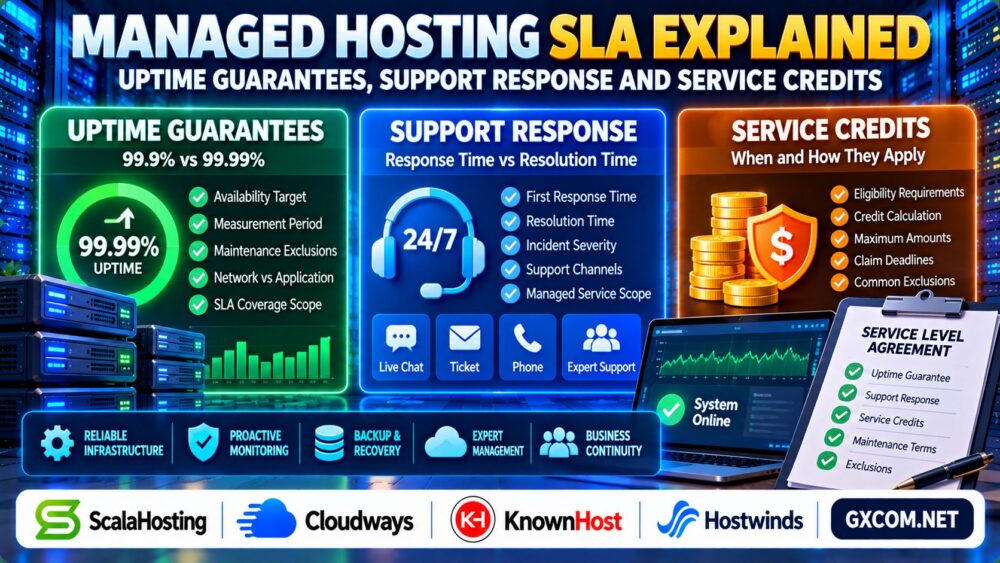
我们的 Managed Hosting SLA Guide explains uptime commitments, response times, and service credits.
6. Managed Hosting Costs and Hidden Fees
Fully managed hosting may cost more because the provider assumes additional operational work.
However, comparing monthly hosting fees alone can be misleading.
可能产生的其他费用包括:
- Control panel licensing.
- 备份存储与恢复。.
- Security services and malware cleanup.
- Server migration assistance.
- Application troubleshooting.
- Emergency administration outside the plan scope.
A semi-managed plan may be economical for an experienced administrator but more expensive in practice for a business that regularly hires external technical support.
Compare total operating costs and the value of your team's time.
7. Which Hosting Model Is Better for WordPress?
WordPress website owners should consider whether the provider manages only the server or also supports WordPress-specific operations.
Application-level responsibilities may include plugin updates, theme compatibility, staging environments, database maintenance, and malware recovery.
These services are not guaranteed by either management label.
For sites that require frequent changes, our WordPress Staging Hosting Guide explains how to evaluate safe testing and deployment features.
Business-critical WordPress and WooCommerce websites may benefit from broader support, but the exact service scope should determine the purchase.
8. Comparing Managed Hosting Providers
When researching managed hosting, compare the provider's written responsibilities rather than relying exclusively on labels.
ScalaHosting 以及 KnownHost are relevant candidates for businesses evaluating managed hosting and server administration requirements.
Hostwinds 以及 AccuWeb 主机服务 are additional providers worth examining when comparing VPS hosting options, management services, and operating system requirements.
Management coverage can vary by product, operating system, and selected support package. Verify current documentation before purchasing.
For a broader explanation of customer control and hosting administration, see our 托管型主机与非托管型主机的对比.
9. Fully Managed or Semi-Managed: Which Should You Choose?
Fully managed hosting may be more suitable when your organization lacks dedicated server administrators, requires broader infrastructure assistance, or prefers to outsource routine maintenance.
Semi-managed hosting may be appropriate when you have technical staff, need greater operational involvement, and only require selected provider services.
Neither model automatically guarantees better website performance, stronger security, or faster incident resolution.

The right choice depends on workload requirements, internal expertise, support scope, and total cost.
Managed Hosting Responsibility Checklist
- Identify who performs operating system updates.
- Confirm monitoring coverage and alert handling.
- Review firewall, security, and malware responsibilities.
- Verify backup ownership and restoration procedures.
- Check application and control panel support.
- Understand emergency response and SLA terms.
- Compare optional service fees and renewal costs.
- Request a written list of excluded management tasks.
常见问题解答
What is the difference between fully managed and semi-managed hosting?
Fully managed hosting generally assigns more server administration tasks to the provider, while semi-managed hosting leaves more responsibilities with the customer.
Does fully managed hosting include WordPress updates?
Not necessarily. Some services manage only the server environment, while others provide WordPress-specific maintenance. Check the plan scope.
Is semi-managed hosting suitable for beginners?
It depends on the tasks retained by the customer. Beginners may struggle if operating system maintenance, security, or troubleshooting is their responsibility.
Does fully managed hosting include backups?
Not always. Backup frequency, storage, restoration, and associated fees must be verified separately.
Is fully managed hosting more secure?
Broader management may help with routine maintenance, but security depends on implementation, supported services, and customer responsibilities.
Is semi-managed hosting cheaper than fully managed hosting?
It may have lower management fees, but total costs depend on technical labor, optional services, and the actual hosting plan.
Final Verdict: Compare Responsibilities Before Pricing
The most important difference in fully managed vs semi-managed hosting is how server administration responsibilities are divided between the provider and the customer.
Before purchasing, verify operating system maintenance, monitoring, security, backups, technical support, and application-level responsibilities.
Choose the management model that matches your team's expertise and operational needs rather than assuming that a “fully managed” label covers every technical task.