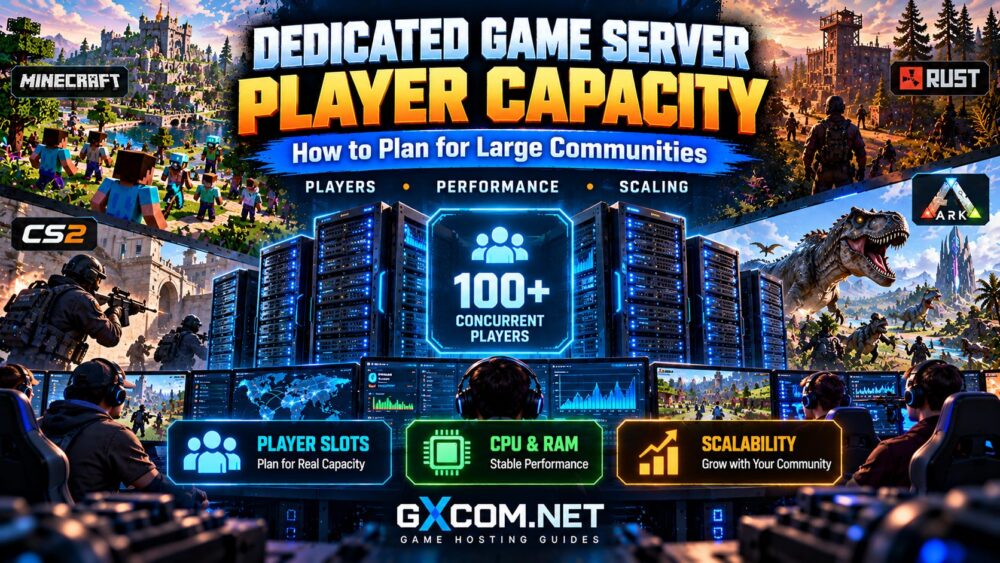
Dedicated game server player capacity determines how many people can play simultaneously without unacceptable lag, unstable simulation, or frequent disconnections. For growing multiplayer communities, estimating this capacity is essential before investing in more powerful hosting.
However, there is no universal formula that converts CPU cores or RAM into a guaranteed player count. Minecraft, Rust, ARK, and competitive shooters place different demands on server hardware.
This guide explains how to estimate realistic concurrent capacity, identify bottlenecks, compare hosting options, and plan infrastructure for larger communities.
What Determines Dedicated Game Server Player Capacity?
Player capacity is the number of simultaneous connections a server can sustain while meeting acceptable performance targets.
A configurable player-slot limit is not the same as proven capacity. Administrators may raise the connection limit without having sufficient resources to support those additional players.
The most important variables include CPU processing speed, memory usage, world complexity, game engine behavior, network stability, and installed modifications.
Managed game-hosting providers such as 主持人哈沃克 以及 生存服务器 are useful comparison candidates for growing communities. However, confirm whether the selected product is a managed game instance or a physical dedicated machine.
Player Slots vs Real Concurrent Capacity
Player slots define how many users may connect. Real capacity describes how many can play comfortably under actual conditions.
For example, a server configured for 100 slots might struggle with fewer players when large bases, complex automation, or demanding plugins create processing bottlenecks.
Conversely, a well-optimized environment may accommodate more players without requiring additional physical hardware.
Capacity planning should therefore focus on sustained performance during busy periods rather than the highest configurable slot count.
CPU, RAM and Network Requirements
| 资源 | Capacity Impact | What to Monitor |
|---|---|---|
| CPU | Game simulation and player actions | Main-thread load and tick duration |
| RAM | World data, entities and plugins | Peak usage and available headroom |
| NVMe 存储 | World saves and data loading | Disk latency and I/O saturation |
| 网络 | Player traffic and responsiveness | Latency, packet loss and throughput |
| Game configuration | Simulation complexity | View distance, entities and mods |
CPU 性能
Many multiplayer workloads depend heavily on one or several busy threads. Modern CPU architecture, strong single-core performance, and sufficient cache can matter more than total core count.
Additional cores remain valuable for multiple server instances, background services, and workloads that scale across threads.
请阅读我们的 用于游戏服务器的高频CPU guide for deeper hardware comparisons.

Memory and Storage
RAM consumption increases with world complexity, loaded assets, plugins, and active players. Leave enough headroom for temporary spikes and background processes.
NVMe storage can help with save operations and loading, but faster disks cannot resolve a saturated game simulation thread.
网络质量
Bandwidth must support concurrent traffic, while routing quality, latency, jitter, and packet loss influence responsiveness.
Public communities should also consider DDoS protection appropriate for their game protocols.
How Player Capacity Differs by Game
Different engines create different bottlenecks, making universal player-per-core estimates unreliable.
《我的世界》
Minecraft performance depends on world generation, entity activity, simulation distance, plugins, and modpacks. Maintaining a stable tick rate is usually more important than maximizing the advertised slot count.
Rust
Rust capacity depends on player activity, map size, monuments, bases, entities, and server configuration. Population spikes around wipes can increase resource demand.
ARK
ARK servers may consume substantial resources as creatures, structures, mods, and persistent world data accumulate. Multi-map clusters require separate capacity planning for each active map.
Competitive Shooters
Games such as CS2 require consistent server processing and responsive networking. Capacity planning must account for supported game modes and engine-specific server behavior.
我们的 游戏服务器更新频率指南 explains why processing consistency matters.
Hosting Providers for Growing Gaming Communities
Large communities should compare providers by product type, resource allocation, management tools, and expansion options—not simply by advertised player slots.
主持人哈沃克
主持人哈沃克 is worth evaluating for managed multiplayer hosting. Confirm supported player limits, upgrade options, server locations, and whether your chosen package provides dedicated resources.
生存服务器
生存服务器 is relevant for communities operating persistent survival games. Compare available resource allocations, management controls, backups, and multi-server capabilities.
GameServerKings
GameServerKings is another candidate for managed game hosting. Check the selected game’s capacity policies and whether expansion requires changing plans or deploying additional instances.
AlphaVPS
AlphaVPS is relevant when evaluating self-managed virtual infrastructure. Verify CPU allocation, virtualization limits, operating-system access, and whether the product meets your game’s hosting requirements.
重要提示: Managed game hosting, VPS hosting, and bare-metal dedicated servers are different products. Do not assume these providers offer identical hardware access or guaranteed player capacity.
For physical server selection, explore our 最佳专用游戏服务器 比较。.
How to Estimate Capacity Before Launch
Start with your expected peak concurrent players rather than total community membership. A Discord community with thousands of members does not necessarily generate thousands of simultaneous game connections.
- Define your target: Estimate normal and peak concurrent player counts.
- Identify your workload: Record maps, plugins, mods, world settings, and background services.
- Establish performance targets: Define acceptable tick performance, latency, and stability.
- Run representative tests: Increase activity gradually while monitoring CPU, RAM, disk, and network usage.
- Reserve headroom: Allow capacity for unexpected spikes, updates, and growing world complexity.
Artificial load tests can help, but real player activity often reveals problems that synthetic benchmarks miss.
何时应该升级或拆分服务器?
If the busiest simulation thread is saturated, adding RAM alone may not improve performance. A faster processor or game-specific optimization may be necessary.
If memory is exhausted, increasing RAM may help, provided the CPU and other resources remain sufficient.
For communities operating multiple worlds, game modes, or regions, separate instances can distribute workloads more effectively than one oversized server.

However, splitting servers introduces administration, networking, and player-progression considerations.
Compare these trade-offs in our 游戏VPS与独立服务器对比 指南。.
Large Community Hosting Buying Checklist
- Verified peak concurrent player requirements
- CPU model and dedicated resource allocation
- RAM capacity and upgrade flexibility
- Network location and DDoS protection
- World complexity and mod compatibility
- 监控、备份和恢复流程
- Additional instance or cluster support
- Renewal pricing and expansion costs
Choose infrastructure that can support realistic growth without committing prematurely to unnecessary hardware.
常见问题解答
一台专用游戏服务器最多能支持多少名玩家?
There is no universal number. Capacity depends on the game, hardware, world complexity, configuration, and acceptable performance targets.
Does More RAM Increase Player Capacity?
It can help when memory is the limiting factor, but it will not fix CPU saturation or poor network routing.
Are More CPU Cores Always Better?
No. Some games depend heavily on individual threads, while multiple instances can benefit from additional cores.
Should Large Communities Use Multiple Servers?
Multiple instances can improve workload separation and regional coverage, but they also increase management complexity and cost.
Final Verdict: Plan for Stable Concurrency
The best approach to dedicated game server player capacity is to measure actual performance, identify bottlenecks, and expand infrastructure according to player activity.
Prioritize stable gameplay over impressive slot limits, and verify resource allocation before purchasing hosting.
For baseline hardware planning, review our 专用游戏服务器的配置要求 指南。.