Choosing between cloud VPS and traditional VPS hosting can be confusing because both solutions provide dedicated virtual resources, better performance than shared hosting and more control over your server environment.
However, cloud VPS and VPS hosting use different infrastructures and offer different levels of scalability, reliability and flexibility.
This guide compares cloud VPS vs VPS hosting and explains the key differences to help you choose the right solution for your website, application or business.
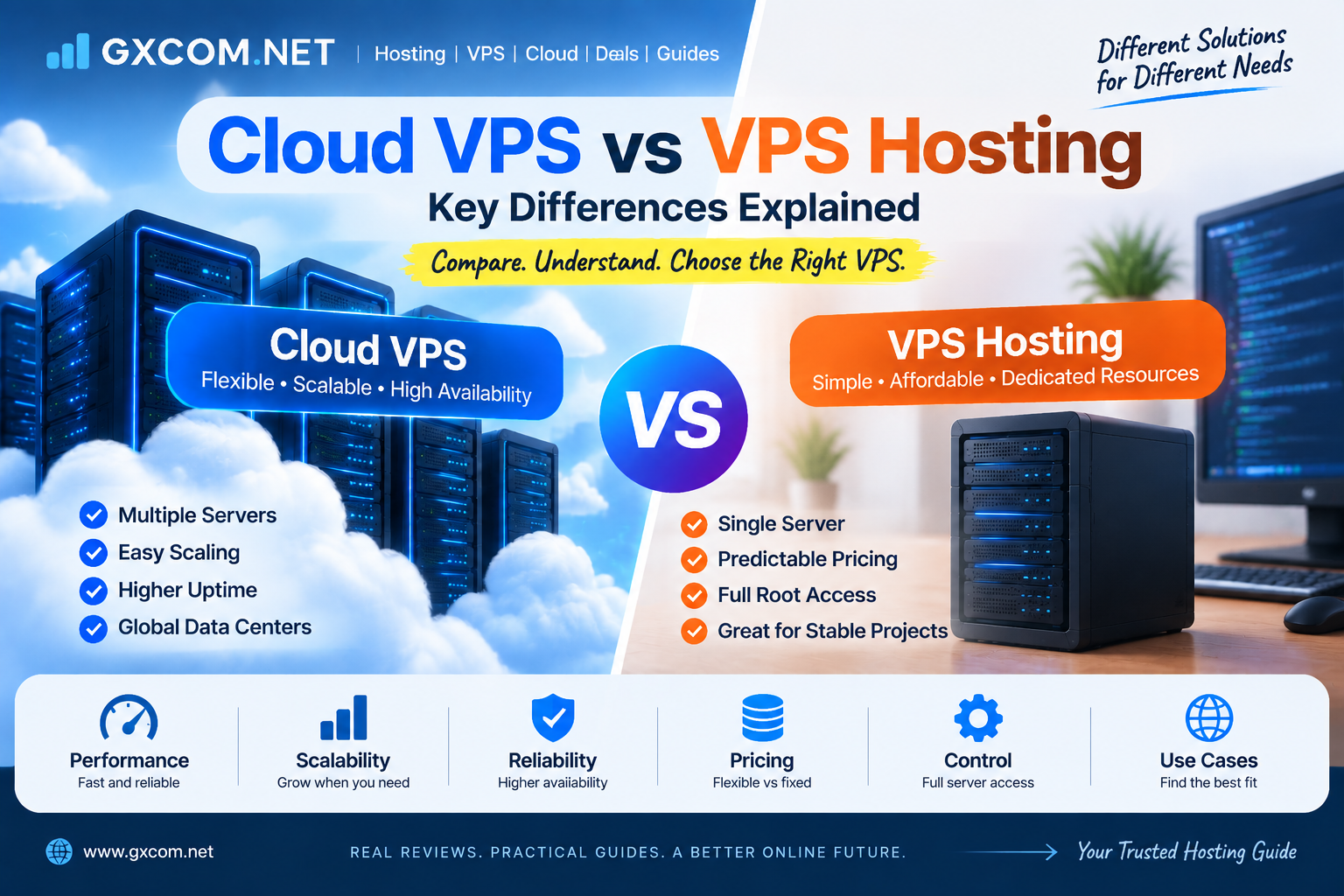
Quick Comparison: Cloud VPS vs VPS Hosting
| 功能 | 云VPS | VPS 主机 |
|---|---|---|
| Infrastructure | Multiple connected cloud servers | Single physical server |
| 可扩展性 | Highly flexible | More limited |
| 可靠性 | Higher availability | Depends on hardware |
| 性能 | Stable and scalable | Depends on host server |
| 定价 | Flexible usage models | Fixed monthly plans |
What Is Cloud VPS Hosting?
Cloud VPS hosting is a virtual private server built on cloud infrastructure.
Instead of relying on one physical machine, cloud VPS uses resources from multiple connected servers to provide better flexibility and availability.
Cloud VPS commonly includes:
- Dedicated virtual CPU and RAM
- SSD 或 NVMe 存储
- 多个数据中心地点
- Flexible resource scaling
- High availability infrastructure
See our complete list of best cloud VPS providers for recommended platforms.
What Is Traditional VPS Hosting?
Traditional VPS hosting divides one physical server into multiple isolated virtual servers.
Each VPS receives allocated resources, including CPU, RAM and storage, but all virtual servers depend on the same physical hardware.
Traditional VPS hosting provides:
- root权限
- Dedicated resources
- Server customization
- Lower cost compared with dedicated servers
Learn more about general VPS solutions in our VPS 托管 指南。.
Main Differences Between Cloud VPS and VPS Hosting
1. Infrastructure Architecture
The biggest difference between cloud VPS and VPS hosting is the underlying infrastructure.
Traditional VPS usually runs on one physical server. If that hardware experiences problems, all VPS instances on that server may be affected.
Cloud VPS uses distributed cloud infrastructure, allowing workloads to operate across multiple servers.
2. Scalability
Cloud VPS has a major advantage in scalability.
Resources such as CPU, RAM and storage can usually be adjusted more easily according to demand.
Traditional VPS often requires upgrading plans or migrating servers when additional resources are needed.
3. Reliability and Uptime
Cloud VPS generally provides higher reliability because it does not rely on a single physical server.
If one server component fails, cloud infrastructure can often redirect resources to available systems.
Traditional VPS reliability depends more heavily on the physical server hosting the VPS.
4. Performance
Both cloud VPS and VPS hosting can provide excellent performance.
Performance depends on:
- CPU 资源
- Memory allocation
- 存储技术
- 网络质量
- 服务器配置
5. Pricing Model
Traditional VPS usually uses fixed monthly pricing.
Cloud VPS providers often provide more flexible pricing based on resources and usage.
Cloud VPS vs VPS Hosting Performance Comparison
| Performance Factor | 云VPS | VPS 主机 |
|---|---|---|
| 速度 | 高 | 高 |
| Traffic Handling | Better for sudden growth | Limited by allocated resources |
| Resource Scaling | 灵活的 | Requires upgrade |
| 可用性 | 更高 | Depends on hardware |
Security Comparison
| Security Feature | 云VPS | VPS 主机 |
|---|---|---|
| Isolation | Virtual isolation | Virtual isolation |
| 备份 | Cloud backup options | Provider dependent |
| 监测 | Advanced options | Basic options |
| Protection | Cloud security tools | Standard VPS security |
Advantages of Cloud VPS
- 更好的可扩展性
- 更高的可靠性
- Flexible resource management
- Multiple server locations
- Suitable for growing applications
Disadvantages of Cloud VPS
- Can cost more
- May require more technical knowledge
- Pricing can be more complex
Advantages of VPS Hosting
- Lower predictable cost
- Simple pricing structure
- Good performance
- Full server control
Disadvantages of VPS Hosting
- Less flexible scaling
- Depends on physical hardware
- Possible resource limitations
Who Should Choose Cloud VPS?
Cloud VPS is suitable for:
- 网站发展
- 电子商务平台
- Web应用程序
- 初创企业
- Businesses needing scalability
Who Should Choose VPS Hosting?
Traditional VPS hosting is suitable for:
- 小型企业网站
- 开发者
- 个人项目
- Users needing affordable server control
Cloud VPS vs VPS Hosting: Which One Is Better?
There is no single answer because the best choice depends on your requirements.
Choose cloud VPS if:
- You need flexible scaling.
- Your website traffic changes frequently.
- You need higher availability.
Choose traditional VPS if:
- You need predictable pricing.
- Your website has stable traffic.
- You want affordable dedicated resources.
最终裁决
Cloud VPS and VPS hosting both provide powerful alternatives to shared hosting, but they are designed for different needs.
Cloud VPS is better for businesses, applications and websites requiring scalability and higher reliability.
Traditional VPS remains an excellent option for users who need affordable server resources and full control.
Before choosing a VPS solution, consider your budget, technical skills and future growth requirements.
常见问题解答
Is cloud VPS better than VPS hosting?
Cloud VPS usually provides better scalability and reliability, while traditional VPS may offer simpler pricing and lower costs.
Is cloud VPS more expensive?
Cloud VPS pricing varies by provider, but flexible resources may result in higher costs depending on usage.
Can beginners use cloud VPS?
Yes, but beginners may prefer managed cloud VPS solutions with easier administration.
Should I choose cloud VPS for my website?
If your website needs growth capacity, better reliability and flexible resources, cloud VPS is a strong choice.