Why Dedicated CPU Matters for Cloud VPS Hosting
A cloud VPS can have enough memory and fast storage yet still feel unpredictable when several virtual machines compete for processor time. Slow database queries, inconsistent API responses, and delayed background jobs may point to CPU contention rather than an undersized application.
A cloud VPS with dedicated CPU aims to provide more predictable compute capacity than a conventional shared-vCPU plan. However, dedicated vCPUs, reserved processor capacity, and exclusive physical cores are not interchangeable promises. Understanding the distinction helps you avoid paying extra for performance your workload cannot use.
Before upgrading, compare your deployment model using our 云托管与VPS对比指南. The right choice depends on sustained demand, latency sensitivity, and how much infrastructure control you need.
Shared vCPU vs Dedicated vCPU: What Changes?
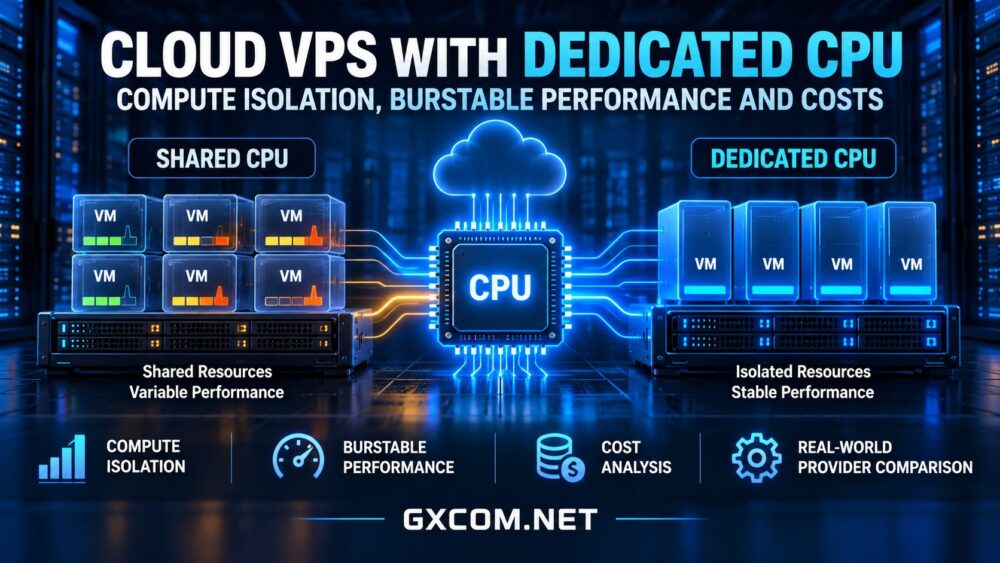
In a virtualized environment, the hypervisor schedules virtual CPUs onto physical processor resources. A shared-vCPU plan allows several tenants to use the same underlying capacity. This improves affordability but may create variable performance when neighboring workloads become busy.
A dedicated-vCPU plan generally offers stronger resource allocation or scheduling guarantees. Depending on the provider, that might mean reserved CPU capacity, dedicated threads, or reduced contention. It does not automatically mean that every vCPU maps to an exclusively owned physical core.
CPU Steal Time and Host Contention
On supported Linux virtual machines, CPU steal time indicates periods when a virtual CPU was ready to run but the hypervisor scheduled other work instead. Elevated steal time during slow requests can suggest host contention. However, low steal time does not prove that an application has sufficient CPU capacity, and monitoring behavior varies by platform.
Review utilization, run queues, application latency, and steal time together. A CPU-bound database can remain slow even without visible contention if queries are inefficient or its allocated compute is insufficient.
Why Core Count Alone Is Misleading
Four vCPUs on different plans may deliver very different throughput. Processor generation, clock behavior, simultaneous multithreading, hypervisor overhead, and allocation policy all matter. More vCPUs can help parallel workloads but may offer little improvement for a single busy application thread.
Burstable CPU vs Sustained Performance
Burstable instances are designed for workloads with relatively low average CPU demand and occasional peaks. Some platforms use CPU credits; others apply different baseline or throttling policies. A short benchmark may look excellent even when sustained performance is limited by the plan’s rules.

Dedicated-capacity plans can be better suited to continuously busy services, but the precise guarantee must be checked. A label such as high frequency, dedicated CPU, or optimized compute should never replace a review of the provider’s resource documentation.
Consider a hypothetical application that uses little CPU overnight but reaches high utilization during a brief daily reporting job. Burstable compute might be economical. By contrast, an API worker pool processing requests throughout the day may benefit more from predictable sustained capacity.
Cloud VPS Providers Worth Comparing
The following providers offer useful starting points for evaluating cloud compute. Their product families, CPU allocation rules, availability, and pricing differ. Verify the exact instance description before assuming dedicated physical cores or unrestricted processor use.
Vultr: Dedicated-CPU Cloud Options
Vultr is a relevant comparison for buyers evaluating dedicated-CPU cloud instances alongside more general cloud compute. Check the current product family, regional availability, processor information, and whether the advertised allocation matches your application’s continuous load profile.
Akamai Cloud: Shared and Dedicated Compute Choices
Akamai Cloud(原名 Linode) provides a useful contrast between general-purpose shared compute and dedicated CPU offerings. Evaluate memory ratios, deployment regions, storage characteristics, and the documented CPU allocation model rather than selecting solely by vCPU count.
OVHcloud: VPS and Broader Compute Infrastructure
OVHcloud is worth assessing when comparing VPS affordability with more isolated cloud or dedicated infrastructure. Do not assume its standard VPS packages provide dedicated physical cores. Identify the specific product tier and its guarantees before treating it as equivalent to a dedicated-vCPU instance.
Kamatera: Configurable Cloud Server Resources
卡马特拉 appeals to teams that want configurable cloud server resources. Its flexibility makes it useful for right-sizing exercises, but configuration choices alone do not establish exclusive CPU ownership. Confirm the scheduling and resource commitments for the selected configuration.
For a broader shortlist, review our 最佳VPS服务商对比 and narrow the options to services whose documented compute policies fit your workload.
How to Benchmark Compute Isolation Properly
Testing a VPS for only a minute can reward temporary boost behavior rather than reliable production performance. Build a repeatable test that reflects your application’s actual request patterns and operating hours.
- Establish a baseline: Record CPU utilization, memory pressure, run queues, and application response times on your current instance.
- Test sustained load: Run representative CPU-heavy tasks long enough to observe throttling, changing clock behavior, or performance degradation.
- Measure tail latency: Compare p95 and p99 request latency, not only average throughput, particularly for APIs and checkout flows.
- Repeat across periods: Run tests at different times to identify variability that a single benchmark might miss.
- Check other bottlenecks: Review disk latency, network behavior, and database waits before attributing every slowdown to CPU sharing.
Storage can mask processor improvements. Our NVMe VPS 性能指南 explains why disk responsiveness should be evaluated separately from compute capacity.
Understanding the Real Cost of Dedicated CPU
The premium for stronger CPU allocation is worthwhile only when it produces measurable business value. Calculate the total monthly expense, including instance charges, attached storage, backups, bandwidth, licensing, and any managed support. Compare costs at realistic utilization levels rather than peak specifications alone.
For illustration, suppose a shared instance costs an assumed $20 monthly and a dedicated-capacity alternative costs an assumed $45. The extra $25 is justified only if reduced latency, greater throughput, or fewer performance incidents matter enough to offset it. These figures are hypothetical, not provider quotes.
Before committing, inspect current 经济实惠的云VPS优惠 and compare renewal terms, transfer allowances, backup charges, and upgrade flexibility. Promotional entry pricing can obscure the long-term operating cost.
When Should You Upgrade?
Choose shared-vCPU hosting for development environments, modest websites, low-duty applications, and services that tolerate occasional variability. Consider dedicated-vCPU capacity when sustained utilization is high, p95 latency matters, or monitoring repeatedly shows contention affecting users.
If you need complete hardware isolation, unusually strict performance requirements, or specialized processor control, evaluate bare metal instead. Dedicated vCPUs remain virtual resources unless the provider explicitly documents stronger physical isolation.
Management requirements also affect the decision. A dedicated-CPU instance does not automatically include operating-system patching, incident response, or application administration. Teams needing those services should compare options in our 托管云主机对比.
最终裁决
A cloud VPS with dedicated CPU can improve performance consistency, especially for workloads that consume processor resources continuously. But the value comes from a verified allocation policy and measurable results, not the word dedicated on a pricing page.
Start with production metrics, test sustained performance, confirm the provider’s CPU guarantees, and calculate the complete recurring cost. The best purchase is the smallest configuration that consistently meets your latency, throughput, reliability, and operational requirements.