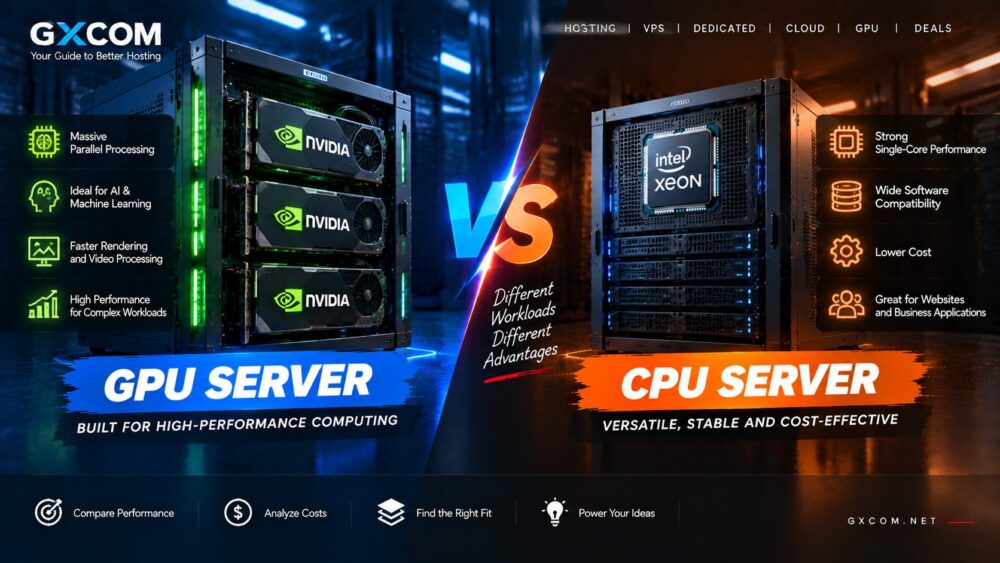
在以下两者之间做出选择: GPU Server vs CPU Server depends on the type of workload you need to run. While CPU servers remain the foundation of traditional computing, GPU servers have become increasingly important for artificial intelligence, machine learning, rendering and other highly parallel workloads.
A CPU server is designed for general-purpose computing tasks that require strong single-thread performance and flexible application support. A GPU server adds specialized graphics processing units that can execute thousands of parallel operations simultaneously.
The better choice depends on your application. Websites, databases and business software often perform well on CPU servers, while AI training, deep learning and scientific computing may benefit significantly from GPU acceleration.
This guide compares GPU servers and CPU servers across performance, cost, scalability, applications and real-world use cases.
Last updated: September 20, 2026. GPU availability, hardware specifications and pricing vary by provider. Always compare current configurations before purchasing.
GPU Server vs CPU Server: Quick Comparison
| 功能 | CPU 服务器 | GPU服务器 |
|---|---|---|
| 主处理器 | Central Processing Unit | CPU + Graphics Processing Units |
| 最适合 | 通用计算 | Parallel computing workloads |
| Performance Strength | Sequential processing | Massive parallel processing |
| 成本 | 较低 | 更高 |
| Power Usage | 较低 | 更高 |
| 常见用途 | Websites, databases, applications | AI, ML, rendering, scientific computing |
What Is a CPU Server?
A CPU server is a traditional server built around one or more central processing units. The CPU handles general computing operations and is optimized for tasks that require complex decision-making, sequential processing and broad software compatibility.
CPU servers are widely used because they support almost every type of application.
Common CPU server workloads include:
- 网站托管
- 数据库系统
- 商业应用
- File servers
- Email platforms
- Virtualization environments
- 企业软件
什么是 GPU 服务器?
A GPU server combines traditional CPUs with one or more graphics processing units designed for parallel computing.
Modern GPUs contain thousands of smaller processing cores that can perform many calculations simultaneously.
This architecture makes GPU servers highly effective for workloads where large numbers of similar calculations must be processed at the same time.
Common GPU server workloads include:
- 人工智能培训
- 机器学习模型
- 大型语言模型
- 3D渲染
- 视频处理
- 科学模拟
- 数据分析
Performance Comparison: GPU Server vs CPU Server
The biggest difference between GPU and CPU servers is how they process information.
CPUs contain fewer but more powerful cores designed for complex general-purpose operations.
GPUs contain many smaller cores optimized for performing large numbers of similar calculations simultaneously.
例如:
- A database query may benefit from CPU optimization.
- Training a neural network may benefit from thousands of GPU parallel operations.
A GPU server is not automatically faster for every workload. Performance depends on whether the software can take advantage of GPU acceleration.
Architecture Difference Between CPU and GPU Servers
CPU servers focus on flexible computing.
A typical CPU architecture includes:
- High-performance processing cores
- Large cache memory
- Advanced instruction handling
- Broad software compatibility
GPU servers add specialized accelerators:
- Thousands of parallel cores
- High-speed GPU memory
- AI acceleration features
- Parallel computation capability
The difference is similar to using a highly skilled individual worker versus a large team performing the same repetitive task.
Cost Comparison: GPU Server vs CPU Server
GPU servers usually cost significantly more because GPUs are specialized hardware components with high demand.
| 服务器类型 | 成本水平 | 典型用户 |
|---|---|---|
| CPU 服务器 | 较低 | Websites, applications, databases |
| GPU服务器 | 更高 | AI, ML and advanced computing |
The correct comparison should focus on cost per completed workload rather than monthly server price alone.
A GPU server may complete an AI training task much faster than a CPU server, reducing total computing time.
GPU Server vs CPU Server for Artificial Intelligence
Artificial intelligence is one of the biggest reasons GPU servers have become popular.
Machine learning models require enormous numbers of mathematical calculations. GPUs are designed to accelerate these parallel operations.
GPU服务器通常用于:
- 深度学习训练
- AI推理
- 自然语言处理
- 计算机视觉
- 生成式人工智能应用
For AI workloads, the GPU model is extremely important. NVIDIA A100, H100 and newer accelerators provide different levels of performance, memory and cost.
探索我们的 AI服务器 section for more AI infrastructure guides.
GPU Server vs CPU Server for Websites
Most websites do not require GPU acceleration.
Traditional websites, content platforms and online stores usually perform well with CPU-based servers because their workloads involve:
- 数据库查询
- PHP processing
- Content delivery
- Application logic
A GPU server would increase costs without providing meaningful benefits for most standard websites.
GPU Server vs CPU Server for Gaming
Gaming servers require careful hardware selection.
Game hosting itself often relies heavily on CPU performance because game engines frequently depend on fast single-thread processing.
However, game development, rendering and AI-related gaming workloads may benefit from GPU acceleration.
GPU Server vs CPU Server for Video Rendering
Video rendering and 3D workloads can benefit significantly from GPU acceleration.
GPU servers can reduce processing time for:
- 3D animation
- Video encoding
- Visual effects
- Real-time rendering
Professional creators and studios often select GPU infrastructure because rendering time directly affects production efficiency.
可扩展性比较
CPU servers are easier to scale for traditional applications because most software is designed around CPU computing.
GPU scaling requires more specialized planning.
Important GPU scaling factors include:
- GPU model availability
- GPU内存容量
- Number of accelerators
- Power requirements
- Software optimization
Cloud GPU platforms can provide flexible access to GPU resources, while dedicated GPU servers provide predictable long-term performance.
GPU Server vs CPU Server: Which Is More Energy Efficient?
Energy efficiency depends on the workload.
A CPU server may consume less power for general tasks.
A GPU server may consume more electricity but complete certain workloads much faster.
For AI training or large-scale computation, completing a task faster can improve overall efficiency despite higher peak power usage.
安全性对比
Security depends more on server configuration than whether the machine uses CPU or GPU hardware.
Both CPU and GPU servers can support:
- Private environments
- 防火墙保护
- Access controls
- Encrypted storage
Organizations should evaluate security architecture, monitoring and operational practices.
When Should You Choose a CPU Server?
A CPU server is usually the right choice when running:
- 网站
- 数据库
- 商业软件
- API
- 虚拟机
- Traditional applications
CPU servers provide excellent value for general-purpose workloads.
When Should You Choose a GPU Server?
A GPU server is better suited for workloads requiring massive parallel computation.
Choose GPU infrastructure for:
- AI模型训练
- 机器学习
- LLM development
- 科学计算
- 渲染工作负载
- GPU-accelerated applications
GPU Server vs CPU Server: Which One Should You Choose?
| Choose CPU Server If | Choose GPU Server If |
|---|---|
| You run websites or databases | You build AI models |
| You need general computing | You need parallel processing |
| You want lower cost | You need acceleration |
| Your software is CPU optimized | Your software supports GPU computing |
GPU Server vs CPU Server: Final Checklist
该 GPU Server vs CPU Server decision depends entirely on your workload.
CPU servers remain the best choice for most traditional applications because they provide flexibility, compatibility and lower costs.
GPU servers provide enormous advantages for AI, machine learning, rendering and other parallel computing workloads.
Before purchasing, analyze your software requirements, performance goals and budget to select the right infrastructure.
GXCOM.NET will continue publishing GPU and server comparison guides to help users choose the right computing solution.