A managed cloud hosting SLA can influence how quickly your business receives assistance when a website, application, or database becomes unavailable. However, a 99.9% uptime commitment and a promise of 24/7 technical support do not necessarily guarantee immediate recovery.
Businesses evaluating managed cloud providers should understand the differences between availability guarantees, first response times, resolution targets, and financial remedies. These terms determine what customers can reasonably expect during an incident.
This guide explains essential SLA provisions and compares the support considerations associated with Cloudways, ScalaHosting, KnownHost, and UltaHost.
What Is a Managed Cloud Hosting SLA?
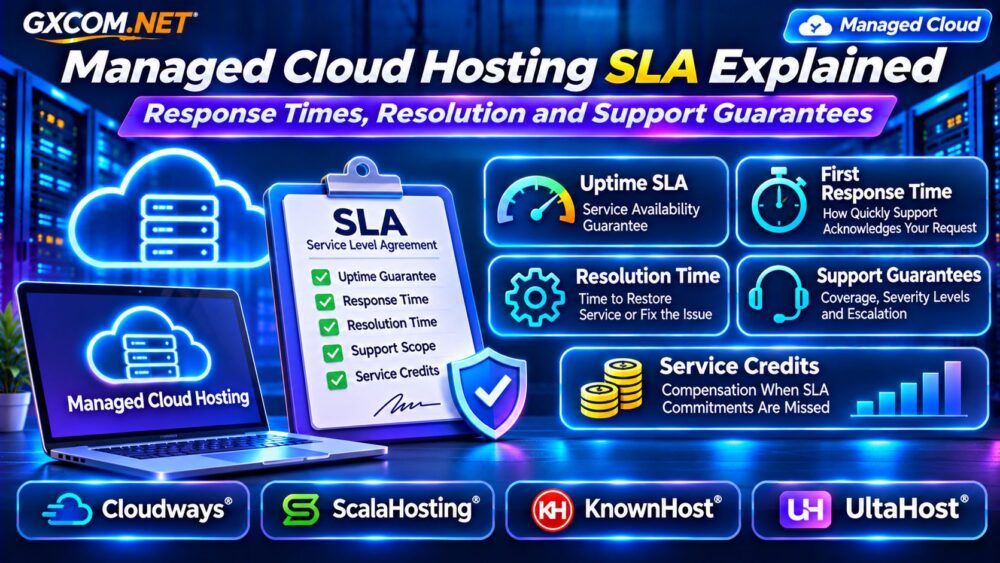
A service level agreement (SLA) defines measurable service commitments between a hosting provider and its customer. Depending on the contract, these may cover infrastructure availability, support responsiveness, incident handling, and service credits.
Managed cloud hosting also involves operational responsibilities, such as server monitoring, software maintenance, security updates, or troubleshooting. However, the exact management scope varies considerably between providers and plans.
An SLA should identify which services are covered, how performance is measured, and what happens when commitments are missed.
Uptime SLA vs Support SLA: Key Differences
An uptime SLA concerns service availability. A support SLA addresses how the provider handles customer requests or incidents.
For example, a provider may advertise 99.9% monthly infrastructure availability while offering continuous access to a support desk. Neither statement automatically guarantees that every critical ticket will be resolved within a specified period.
Buyers should examine both commitments separately. Infrastructure reliability matters, but so does the provider’s ability to diagnose problems and communicate effectively.
如需了解更全面的采购概况,请参阅我们的 托管云主机对比.
First Response Time vs Resolution Time
First response time measures how long it takes the support team to provide an initial qualifying response after receiving a request.
Resolution time measures how long it takes to restore service or resolve the reported issue, depending on the contract’s definition.
These measurements are not interchangeable. A technician may acknowledge a critical incident quickly while the underlying problem requires several hours of investigation.
Some agreements provide response targets without contractual resolution guarantees. Others distinguish between temporary workarounds and permanent fixes.
Ask whether the initial response must come from a qualified technician or whether an automated acknowledgment counts.
How Incident Severity Changes Support Priorities
Managed hosting providers may classify incidents by severity, business impact, or urgency.
- 重要: Complete production outage or severe service disruption.
- 高: Major functionality affected without a complete outage.
- Medium: Partial degradation or a noncritical technical issue.
- 低: General questions, configuration requests, or minor problems.
These categories are illustrative; actual definitions differ between providers.

Review who assigns severity, whether customers can request escalation, and whether response commitments apply outside business hours.
For revenue-generating applications, an escalation procedure can be as important as the headline response target.
What Does a 99.9% Uptime Guarantee Mean?
A 99.9% monthly availability target permits approximately 43.2 minutes of unavailability in a hypothetical 30-day month, assuming continuous measurement and no exclusions.
A 99.95% target corresponds to approximately 21.6 minutes, while 99.99% corresponds to roughly 4.3 minutes.
These calculations describe mathematical availability thresholds, not guarantees of maximum individual outage duration.
Actual SLA measurement may exclude scheduled maintenance, customer configuration errors, third-party services, or other specified events.
Read the availability formula carefully before comparing percentages.
Service Credits: What Happens When an SLA Is Missed?
Many hosting agreements offer service credits when qualifying availability commitments are missed. Credits generally reduce eligible future service charges rather than reimburse the customer’s full business losses.
Some contracts require customers to submit claims within a defined period and provide incident evidence.
Review credit caps, eligibility rules, claim deadlines, and whether credits apply to infrastructure, management fees, or both.
A substantial-looking SLA percentage provides limited financial protection if the available remedy is small or difficult to claim.
Managed Cloud Hosting Providers to Evaluate
1. Cloudways: Managed Cloud Operations
Cloudways is relevant for teams seeking managed cloud infrastructure and application-oriented administration.
When evaluating its service, review the support level included with the selected plan, escalation options, backup provisions, and responsibilities involving the underlying infrastructure.
Confirm which availability commitments apply to the specific service and whether additional support products change the scope of assistance.
2. ScalaHosting: Managed VPS Support
ScalaHosting is an option for businesses comparing managed VPS resources with technical administration.
Examine server management coverage, security maintenance, backup responsibilities, and the provider’s applicable uptime and support policies.
Distinguish routine administration from emergency application troubleshooting, since the two may have different service boundaries.
3. KnownHost: Managed Infrastructure
KnownHost offers managed hosting options worth considering for organizations prioritizing technical assistance and predictable operational responsibilities.
Compare the exact product’s management coverage, support channels, incident escalation process, and availability terms.
Do not assume that every hosting product shares identical contractual commitments or restoration procedures.
4. UltaHost:托管型VPS要求
UltaHost may suit businesses evaluating managed VPS hosting and associated support services.
Review whether the selected plan includes operating system management, application assistance, backups, and proactive monitoring.
Ask which failures fall within the provider’s responsibility and how critical incidents are prioritized.
Support Responsibilities: What Is Actually Managed?
The word “managed” does not establish a universal support standard.
One provider may manage operating system updates and server security while leaving application code, third-party plugins, and database queries to the customer.
Another may offer additional application assistance through a separate service.
Before purchasing, request a written responsibility matrix covering infrastructure, operating systems, web servers, databases, backups, security incidents, and application troubleshooting.
Businesses considering greater administrative control can review our 托管型与非托管型VPS指南.
SLA Guarantees vs Business Recovery Objectives
An uptime commitment does not replace disaster recovery planning.
Recovery Time Objective (RTO) describes the targeted duration for restoring a service. Recovery Point Objective (RPO) describes the acceptable amount of data loss measured in time.
Neither objective is automatically guaranteed by a hosting SLA.
Businesses operating payment systems, customer databases, or critical applications should assess backup frequency, restoration testing, redundancy, and incident communication.
Explore architectural considerations in our 高可用性云服务器指南.
How to Compare Managed Cloud Hosting Costs
The cheapest monthly subscription may not provide the most appropriate support coverage.
Consider a hypothetical managed cloud plan costing $80 monthly and another costing $110. The $30 difference equals $360 annually.
If the higher-priced service includes operational assistance your business would otherwise purchase separately, the additional expense may be justified.
These prices are illustrative and do not represent current provider quotations.
Compare support scope, management fees, backups, monitoring, restoration assistance, and escalation availability before calculating total cost.
Managed Cloud Hosting SLA Buying Checklist
- Confirm the exact uptime measurement and exclusions.
- Distinguish initial response targets from resolution commitments.
- Review incident severity definitions and escalation procedures.
- Identify infrastructure and application management responsibilities.
- Check service credit eligibility and claim deadlines.
- Verify backup, restoration, and disaster recovery arrangements.
- Calculate total hosting and support costs.
For additional infrastructure choices, consult our 最佳云托管解决方案 比较。.
常见问题解答
Does 24/7 Support Guarantee Immediate Resolution?
No. Continuous support availability does not necessarily establish a contractual repair deadline.
Is 99.99% Uptime Always Better Than 99.9%?
A higher availability target may be attractive, but exclusions, measurement methods, service scope, and remedies also matter.
Can Managed Cloud Hosting Prevent Every Outage?
No. Managed services can reduce operational burdens, but infrastructure failures, application defects, and external dependencies remain possible.
最终裁决
A managed cloud hosting SLA should be evaluated as a complete operational agreement rather than a single uptime percentage.
比较 Cloudways, ScalaHosting, KnownHost, and UltaHost using their current plan-specific support policies, availability commitments, escalation procedures, and management responsibilities.
Choose the provider whose documented service commitments match your application’s business impact, recovery requirements, and operating budget.