发现有价值的事物 VPS hosting deals for Docker means looking beyond the cheapest advertised server. Docker containers share the host operating system kernel, but they still consume real CPU time, memory, disk space, and network resources. An undersized VPS can cause failed deployments, slow applications, and unexpected upgrade costs.
Whether you run Docker Compose, self-hosted applications, development environments, or a small SaaS platform, the right VPS should provide enough capacity without unnecessary spending. This guide compares Docker resource requirements, suitable hosting providers, and practical monthly container costs.
What Makes a VPS Suitable for Docker?
Docker works well on compatible Linux VPS environments with appropriate kernel features, storage drivers, and container permissions. However, not every low-cost virtual server provides the same virtualization capabilities or administrative access.
Before purchasing, confirm that the provider supports Docker Engine, your preferred Linux distribution, and the networking features required by your applications.
Full root access is useful for installing Docker, configuring firewalls, managing volumes, and troubleshooting services. Also consider whether you can maintain the operating system securely.
我们的 托管型与非托管型VPS指南 说明了相关职责。.
How Much RAM Does Docker VPS Hosting Need?
Docker itself can run with modest resources, but actual memory requirements depend on the containers. A reverse proxy may consume relatively little RAM, while databases, search engines, and Java applications can require substantially more.
Use the following planning ranges as starting points, not guaranteed container capacities.
| VPS 内存 | Illustrative Workload |
|---|---|
| 2GB | Lightweight testing and small services |
| 4GB | Small Docker Compose application stack |
| 8GB | Several services with a modest database |
| 16GB+ | Heavier applications and multiple environments |
Reserve memory for Linux, filesystem cache, monitoring, and traffic spikes. Allocating every available gigabyte to containers leaves little room for unexpected demand.
Docker Memory Limits and OOM Errors
Containers do not automatically receive dedicated memory allocations. Without suitable limits, one application can consume enough RAM to destabilize other services.
Docker supports memory controls through Linux control groups, commonly called cgroups. Administrators can configure container limits and monitor consumption using Docker tools.
When memory is exhausted, the operating system may terminate processes through the out-of-memory mechanism. Repeated OOM events indicate that application tuning, memory allocation, or VPS capacity needs attention.
Set realistic limits, monitor peak usage, and avoid treating configured memory ceilings as additional physical RAM.

Shared vCPU vs Dedicated CPU for Containers
Docker containers compete for CPU resources according to workload demand and scheduling policies. Shared-vCPU hosting can be economical for applications with occasional processing spikes.
However, sustained builds, background workers, data processing, and busy APIs may suffer when physical CPU resources are heavily contended.
Compare processor generation, vCPU allocation, sustained performance policies, and available monitoring metrics. A higher advertised vCPU count does not necessarily guarantee better throughput.
For troubleshooting CPU contention, read our VPS CPU Steal Time Guide.
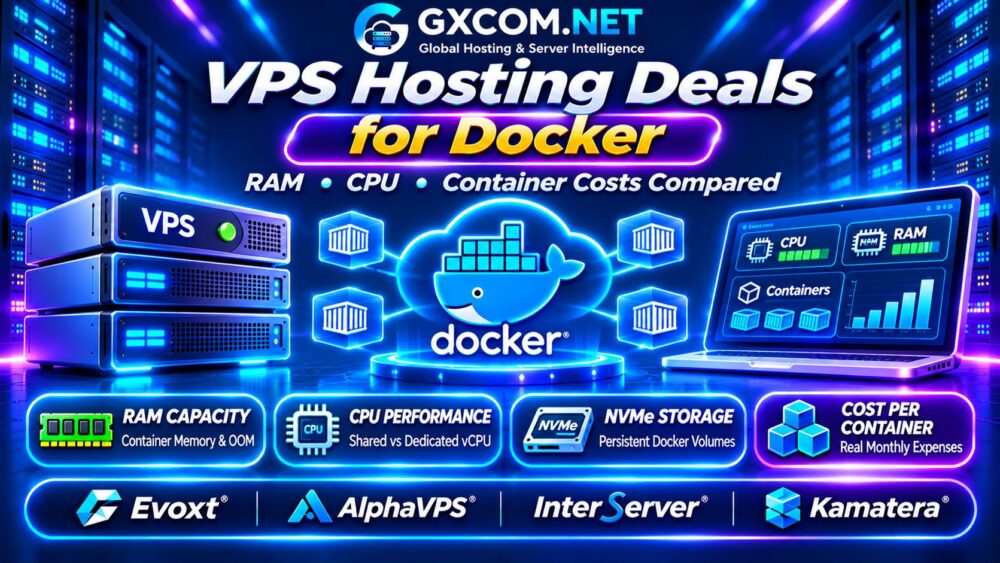
四家值得对比的 Docker VPS 服务商
Evoxt: Budget Linux VPS Deployments
Evoxt is worth evaluating for developers seeking affordable Linux VPS resources. Compare available RAM, CPU, storage, locations, and monthly billing options.
Confirm Docker compatibility for the selected virtualization environment and include any backup charges in your budget.
AlphaVPS: Self-Managed Container Hosting
AlphaVPS is relevant to Linux administrators comfortable configuring their own container infrastructure. Review virtualization support, available memory, storage capacity, and network allowances.
Check the exact plan’s billing period and whether promotional configurations remain available.
InterServer: VPS for Persistent Applications
InterServer is another candidate for Docker applications that need ongoing server resources. Evaluate CPU allocation, memory upgrades, operating system choices, and storage requirements.
Ask about backup availability and confirm whether the selected service includes management assistance.
Kamatera: Configurable Cloud VPS Resources
卡马特拉 is relevant to teams seeking configurable cloud infrastructure for containerized applications. Compare CPU, RAM, storage, server locations, and billing arrangements.
Flexible configurations can be useful during growth, but additional services and resource increases may raise operating expenses.
These providers are comparison candidates, not verified offers of active Docker-specific discounts. Explore our 最佳VPS服务商对比 for broader purchasing context.
NVMe Storage and Docker Persistent Volumes
Container images, build caches, application logs, and persistent volumes all consume storage. Databases are particularly sensitive to disk latency and sustained I/O performance.
NVMe storage may improve demanding workloads, but actual performance depends on the underlying hardware and resource-sharing policies.
Keep important application data in appropriately managed persistent volumes. Container recreation should not accidentally destroy production databases or uploaded files.
我们的 NVMe VPS 与 SSD 性能对比指南 covers relevant storage considerations.
Calculate Real Docker Container Hosting Costs
Counting containers alone does not measure hosting efficiency. A lightweight monitoring container and a busy database may have dramatically different resource requirements.
Consider two hypothetical VPS configurations:
| 每月费用 | VPS A | VPS B |
|---|---|---|
| Base hosting | $12 | $22 |
| 备份 | $3 | $4 |
| 总计 | $15 | $26 |
| Usable application containers | 5 | 10 |
| Cost per container | $3.00 | $2.60 |
VPS B has a higher monthly bill but a lower illustrative cost per container. This comparison assumes workloads of comparable size and excludes administration, taxes, and external services.
Never assume that ten containers will fit simply because ten were used in a pricing example. Measure real CPU, RAM, and disk consumption.
Docker Compose vs Managed Container Platforms
Docker Compose simplifies running multiple related services on one VPS. It can be economical for predictable workloads, but administrators must manage updates, monitoring, networking, and recovery.
Managed container platforms may reduce operational effort while introducing additional service charges or different scaling models.
For small projects, a single VPS can be practical. Growing production systems may eventually need separate databases, load balancing, or multiple application nodes.
Hidden Docker VPS Expenses
Budget for backups, snapshots, additional storage, control panels, monitoring, and outbound bandwidth. Also account for the time required to maintain images, patch vulnerabilities, and restore services.
请查看我们的 VPS 快照与备份恢复指南 before choosing a backup strategy.
Docker VPS Buying Checklist
- Verify Docker Engine and Linux kernel compatibility.
- Estimate peak RAM consumption with host headroom.
- Compare sustained CPU performance, not only vCPU counts.
- Check NVMe capacity and persistent volume requirements.
- Include backups, bandwidth, and renewal costs.
- Confirm upgrade options and cancellation conditions.
常见问题解答
Is 2GB RAM Enough for Docker?
It can support lightweight services, but databases and larger application stacks may require substantially more memory.
Can Docker Run on a Cheap VPS?
Yes, when the VPS supports the necessary kernel features and provides sufficient resources for the intended workloads.
How Many Docker Containers Can One VPS Run?
There is no universal number. Capacity depends on each container’s resource consumption, concurrency, and required performance.
最终裁决
The best VPS hosting deals for Docker balance memory capacity, sustained CPU performance, reliable storage, and transparent operating costs.
比较 Evoxt, AlphaVPS, InterServer, and Kamatera using your actual container stack rather than advertised specifications alone. Choose the VPS that delivers dependable application performance at a sustainable total monthly cost.