Using Proxmox for game servers can simplify the management of multiple Minecraft, Rust, ARK, and other multiplayer environments on one physical machine. Instead of installing every game service directly on the host, administrators can separate workloads into virtual machines or Linux containers.
However, virtualization does not create additional CPU capacity or memory. Poor resource allocation can cause lag, storage contention, and unexpected hosting expenses. This guide explains how Proxmox VE works for gaming infrastructure, when KVM or LXC makes sense, and how to evaluate dedicated server costs.
What Is Proxmox VE for Game Server Hosting?
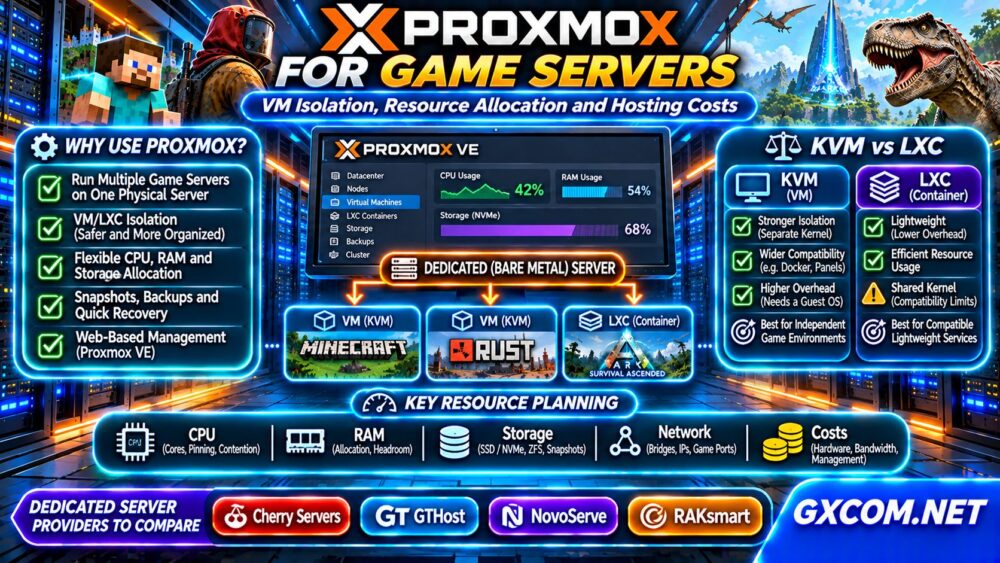
Proxmox Virtual Environment is a virtualization management platform built around KVM virtual machines and Linux containers. It provides a web interface for managing guest systems, storage, networking, backups, and resource assignments.
For game hosting, administrators can create separate environments for different communities or applications. A Minecraft server might run inside one Linux VM, while Rust and supporting services operate in other guests.
This arrangement improves administrative separation, but every guest still shares the underlying physical hardware unless resources are specifically reserved.
KVM vs LXC: Which Is Better for Game Servers?
| 功能 | KVM Virtual Machine | LXC Container |
|---|---|---|
| 内核 | Separate guest kernel | Shares host kernel |
| 隔离 | Stronger virtualization boundary | OS-level isolation |
| Overhead | Guest OS resources required | Generally lighter |
| Docker 工作负载 | Usually simpler to support | Additional compatibility considerations |
| 最佳匹配 | Independent game environments | Compatible lightweight services |
KVM is often preferable when different administrators need separate operating systems or when a game management platform depends on Docker. LXC can reduce overhead, but its shared-kernel architecture introduces different security and compatibility considerations.
Neither option guarantees better gameplay performance without appropriate resource planning.
How to Allocate CPU Cores in Proxmox
Proxmox allows administrators to assign virtual CPUs and configure scheduling behavior. These settings influence how guests compete for physical processing time.
A VM assigned eight vCPUs does not automatically receive eight exclusive physical cores. CPU oversubscription can work for lightly loaded services, but simultaneous game workloads may create contention.
For CPU-sensitive servers, consider limiting oversubscription, monitoring busy threads, and evaluating CPU affinity or pinning where appropriate.

Minecraft often benefits from strong single-thread performance. Rust and ARK have different processing demands, so benchmark actual workloads before allocating resources.
我们的 CPU Steal Time VPS Troubleshooting Guide explains related scheduling symptoms.
RAM Allocation: Avoid Overcommitting Memory
Memory planning should include the Proxmox host, guest operating systems, game processes, management tools, and filesystem caching.
For example, a dedicated server with 64 GB RAM should not automatically assign all 64 GB to game VMs. The host and storage services need their own capacity.
Memory ballooning and overcommitment can be useful in certain environments, but game servers with unpredictable peaks may suffer when available memory becomes constrained.
Monitor actual usage during world generation, player activity, backups, and scheduled updates. Keep sufficient headroom for simultaneous demand rather than sizing every guest around average consumption.
Storage Performance: SSD, NVMe, and ZFS
Game worlds, databases, logs, plugins, and backups generate storage activity. Running several virtual machines on one device can concentrate I/O demand.
NVMe storage may improve responsiveness, but sustained performance depends on the drive, workload, controller, and storage configuration.
ZFS offers useful data integrity and snapshot capabilities, although its memory and operational requirements must be considered. Avoid assuming that snapshots alone provide complete backup protection.
有关恢复计划,请参阅我们的 VPS 快照与备份恢复指南.
Network Isolation and Game Server Ports
Proxmox supports virtual bridges and other networking configurations that connect guests to physical networks. Administrators must plan IP addressing, routing, firewall policies, and game-specific ports.
Different game servers may require separate TCP or UDP allocations. Avoid exposing the Proxmox management interface directly to the public internet without appropriate protections.
Use secure administrative access, restricted firewall rules, strong credentials, and timely security updates. If guests serve different communities, separate their administrative permissions and network access.
Running Pterodactyl with Proxmox
Pterodactyl can complement Proxmox by managing game instances inside an appropriately configured Linux VM. Proxmox manages the virtual infrastructure, while Pterodactyl Panel and Wings manage supported game containers.
Wings relies on Docker, making a conventional KVM-based Linux VM a straightforward architecture to evaluate. Docker inside LXC can require additional privileges or configuration and may introduce support complications.
Test Docker networking, game ports, resource limits, and backup procedures before migrating production servers.
How Much Does Proxmox Game Hosting Cost?
Proxmox VE software availability does not eliminate infrastructure expenses. Budget for dedicated hardware, storage, bandwidth, backups, administration, and any optional support or subscription services.
A single physical server may be economical when several communities share its resources. However, consolidation also creates a common failure point: hardware downtime can interrupt every hosted game.
Compare total ownership costs rather than dividing the advertised server price by the number of virtual machines.
Four Dedicated Server Providers to Compare
Cherry 服务器, GTHost, NovoServe, ,以及 RAKsmart are relevant providers to investigate for bare-metal or dedicated infrastructure. Confirm the specific product’s operating-system installation options and virtualization permissions.
Cherry 服务器
Evaluate available processor configurations, RAM capacity, storage options, and bare-metal management features for multi-VM deployments.
GTHost
Compare dedicated hardware, server locations, network policies, and remote management capabilities before planning a Proxmox installation.
NovoServe
Review regional infrastructure options, bandwidth terms, storage configurations, and support responsibilities for communities serving European or North American players.
RAKsmart
Investigate dedicated server availability, processor specifications, storage, and virtualization compatibility for your intended deployment region.

Compare broader infrastructure choices in our 裸机服务器对比.
Proxmox vs Managed Game Hosting
Proxmox provides flexibility for administrators comfortable maintaining operating systems, networking, security, and recovery procedures. Managed game hosting reduces infrastructure responsibilities but may offer less control over virtualization.
For a single small community, managed hosting can be simpler. For multiple independent workloads, dedicated hardware with Proxmox may justify the additional administration.
探索我们的 游戏托管服务对比 以及 专用服务器与VPS对比指南 在做出选择之前。.
常见问题解答
Is Proxmox Good for Minecraft Servers?
Yes, when the host provides sufficient CPU, RAM, and storage performance. Virtualization does not eliminate Minecraft’s main-thread limitations.
Can Proxmox Run Multiple Game Servers?
Yes. Separate VMs or compatible containers can host different workloads, provided physical resources and networking are planned correctly.
Is Proxmox Free for Game Hosting?
Proxmox VE can be used without a paid subscription, but hardware, hosting, backups, maintenance, and optional support still cost money.
最终裁决
Proxmox is a practical option for managing multiple game servers on dedicated hardware when isolation and administrative control matter. Prefer KVM for independent Docker-based environments, reserve CPU and RAM headroom, protect management access, and evaluate total hosting costs before consolidating production communities.