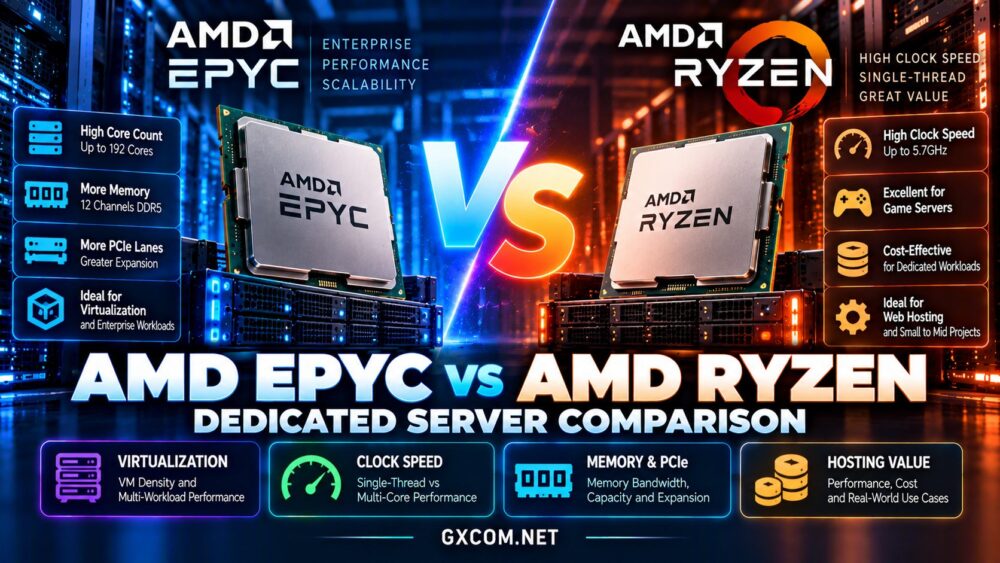
Buying a dedicated server with two processors sounds like an obvious upgrade over a single-CPU machine. But two sockets do not automatically deliver twice the performance. Memory placement, application scaling, software licensing, and server architecture can make a powerful dual-socket system less economical than a modern single-socket alternative.
这个 single-socket vs dual-socket server comparison examines NUMA latency, CPU performance, memory capacity, virtualization density, and hosting costs. The goal is to help you select hardware that matches your workload rather than paying for processor capacity you cannot effectively use.
Single-Socket vs Dual-Socket Server: Quick Verdict
Choose a single-socket server when one modern processor provides sufficient cores, RAM, and PCIe connectivity. It is often the simpler choice for web hosting, smaller virtualization environments, game servers, and latency-sensitive applications.
Choose a dual-socket server when your workload genuinely requires additional memory capacity, aggregate CPU resources, or expansion capabilities beyond a suitable single-socket configuration.
For a broader purchasing overview, see our 专用服务器托管指南.
What Is a Single-Socket Server?
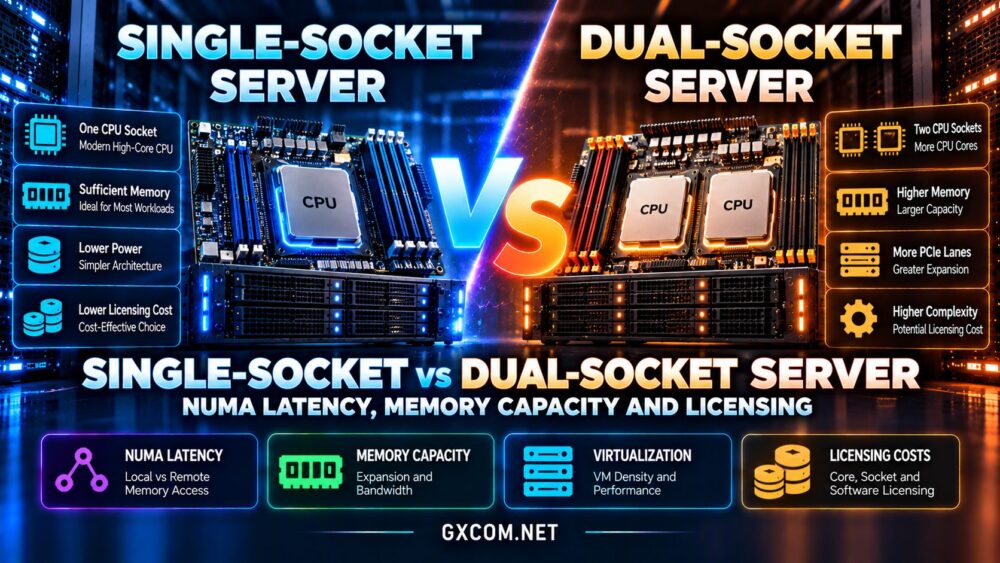
A single-socket server contains one physical CPU package. That processor may have many cores, multiple memory channels, and substantial PCIe connectivity.
Modern server processors can support demanding production environments without requiring a second CPU. High-core-count AMD EPYC and Intel Xeon platforms demonstrate why socket count alone is a poor measure of computing capacity.
Single-socket systems generally offer simpler hardware configurations, potentially lower platform power consumption, and fewer cross-socket memory considerations.
However, the exact capabilities depend on processor generation, motherboard design, installed memory, and available expansion slots.
What Is a Dual-Socket Server?
A dual-socket server contains two physical processors connected through a platform-specific interconnect.
Each CPU typically contributes cores, memory controllers, and platform resources. Applications may access memory attached to either processor, although access times can differ.
Dual-socket systems are commonly used for large virtualization hosts, enterprise databases, analytics, and workloads requiring substantial aggregate compute capacity.
They also introduce additional hardware, power, cooling, and topology considerations that must be included in the purchasing decision.
Single-Socket vs Dual-Socket: Key Differences
| 因子 | Single Socket | Dual Socket |
|---|---|---|
| Physical processors | One | Two |
| Core capacity | One CPU’s available cores | Combined cores of two CPUs |
| Memory expansion | 取决于平台 | Often higher total capacity |
| NUMA 复杂性 | Potentially simpler | Cross-socket locality matters |
| PCIe resources | 取决于平台 | May provide greater aggregate expansion |
| 功耗 | Often lower at comparable configurations | Additional processor and platform overhead |
| Licensing exposure | Depends on cores and software terms | May increase core or socket charges |
| 最佳匹配 | Right-sized workloads | Large-scale consolidation |
A newer single-socket server can outperform an older dual-socket machine. Always compare specific processor models, not merely the number of sockets.
NUMA Latency: Why Memory Location Matters
Non-Uniform Memory Access, or NUMA, describes systems where memory access latency depends on the relationship between a processor and the memory being accessed.
In a typical dual-socket architecture, each processor has directly attached memory. Accessing memory associated with the other socket may require communication across the CPU interconnect.

This remote access can increase latency and consume interconnect bandwidth.
Local vs Remote Memory Access
Applications that repeatedly access remote memory may experience slower execution, especially when they depend on latency-sensitive data structures or frequent synchronization.
Database engines, virtual machines, and in-memory analytics can be affected when CPU threads and memory allocations are poorly placed.
However, the performance penalty varies with processor architecture, workload, and system configuration. It should be measured rather than assumed.
Can Single-Socket Servers Have NUMA?
Yes. Some single-socket processors use multiple internal compute or memory domains and may expose different NUMA topologies depending on firmware settings.
A single physical socket therefore does not guarantee uniform memory access.
On Linux, tools such as lscpu, numactl --hardware, ,以及 numastat help administrators inspect topology and memory placement.
Virtualization: Proxmox, KVM and VM Density
Virtualization capacity depends on available cores, RAM, storage performance, and the behavior of individual virtual machines.
A modern single-socket server can host many VMs when its resources match the workload.
Dual-socket systems become attractive when consolidation requires more aggregate memory or compute capacity than one processor platform can provide.
CPU Pinning and NUMA-Aware Placement
Large VMs may benefit from keeping virtual CPUs and memory within suitable NUMA boundaries.
In Proxmox or KVM environments, administrators should review NUMA settings, CPU affinity, memory allocation, and host scheduling behavior.
Blindly pinning every workload can reduce flexibility, so configuration should follow performance measurements.
Before consolidating multiple VPS workloads, review our 裸机与VPS对比.
Memory Capacity and Bandwidth
Memory capacity is often a stronger reason to consider dual sockets than raw CPU performance.
Two processors may provide additional memory channels and DIMM slots, allowing greater total RAM capacity on supported platforms.
This matters for large databases, virtualization clusters, and analytics systems with substantial working datasets.
However, a high-capacity single-socket server may already meet your requirements.
Memory bandwidth also depends on channel population, DIMM speed, processor architecture, and workload characteristics.
For database hosting, compare usable RAM and measured memory performance instead of assuming that additional sockets automatically improve query latency.
PCIe Expansion, NVMe and Network Capacity
Dual-socket platforms may offer additional aggregate PCIe connectivity for storage devices, high-speed networking, or accelerator cards.
Nevertheless, available PCIe lanes and slot wiring vary by server model. Some slots may connect to different CPUs, affecting device locality.
A database using locally attached NVMe storage can benefit from appropriate CPU and PCIe placement, particularly under demanding I/O workloads.
For many smaller applications, a single-socket server already provides sufficient expansion.
我们的 裸机服务器对比 covers additional hardware selection factors.
Software Licensing: The Hidden Cost
Software licensing can materially change the economics of a dual-socket server.
Some commercial products charge according to physical cores, processors, sockets, or other capacity metrics.
Adding a second CPU may therefore increase licensing obligations even when application performance improves only slightly.
Windows Server and Virtualization Rights
Windows Server licensing commonly involves physical-core requirements, minimum licensing thresholds, and edition-specific virtualization rights.
The applicable terms depend on product edition, licensing channel, deployment rights, and current Microsoft rules.
Do not assume that purchasing a server with more sockets automatically includes additional Windows guest licenses.
Database and Enterprise Software
Commercial database products may apply processor-based or core-based licensing rules that substantially affect total cost.
Before purchasing, obtain a written licensing calculation covering the exact CPU models, physical cores, virtualization configuration, and intended software.
For related licensing considerations, read our Windows 专用服务器许可指南.
值得比较的专用服务器提供商
Cherry Servers: Flexible Bare Metal Options
Cherry 服务器 is worth evaluating for dedicated infrastructure where processor generation, memory capacity, and storage configuration are important.
Compare available single-socket and multi-processor offerings by exact CPU model. Check RAM limits, NVMe options, deployment regions, and support terms.
ServerMania: Enterprise Dedicated Infrastructure
ServerMania provides dedicated server solutions for businesses evaluating virtualization and enterprise workloads.
Request configuration details covering physical processors, memory population, network capacity, and management responsibilities before comparing total costs.
NovoServe: European Bare Metal Infrastructure
NovoServe is another option for organizations comparing dedicated servers and European infrastructure locations.
Confirm the exact hardware configuration, regional availability, bandwidth policies, and deployment requirements for your workload.
Bacloud: Dedicated Hosting Alternative
Bacloud offers dedicated hosting options that can be considered when comparing infrastructure configurations and European hosting requirements.
Verify socket count, CPU generation, memory capacity, storage redundancy, and replacement procedures before purchasing.
Single-Socket vs Dual-Socket Hosting Costs
A dual-socket server may cost more because it includes an additional processor and potentially greater power, cooling, memory, and platform requirements.
But rental price alone does not establish value.
One large server may consolidate several smaller workloads, reducing the number of machines administrators must manage.
Conversely, multiple smaller servers can improve workload separation and reduce dependence on one physical host.
Calculate compute rental, software licensing, backup infrastructure, power-related charges where applicable, and recovery requirements.
For purchasing options, explore our 经济实惠的独立服务器套餐.
How to Benchmark Socket Configurations
Compare servers using the same application versions and representative production workloads.
Measure sustained CPU throughput, p95 and p99 application latency, memory bandwidth, and database response times.
For virtualization, record VM performance, memory locality, CPU scheduling delays, and resource utilization.
Repeat tests under sustained load. A short multicore benchmark cannot establish real-world NUMA behavior or licensing value.
常见问题解答
Is a dual-socket server twice as fast?
No. Performance depends on application parallelism, processor models, memory locality, and platform configuration.
Does a single-socket server avoid NUMA latency?
Not always. Some single-socket processors can expose multiple NUMA domains depending on their architecture and firmware settings.
Which is better for Proxmox?
Both can work well. Choose according to VM density, available RAM, CPU topology, and measured performance requirements.
Does dual-socket hosting cost more to license?
It can. Core-based or socket-based licensing may increase costs, depending on the software and applicable terms.
When is dual-socket worth it?
It becomes attractive when workloads need memory, compute, or expansion resources beyond a suitable single-socket platform.
Final Verdict: One Socket or Two?
该 single-socket vs dual-socket server decision should be driven by workload requirements, not processor count alone.
选择 single-socket hosting when a modern CPU provides enough cores, memory, and I/O capacity with simpler management and favorable licensing economics.
选择 dual-socket hosting when additional memory capacity or aggregate resources justify greater NUMA complexity and operating costs.
Compare Cherry Servers, ServerMania, NovoServe, and Bacloud using actual hardware specifications and complete licensing requirements.
The best server is the configuration that meets performance targets without paying for unused capacity or avoidable complexity.