NVMe VPS hosting is everywhere.
Hosting providers advertise NVMe storage as faster, lower-latency and better suited to modern websites and applications than traditional SSD VPS hosting.
Technically, that is true: NVMe was designed to take better advantage of modern flash storage and can deliver substantially higher throughput and IOPS than older SATA-based SSD technology.
But there is a more important question for VPS buyers:
Will you actually notice the difference?
For a database-heavy application, busy WooCommerce store or I/O-intensive workload, NVMe can provide meaningful performance benefits. For a small cached website, the real-world difference between a good SSD VPS and NVMe VPS may be much smaller than benchmark charts suggest.
This guide looks beyond theoretical storage speeds to answer whether NVMe VPS is worth it, which workloads benefit most, and when a regular SSD VPS remains perfectly adequate.
Is NVMe VPS Worth It? The Short Answer
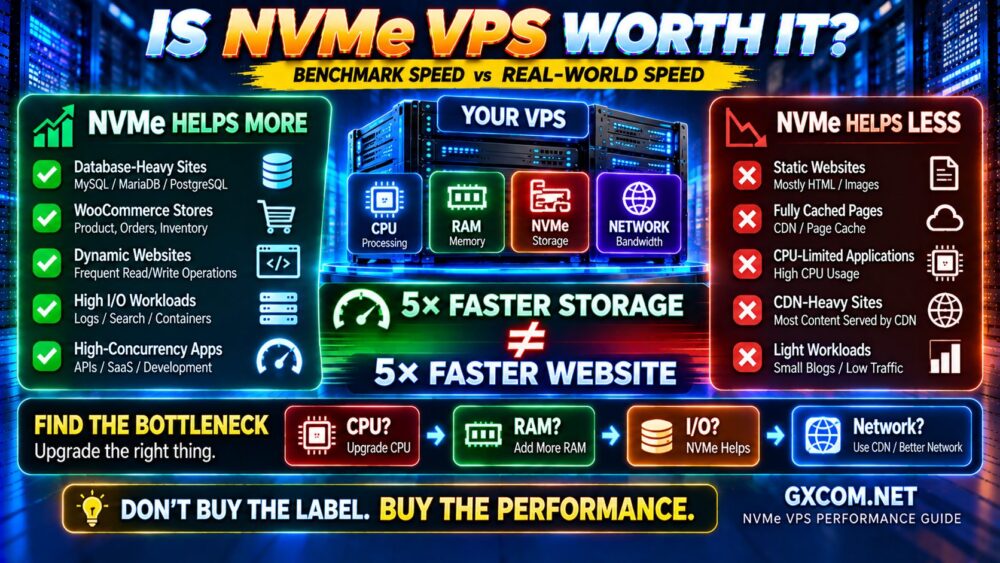
Yes, NVMe VPS is usually worth considering when the price difference is small and your workload performs frequent storage operations.
NVMe is particularly attractive for:
- 数据库密集型网站
- WooCommerce 商店
- 访问量较大的 WordPress 网站
- 高并发应用程序
- APIs with database activity
- 大型数据库
- Development and build workloads
- Applications performing frequent random reads and writes
However, NVMe may provide little noticeable improvement when:
- Your website is mostly static
- Most pages are served from cache
- A CDN handles most static traffic
- Your CPU is already the bottleneck
- Your application is limited by external APIs
- Your network latency dominates response time
The key principle is:
FASTER STORAGE ONLY MATTERS WHEN STORAGE IS PART OF THE BOTTLENECK.
什么是 NVMe VPS?
An NVMe VPS is a virtual private server whose storage infrastructure uses NVMe-based solid-state drives rather than traditional SATA SSDs or hard disk drives.
NVMe 代表 非易失性存储器快车.
Unlike older storage protocols originally designed around slower disk technologies, NVMe was developed specifically for modern solid-state storage and communicates through PCI Express.
In practical terms, NVMe can offer:
- 降低存储延迟
- 更高的 IOPS
- 更高的序列吞吐量
- Better parallelism
- Faster random reads and writes
Those advantages can matter on a VPS—but the underlying drive is only one part of the hosting platform.
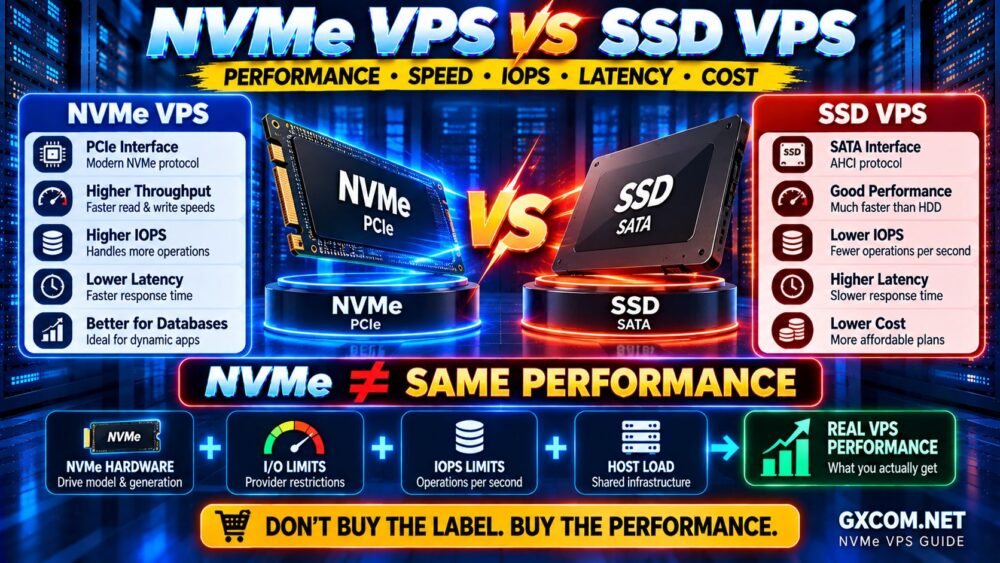
NVMe VPS vs SSD VPS: What's the Difference?
Both NVMe and SATA SSD storage use flash memory, so both are dramatically faster than traditional HDD storage.
The main difference is how the storage communicates with the system.
| 功能 | NVMe VPS | Regular SSD VPS |
|---|---|---|
| 存储技术 | NVMe / PCIe | 通常是 SATA 固态硬盘 |
| 潜在延迟 | 较低 | 更高 |
| IOPS Potential | 高得多 | 较低 |
| 并行操作 | 非常棒 | 更有限 |
| Sequential Throughput | Higher Potential | Lower Potential |
| 典型成本 | Sometimes Higher | 通常较低 |
如需更深入的技术对比,请参阅我们的 NVMe VPS 与 SSD VPS 对比 指南。.
But specifications alone do not tell you whether your website will actually become faster.
Theoretical Speed vs Real-World VPS Performance
This is where many hosting comparisons become misleading.
A benchmark may show that NVMe storage can process many times more I/O operations than SATA SSD storage.
That does not mean:
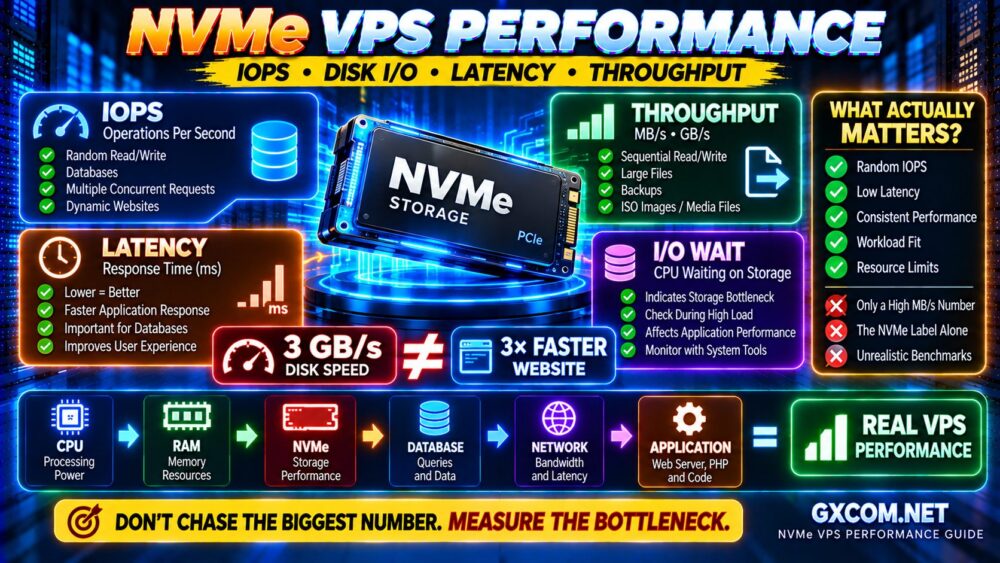
5× FASTER STORAGE = 5× FASTER WEBSITE.
A website request may involve:
访客
↓
网络
↓
Web 服务器
↓
PHP / 应用程序
↓
数据库
↓
存储
If storage represents only a small part of total request time, making storage dramatically faster can produce only a modest improvement in overall page generation time.
Real-world performance is determined by the slowest or most constrained parts of the complete workload.
When Does NVMe Make a VPS Noticeably Faster?
NVMe provides the greatest benefit when your application performs frequent storage operations and those operations are contributing meaningfully to response time.
常见的例子包括:
- Large database workloads
- Frequent random database reads
- Heavy database writes
- 日志密集型应用程序
- 搜索索引
- 大文件操作
- Software compilation
- 容器工作负载
- 高并发应用程序
In these situations, lower storage latency and higher IOPS can improve application responsiveness.
Is NVMe VPS Worth It for WordPress?
For many WordPress websites, NVMe is beneficial—but the size of the benefit depends heavily on caching.
Consider a fully cached page.
The request may follow a path such as:
VISITOR → CDN / PAGE CACHE → RESPONSE
Very little database or storage activity may be required.
Now consider an uncached request:
访客
↓
PHP
↓
MYSQL / MARIADB
↓
存储
↓
GENERATED PAGE
Storage performance becomes more relevant.
NVMe therefore tends to offer greater value for:
- 大型 WordPress 数据库
- Busy dynamic sites
- 会员制网站
- 搜索量较大的网站
- Sites with many uncached requests
- Sites performing frequent backend operations
For a small blog with excellent full-page caching, switching from a good SSD VPS to NVMe alone may not create a dramatic visible improvement.
Is NVMe VPS Worth It for WooCommerce?
WooCommerce is a much stronger case for NVMe.
Many ecommerce requests are dynamic and cannot simply be served from full-page cache.
例如:
- 购物车
- 结账
- 客户账户
- 订单
- Inventory changes
- 产品筛选
- Database searches
- 后台任务
These operations can create more frequent database reads and writes than a typical cached blog.
That means storage latency and IOPS can become more important as traffic and concurrency increase.

For a revenue-generating WooCommerce store, choosing NVMe is often sensible when the additional cost is modest.
但请记住:
NVMe WILL NOT FIX A POORLY OPTIMIZED DATABASE.
Is NVMe VPS Better for Databases?
This is one of the clearest NVMe use cases.
Databases frequently perform random I/O operations rather than simply reading one large file sequentially.
Workloads involving MySQL, MariaDB or PostgreSQL can benefit from low latency and high IOPS, particularly when datasets exceed available memory or write activity is significant.
Potential benefits include:
- Faster query-related disk access
- Faster writes
- Reduced storage wait time
- Better performance under concurrent I/O
- Faster database imports and exports
However, database performance also depends heavily on:
- Indexes
- Query efficiency
- 可用内存
- Buffer configuration
- CPU性能
- Database architecture
A slow SQL query does not become a good query merely because the server uses NVMe.
NVMe vs SSD for High-Traffic Websites
High traffic does not automatically mean you need NVMe.
A website serving millions of cached static requests may create relatively little storage pressure at the origin server.
Meanwhile, a smaller dynamic website may continuously access its database and generate significant I/O.
因此:
TRAFFIC VOLUME ≠ STORAGE DEMAND.
When evaluating a busy VPS, look at:
- 磁盘I/O
- I/O wait
- IOPS
- 数据库活动
- 缓存命中率
- 并发请求
我们的 一台VPS能处理多少流量? guide explains why visitor count alone is not enough to size a server.
NVMe 能否提升网站加载速度?
Sometimes—but not always by an amount visitors will notice.
Website loading speed includes both backend and frontend delays.
例如:
SERVER RESPONSE
+
NETWORK LATENCY
+
HTML DOWNLOAD
+
CSS / JAVASCRIPT
+
IMAGES
+
BROWSER RENDERING
=
USER-PERCEIVED LOAD TIME
NVMe primarily improves the storage-related portion of server-side work.
If a 4 MB image is slowing the page, NVMe is not the solution.
If a poorly optimized JavaScript bundle delays rendering, NVMe is not the solution.
If database storage latency is delaying dynamic page generation, NVMe may help.
NVMe Cannot Fix a CPU Bottleneck
This is particularly important when buying VPS hosting.
Suppose your server CPU remains at or near saturation during traffic spikes.
Moving from SATA SSD to NVMe while keeping the same CPU performance may produce little improvement.
The CPU is still the bottleneck.
Likewise:
CPU BOTTLENECK → FASTER CPU
RAM BOTTLENECK → MORE / BETTER MEMORY USE
STORAGE BOTTLENECK → FASTER STORAGE
NETWORK BOTTLENECK → BETTER NETWORK / CDN
The correct upgrade depends on the actual constraint.
NVMe Cannot Replace Enough RAM
Fast storage is not a substitute for memory.
RAM is dramatically faster than persistent storage, including NVMe.
Databases and applications frequently use memory to cache frequently accessed information precisely because retrieving it from storage is slower.
If your server constantly runs out of memory and relies heavily on swap, moving to faster storage may reduce some pain—but solving the memory shortage is usually more important.
NVMe IS FAST STORAGE.
NVMe IS NOT RAM.
NVMe VPS and Caching: Which Matters More?
For many websites, good caching can have a greater performance impact than changing storage technology.
为什么?
Because caching can eliminate work entirely.
Without cache:
REQUEST → PHP → DATABASE → STORAGE → RESPONSE
With effective cache:
REQUEST → CACHED RESPONSE
Making a storage operation faster is useful.
Avoiding that storage operation can be even better.
This is why storage upgrades should be part of a broader optimization strategy.
请阅读我们的 网站缓存详解 guide for browser, server, CDN and object caching strategies.
Does a CDN Make NVMe Less Important?
For cacheable frontend content, it can.
A CDN can serve images, CSS, JavaScript and sometimes cached HTML without requiring the origin VPS to process every request.
This reduces:
- 源带宽
- Web server requests
- Storage reads
- Geographic latency
However, a CDN cannot eliminate backend storage requirements for every dynamic request.
WooCommerce checkout, authenticated dashboards and personalized applications still depend on origin infrastructure.
请参阅我们的 使用 CDN 与不使用 CDN 请参阅对比表以获取更多详细信息。.
Is Every NVMe VPS Fast?
不。.
This is probably the biggest mistake buyers make when shopping for NVMe VPS hosting.
Seeing the word NVMe does not tell you the actual storage performance available to your virtual server.
Real performance can depend on:
- Underlying NVMe hardware
- RAID or storage architecture
- Network-attached vs local storage
- Virtualization layer
- IOPS 限制
- 吞吐量限制
- 主机节点争用
- 其他租户
A provider can use extremely fast NVMe drives while limiting each VPS to a fraction of the hardware's total performance.
因此:
NVMe LABEL ≠ UNLIMITED NVMe PERFORMANCE.
Shared Storage Performance Matters
Most VPS customers do not own the physical storage device underneath their virtual machine.
The host platform may distribute storage performance across multiple virtual servers.
If many workloads generate heavy I/O simultaneously, actual VPS performance may differ from ideal drive benchmarks.
This is why real-world testing is valuable.
When possible, examine:
- Read/write latency
- Random IOPS
- 顺序吞吐量
- I/O consistency
- Performance during peak periods
Consistency can be more important than one impressive benchmark result.
Should You Pay More for NVMe VPS?
It depends on the premium.
If two otherwise comparable VPS plans have similar prices and one provides quality NVMe storage, choosing NVMe is usually easy to justify.
The decision becomes less obvious when the NVMe plan costs significantly more.
请问:
- Is storage currently a bottleneck?
- Does my application perform heavy database I/O?
- Do I need higher IOPS?
- Is the CPU also better?
- Do I receive more RAM?
- Are the providers equally reliable?
- 是否包含备份?
- Are there storage performance limits?
Never evaluate the word “NVMe” in isolation.
NVMe VPS vs More CPU: Which Upgrade Is Better?
Choose based on the bottleneck.
| Workload Problem | More Likely Upgrade |
|---|---|
| CPU 占用率过高 | Better / more CPU |
| RAM consistently exhausted | 更多内存 |
| 高I/O等待 | Faster storage / investigate I/O |
| Database disk latency | NVMe may help |
| Slow static assets worldwide | CDN / frontend optimization |
| Slow SQL queries | Query/database optimization first |
Do not upgrade based on marketing terminology.
MEASURE → IDENTIFY BOTTLENECK → UPGRADE.
NVMe VPS vs More RAM: Which Is Better?
If the server has insufficient memory, RAM is usually the priority.
Additional memory can allow the operating system and database to cache more frequently accessed data, potentially reducing storage operations altogether.
For example, a database workload may benefit more from:
8 GB RAM + GOOD SSD
than:
2 GB RAM + FAST NVMe
if memory pressure is the dominant problem.
Again, workload matters more than the storage label.
值得比较的 NVMe VPS 服务商
When shopping for an NVMe VPS, compare the entire platform rather than selecting a provider solely because “NVMe” appears on the product page.
Vultr 以及 DigitalOcean are relevant for users comparing developer-oriented VPS and cloud infrastructure.
数据库集市 is another option worth evaluating when comparing VPS configurations, storage and server resources.
Budget-conscious buyers may also encounter providers such as RackNerd when looking for lower-cost VPS options.
The right comparison is:
CPU 质量
+
RAM
+
REAL STORAGE PERFORMANCE
+
网络
+
RESOURCE LIMITS
+
支持
+
总费用
not simply:
SSD vs NVMe.
Who Should Choose NVMe VPS?
NVMe VPS is a particularly strong fit for:
- 访问量较大的 WordPress 网站
- WooCommerce 商店
- 数据库密集型应用程序
- API
- 高并发应用程序
- 开发环境
- 大型数据库
- 存储密集型工作负载
- Users choosing between similarly priced SSD and NVMe plans
Who Can Still Use a Regular SSD VPS?
A quality SSD VPS can remain perfectly adequate for:
- 小型博客
- 静态网站
- Low-traffic business websites
- Highly cached websites
- Development projects with light I/O
- Applications where CPU or network is the real bottleneck
Regular SSD storage did not suddenly become slow simply because NVMe became available.
For many lightweight workloads, SATA SSD performance is still more than sufficient.
NVMe VPS 购买检查清单
Before buying an NVMe VPS, check:
- ✓ CPU generation
- ✓ Shared vs dedicated CPU policy
- ✓ 内存分配
- ✓ NVMe 存储容量
- ✓ Published IOPS limits
- ✓ Published I/O limits
- ✓ Local vs distributed storage
- ✓ Bandwidth allowance
- ✓ 网络端口速度
- ✓ 备份策略
- ✓ Snapshot pricing
- ✓ 数据中心位置
- ✓ 升级选项
- ✓ 支持范围
- ✓ 续费价格
别被“NVMe”这个标签蒙蔽了。.
BUY THE PERFORMANCE YOUR WORKLOAD NEEDS.
Is NVMe VPS Worth It? FAQ
NVMe VPS 比 SSD VPS 更快吗?
NVMe has significantly greater storage performance potential than traditional SATA SSD technology, including lower latency and higher IOPS. The actual performance available to a VPS depends on the provider's storage architecture and resource limits.
Will NVMe make my website faster?
It can improve server-side performance when storage or database I/O contributes to the bottleneck. A cached or mostly static website may show a much smaller improvement.
Is NVMe worth it for WordPress?
It is useful for busy or database-heavy WordPress websites, particularly when many requests bypass full-page caching. Small cached blogs may see less noticeable benefit.
Is NVMe worth it for WooCommerce?
Often yes. WooCommerce performs many dynamic database operations, making storage latency and IOPS more relevant than they are for a simple cached website.
Is NVMe better than more RAM?
Not when memory is the actual bottleneck. If the VPS is running out of RAM, adding memory can provide more benefit than upgrading storage. Measure resource usage before deciding.
Is NVMe better than more CPU?
Only for workloads limited by storage. CPU-heavy applications need better CPU performance rather than faster storage.
Does every NVMe VPS provide the same performance?
No. Providers can use different hardware, virtualization systems, storage architectures and I/O limits. Two NVMe VPS plans can therefore deliver very different real-world performance.
Is regular SSD VPS still good?
Yes. SATA SSD VPS hosting can still provide excellent performance for small websites, cached WordPress sites and workloads that are not storage intensive.
Final Verdict: Is NVMe VPS Really Worth It?
NVMe VPS is worth it when your workload can actually use faster storage—and especially when the price difference from regular SSD hosting is small.
For databases, WooCommerce, busy dynamic websites and I/O-intensive applications, lower latency and higher IOPS can provide meaningful real-world benefits.
For small static or heavily cached websites, the difference may be much less noticeable.
The most important lesson is:
NVMe ≠ AUTOMATICALLY FASTER WEBSITE.
Real performance depends on:
CPU
+
RAM
+
存储
+
数据库
+
缓存
+
网络
=
REAL-WORLD VPS PERFORMANCE
If storage is the bottleneck, NVMe can be an excellent upgrade.
If CPU, RAM, application code or network latency is holding the server back, paying more for NVMe alone may solve very little.
So before upgrading, follow one rule:
首先找出瓶颈。.
Then spend your hosting budget where it will actually improve performance.