Shared hosting is often the easiest and most affordable way to launch a website. It requires little server administration, usually includes a control panel and can handle many small websites perfectly well.
But as a website grows, shared hosting can eventually become restrictive.
You may start encountering CPU limits, memory limits, slow database performance, traffic spikes or restrictions on server configuration. At that point, a managed VPS becomes an attractive upgrade.
A 托管型VPS provides more isolated server resources and greater control while the hosting provider handles many server administration tasks for you.
But does every growing website need one?
这个 托管型VPS与共享主机对比 comparison explains performance, CPU and RAM resources, control, security, management, scalability and cost—and shows when upgrading actually makes sense.
SHARED HOSTING = SIMPLE + AFFORDABLE
MANAGED VPS = MORE RESOURCES + MORE CONTROL + PROVIDER MANAGEMENT
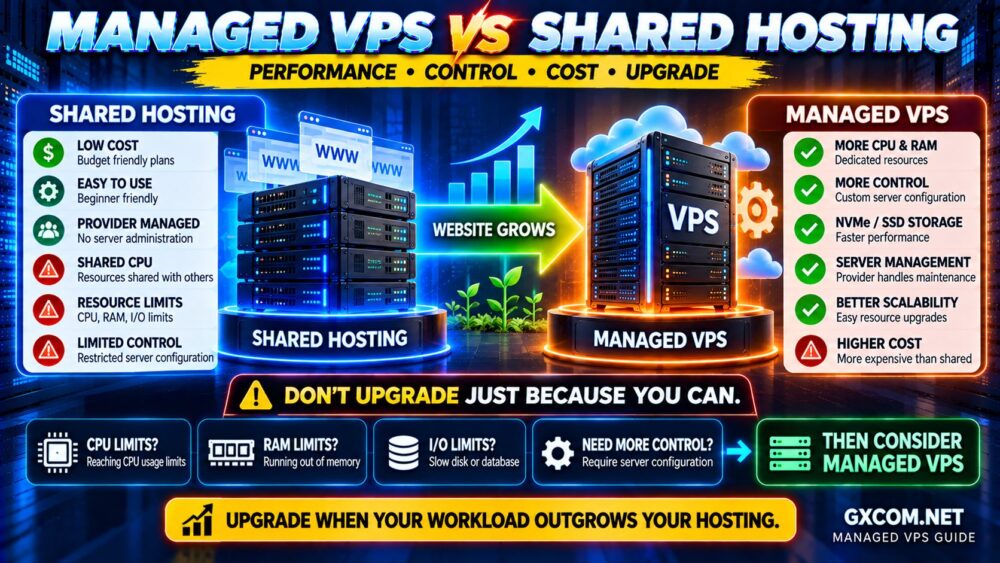
Managed VPS vs Shared Hosting: Quick Comparison
| 功能 | 共享主机 | 托管型VPS |
|---|---|---|
| 价格 | 较低 | 更高 |
| CPU 资源 | Shared and restricted | More clearly allocated |
| RAM | Account-level limits | 固定VPS分配 |
| 存储 | 共享基础设施 | Defined SSD/NVMe allocation |
| root 权限 | 通常没有 | Depends on management model |
| 服务器配置 | 限量版 | Much greater flexibility |
| 服务器管理 | 服务提供商 | Provider handles agreed management scope |
| 可扩展性 | 计划升级 | CPU/RAM/storage upgrades |
| 最适合 | 小型网站 | Growing or resource-intensive websites |
什么是共享主机?
Shared hosting places multiple customer accounts on the same server infrastructure.
The hosting provider manages the operating system, web server, control panel and underlying server environment.
Customers normally manage their websites through a control panel rather than administering the server itself.
This makes shared hosting attractive for:
- 个人网站
- 博客
- 作品集网站
- 小型企业网站
- 访问量较低至中等的 WordPress 网站
- Simple landing pages
The major advantages are simplicity and price.
But because many accounts share infrastructure, providers need resource limits to maintain stability.
这些可能包括:
- CPU 限制
- RAM limits
- 磁盘 I/O 限制
- IOPS 限制
- Entry process limits
- PHP process limits
- Database restrictions
- Inode limits
我们的 Shared Hosting Limitations guide explains how these restrictions affect real website performance.
What Is a Managed VPS?
A managed VPS is a virtual private server combined with server management services from the hosting provider.
Instead of placing your website inside a tightly controlled shared hosting account, you receive a virtual server with defined resources such as:
- vCPU
- RAM
- SSD 或 NVMe 存储
- 带宽
- 操作系统环境
The provider then manages some or most of the server administration according to the plan.
Management may include:
- 操作系统更新
- 安全补丁
- 服务器监控
- 控制面板管理
- Web 服务器配置
- 备份协助
- 安全加固
- 故障排除
However, the phrase 全托管型VPS does not have exactly the same meaning at every hosting company.
Always check the provider's management scope before buying.
Managed VPS vs Shared Hosting: The Biggest Difference
The biggest difference is not simply speed.
It is the way server resources and responsibilities are allocated.
共享主机:
ONE SERVER
↓
MANY HOSTING ACCOUNTS
↓
ACCOUNT RESOURCE LIMITS
Managed VPS:
SERVER INFRASTRUCTURE
↓
ISOLATED VIRTUAL SERVER
↓
DEFINED VPS RESOURCES
↓
PROVIDER MANAGEMENT
This gives a managed VPS more flexibility without requiring the customer to become a full-time system administrator.
Performance: Managed VPS vs Shared Hosting
A managed VPS generally has greater performance potential because it provides a clearer allocation of computing resources.
But moving to VPS does not automatically make every website faster.
Real website performance depends on:
- CPU性能
- 可用内存
- 存储性能
- Database efficiency
- PHP 配置
- 缓存
- Website code
- 网络延迟
A badly optimized WordPress website can remain slow after moving to a VPS.
Likewise, a well-optimized cached website can perform extremely well on quality shared hosting.
The correct rule is:
VPS RESOURCES CREATE PERFORMANCE HEADROOM.
OPTIMIZATION DETERMINES HOW WELL YOU USE IT.
CPU: Shared Limits vs VPS Resources
CPU is one of the main reasons growing websites move away from shared hosting.
Shared hosting providers need to prevent one customer from consuming excessive processor time, so CPU usage is normally restricted.
This may become noticeable during:
- 流量激增
- WooCommerce 活动
- WordPress admin operations
- 备份
- 安全扫描
- Large database operations
- 后台任务
A VPS generally provides a specified number of vCPUs.
例如:
共享主机
CPU usage controlled by account limits
对比:
托管型VPS
2 vCPU / 4 vCPU / 8 vCPU or another defined allocation
However, vCPU count alone does not determine performance.
CPU generation, clock performance and whether processor resources are shared or dedicated can also matter.
RAM: A Major VPS Advantage
Shared hosting accounts usually operate within provider-defined memory restrictions.
With a VPS, RAM allocation is much clearer.
A plan may provide:
- 4 GB 内存
- 8 GB 内存
- 16 GB 内存
- 32 GB 内存
This memory can support the operating system, web server, database, PHP processes, caching and applications.
More RAM can be particularly useful for:
- 大型 WordPress 网站
- WooCommerce
- 繁忙的数据库
- 对象缓存
- 多个网站
- Applications with many concurrent processes
But more RAM does not automatically make a website faster if RAM was never the bottleneck.
MORE RAM ≠ AUTOMATICALLY MORE PERFORMANCE.
Storage and I/O Performance
Both shared hosting and managed VPS plans may advertise SSD or NVMe storage.
The important difference is how storage performance is allocated.
Shared hosting accounts can have restrictions on:
- 磁盘I/O
- IOPS
- 并发进程
VPS plans may provide greater storage performance, but they can still have provider-defined limits.
Do not assume that every NVMe VPS delivers identical performance.
我们的 NVMe VPS 与 SSD VPS 对比 comparison explains why NVMe hardware, IOPS limits, I/O policies and host load all influence real VPS storage speed.
Managed VPS vs Shared Hosting for WordPress
Shared hosting is sufficient for many WordPress websites.
A small content website with effective page caching may never require a VPS.
A managed VPS becomes more attractive when WordPress begins consuming substantial server resources.
典型的例子包括:
- 大型内容网站
- 高流量
- Many plugins
- Frequent publishing
- 大型数据库
- 会员制网站
- 多个 WordPress 安装
The advantage is not merely additional CPU and RAM.
A managed VPS may also allow the hosting environment to be configured more specifically for the workload.
Managed VPS vs Shared Hosting for WooCommerce
WooCommerce is one of the strongest cases for upgrading from shared hosting as a website grows.
Unlike a mostly cached blog, an online store has many dynamic operations:
- 购物车
- 结账
- 客户账户
- 产品搜索
- Inventory updates
- 支付业务
- Order processing
- 后台任务
These activities can increase CPU, PHP and database demand.
A managed VPS provides more resource headroom while retaining professional server management.
That combination can be attractive for store owners who need better performance but do not want to administer Linux themselves.
Control: Why Managed VPS Is Different
Shared hosting intentionally limits server-level control.
You usually cannot freely modify:
- 操作系统配置
- System services
- Web server architecture
- Low-level firewall rules
- 定制服务器软件
A VPS provides a much more flexible environment.
Depending on the provider and management plan, you may be able to customize:
- PHP versions and settings
- Web 服务器配置
- 数据库配置
- Redis or other caching systems
- 防火墙规则
- Application services
This is particularly useful when your application has requirements that shared hosting cannot accommodate.
托管型VPS是否包含root权限?
有时——但并非总是如此。.
Some managed VPS providers allow full root access while still offering management.
Others restrict certain administrative actions because the provider needs to maintain a supported server configuration.
This is an important buying question:
DO I NEED FULL ROOT ACCESS?
If yes, verify it before purchasing.
Do not assume that every managed VPS provides the same level of administrative control.
Server Management: The Main Reason to Choose Managed VPS
A self-managed VPS gives you server resources but also makes you responsible for server administration.
这可能包括:
- SSH 安全性
- 防火墙配置
- 系统更新
- Web 服务器配置
- 数据库管理
- 监测
- 备份
- Incident response
A managed VPS shifts some or much of this responsibility to the provider.
This is why managed VPS should not be compared only on raw CPU and RAM price.
You are paying for:
SERVER RESOURCES
+
SERVER MANAGEMENT
+
TECHNICAL SUPPORT
For businesses without an experienced system administrator, that service can be valuable.
Managed VPS vs Shared Hosting Security
Shared hosting has a major security advantage for beginners: the provider controls most of the server environment.
With a VPS, the security model changes because you have a more independent server environment.
A properly managed VPS may include assistance with:
- 安全更新
- 防火墙配置
- 恶意软件防护
- 监测
- 服务器加固
But management coverage varies.
You remain responsible for application-level security, including WordPress plugins, themes, passwords and administrator accounts.
For a deeper look at server security, see our 如何保障VPS的安全 指南。.
Managed VPS vs Shared Hosting Scalability
Shared hosting usually scales by moving between predefined hosting plans.
Eventually, you may reach the highest shared plan available.
VPS hosting provides a clearer growth path:
2 个 vCPU / 4 GB 内存
↓
4 个虚拟CPU / 8 GB 内存
↓
8 个 vCPU / 16 GB 内存
↓
LARGER VPS OR CLOUD INFRASTRUCTURE
The exact upgrade process depends on the provider.
Some platforms allow relatively quick resource upgrades, while others may require migration or downtime.
共享主机能处理多少流量?
There is no universal visitor number at which shared hosting stops working.
A cached content website may handle far more visitors than a dynamic WooCommerce store on the same hosting plan.
Traffic capacity depends on:
- CPU demand per request
- PHP 处理
- 数据库活动
- 缓存
- 并发用户数
- Bot traffic
- Provider resource limits
This is why monthly visitor counts alone are a poor upgrade metric.
我们的 共享主机能处理多少流量? guide explains this in detail.
When Should You Upgrade From Shared Hosting to Managed VPS?
You should consider upgrading when the current hosting environment—not simply the website itself—is becoming a consistent bottleneck.
Common warning signs include:
- CPU limits are repeatedly reached
- RAM limits are repeatedly reached
- Disk I/O is regularly throttled
- Traffic spikes cause errors
- WooCommerce becomes slow under load
- Database-heavy operations are struggling
- You need server-level configuration
- 你需要更多可预测的资源
- You host multiple resource-intensive websites
- You have outgrown the provider's shared hosting plans
The correct upgrade process is:
MEASURE
↓
IDENTIFY BOTTLENECK
↓
优化
↓
MONITOR
↓
UPGRADE IF LIMITS REMAIN
When You Should NOT Upgrade Yet
Buying a VPS is not the correct solution to every slow website.
You may not need to upgrade if the real problem is:
- Unoptimized images
- Poor caching
- 运行缓慢的插件
- Bad database queries
- 第三方脚本
- External API delays
- Frontend JavaScript
- Poorly configured CDN
A faster server cannot completely solve inefficient application design.
Before upgrading, use the process in our 服务器运行缓慢故障排除指南 to determine whether CPU, RAM, disk or network resources are actually responsible.
托管型VPS与共享主机的费用对比
Shared hosting is almost always cheaper at the entry level.
One server can host many accounts, allowing providers to offer low monthly prices.
Managed VPS costs more because the product combines dedicated virtual server resources with management services.
The real managed VPS cost is closer to:
VPS 基础设施
+
控制面板
+
备份
+
监测
+
SERVER MANAGEMENT
+
支持
=
实际托管VPS费用
This is why comparing a $5 self-managed VPS with a $30 or $50 managed VPS solely on CPU and RAM is misleading.
They are not the same service.
Is Managed VPS Worth the Extra Cost?
Managed VPS is usually worth considering when server performance matters to your business but you do not have the time or expertise to administer the server yourself.
The extra cost can buy:
- 更可预测的资源
- 更大的配置灵活性
- 服务器监控
- 技术援助
- 安全管理
- Reduced administration workload
For a personal blog with modest traffic, this may be unnecessary.
For a revenue-generating WooCommerce store or business application, paying more for reliable infrastructure and server management can be much easier to justify.
值得比较的托管型VPS服务商
When moving beyond shared hosting, compare providers based on both infrastructure and the actual management service included.
ScalaHosting is particularly relevant for users looking for a managed VPS upgrade path and who prefer provider-assisted server administration.
AccuWeb 主机服务 is also worth comparing because it offers hosting products across shared, VPS and other server categories, which can be useful when planning a gradual infrastructure upgrade.
Hostwinds can be considered when comparing VPS configurations and different management requirements.
If you are comfortable with a more developer-oriented cloud environment, DigitalOcean represents a different path: flexible cloud virtual machines rather than a traditional fully managed shared-to-VPS experience.
The right comparison is not simply:
WHO HAS THE CHEAPEST VPS?
不妨比较一下:
RESOURCES → MANAGEMENT SCOPE → SUPPORT → BACKUPS → SECURITY → TOTAL COST.
Shared Hosting vs Managed VPS: Which Should You Choose?
Choose Shared Hosting If:
- Your website is small or relatively lightweight
- Your resource usage remains comfortably within limits
- You do not need server-level configuration
- You want the lowest possible hosting cost
- You want a simple control-panel experience
Choose Managed VPS If:
- Your website repeatedly reaches shared hosting limits
- 你需要更强的CPU或更大的内存
- You run a growing WooCommerce store
- You need more control over the server stack
- 你需要更多可预测的资源
- 您托管着多个要求较高的网站
- You want VPS resources without managing everything yourself
Managed VPS vs Shared Hosting Decision Checklist
| If You Need… | Usually Choose |
|---|---|
| Lowest hosting cost | 共享主机 |
| 简单的网站管理 | 共享主机 |
| 更强的CPU和更大的内存 | 托管型VPS |
| 更强的服务器控制权 | 托管型VPS |
| 自定义服务器配置 | 托管型VPS |
| 发展中的 WooCommerce 商店 | 托管型VPS |
| Server administration included | Either, but Managed VPS for VPS-level resources |
| Small cached WordPress site | 共享主机 |
| More predictable resource allocation | 托管型VPS |
Common Upgrade Mistakes
Upgrading Because the Website Is Slow Without Finding the Cause
Performance problems can originate from plugins, database queries, external services or frontend code rather than hosting resources.
Buying More RAM Without Checking RAM Usage
If memory is not the bottleneck, additional RAM may provide little benefit.
认为“托管”就意味着一切都由托管方负责
Always check exactly what the provider includes.
Choosing VPS Based Only on vCPU Count
CPU generation and allocation policies can matter as much as the advertised core count.
Ignoring Backup Policies
Managed hosting does not automatically mean unlimited backups or complete disaster recovery.
Choosing the Cheapest Managed VPS
A low price is not good value if the management scope, infrastructure or support does not meet your requirements.
Managed VPS vs Shared Hosting FAQ
Is managed VPS faster than shared hosting?
A managed VPS generally provides greater performance potential and more predictable resources, but actual speed still depends on server hardware, configuration and website optimization.
我应该什么时候从共享主机升级到VPS?
Consider upgrading when an optimized website repeatedly reaches shared hosting CPU, RAM, I/O or process limits, or when you require server-level configuration unavailable on shared hosting.
Do I need technical knowledge for a managed VPS?
Less than with a self-managed VPS, but the amount of knowledge required depends on what the provider actually manages. A control panel and strong management service can make VPS hosting much easier for non-specialists.
托管型VPS适合运行WordPress吗?
Yes, particularly for larger or more resource-intensive WordPress websites. Small cached WordPress websites may not need VPS resources.
Is managed VPS better for WooCommerce?
It can be a strong upgrade for growing WooCommerce stores because dynamic checkout, customer sessions, database operations and background tasks can require more CPU, RAM and PHP capacity.
Does managed VPS include backups?
It depends on the provider and plan. Never assume backups are included; check frequency, retention, storage location and restoration policies.
Does managed VPS include root access?
Some providers allow root access, while others restrict certain administrative functions to maintain their managed environment. Verify the policy before purchasing.
托管型VPS值得多花这笔钱吗?
It can be when your website genuinely needs VPS resources and you value provider-assisted server management. For small websites operating comfortably on shared hosting, the additional cost may not be necessary.
Final Verdict: Shared Hosting or Managed VPS?
Shared hosting remains one of the best choices for websites that need affordability, simplicity and minimal server administration.
There is no reason to leave it simply because VPS hosting sounds more powerful.
Upgrade when your workload actually requires it.
选择 共享主机 在确定优先级时:
LOW COST → SIMPLICITY → EASY MANAGEMENT
Choose a 托管型VPS 在确定优先级时:
MORE RESOURCES → MORE CONTROL → PROVIDER MANAGEMENT
The ideal upgrade path is:
共享主机
↓
MEASURE RESOURCE USAGE
↓
优化
↓
LIMITS STILL REACHED?
↓
托管型VPS
Do not upgrade because a VPS has more impressive specifications.
UPGRADE WHEN YOUR WORKLOAD OUTGROWS THE ENVIRONMENT.