每个网站都需要CDN吗?
不。但对于合适的网站而言,内容分发网络(CDN)可以降低延迟、减少源服务器的流量、提高系统韧性,并更快地向全球访问者分发静态内容。.
关键问题并不只是CDN好还是不好,而是您的网站受众、内容、基础设施和流量模式能否真正从中受益。.
在这篇 使用 CDN 与不使用 CDN 通过对比分析,我们将说明CDN如何改变网站的交付方式、性能提升的来源、相关成本以及您的网站何时真正需要使用CDN。.
位置 → 延迟 → 缓存 → 源加载 → 成本
什么是CDN?
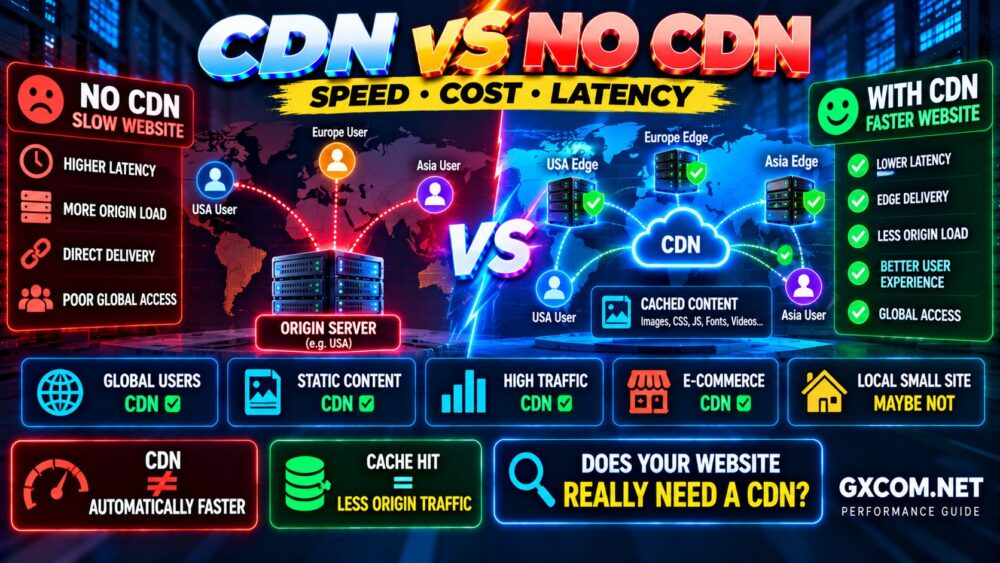
内容分发网络(CDN)是一个由服务器组成的分布式网络,旨在将网站内容分发到更接近用户的位置。.
如果没有 CDN,访问者通常会向您的源服务器请求内容:
访问者 → 源服务器
如果您的服务器位于美国,且访问者也身处附近,那么这种方式可能完全可行。.
但如果您的访问者分布在北美、欧洲和亚洲各地,那么部分用户可能距离源服务器有数千英里之遥。.
CDN 会改变内容分发路径:
访问者 → 附近的 CDN 边缘节点 → 缓存内容
当请求的资源在边缘可用时,CDN 可以直接返回该资源,而无需源服务器再次提供相同的内容。.
CDN 与非 CDN 一览
| 因子 | 使用 CDN | 未启用 CDN |
|---|---|---|
| 内容分发 | 分布式边缘站点 | 主要源服务器 |
| 全球延迟 | 对于缓存内容,该值通常较低 | 很大程度上取决于来源地的距离 |
| 源加载 | 可以大幅减少 | Origin 直接处理请求 |
| 交通流量激增 | Edge 可以处理可缓存的请求 | 原产地面临更大压力 |
| 配置 | 更复杂 | 更简单的架构 |
| 缓存管理 | 必填 | 边缘缓存的复杂度较低 |
| 成本 | 免费、按使用量计费或高级版 | 源带宽/资源 |
| 最适合 | 分布式受众与可缓存内容 | 小型/本地或高度动态的工作负载 |
CDN 如何让网站运行更快
CDN 最明显的优势在于缩短了访问者与内容之间的距离。.
设想一个托管在洛杉矶的网站。.
附近的一位访客可能已经拥有相对较低的网络延迟:
洛杉矶访客 → 洛杉矶出发
现在设想一位来自伦敦的访客:
伦敦游客 → 洛杉矶出发 → 伦敦
网络距离会带来额外的往返延迟。.
借助 CDN,可缓存的内容可以从距离访问者更近的边缘节点进行分发:
伦敦游客 → 附近的边缘缓存
这对以下情况尤为有用:
- 图片
- CSS 文件
- JavaScript
- 字体
- 下载
- 视频
- 可缓存的 HTML
这样可以加快内容分发速度,并减少发往源服务器的请求数量。.
CDN 的性能取决于缓存命中率
CDN 并不能凭空让每个请求都变得很快。.
其中一个最重要的概念是 缓存命中率.
一个简化的 CDN 请求如下所示:
请求
↓
边缘缓存
↓
HIT?
如果是:
EDGE → 访客
如果不是:
边缘 → 源 → 边缘 → 访问者
缓存命中可以省去为该资源向源服务器发起的请求。.
即使发生缓存未命中,CDN 仍需向上游检索该资源。.
因此:
启用 CDN ≠ 所有内容均被缓存。.
缓存策略的质量几乎与是否使用 CDN 同样重要。.
何时CDN能带来最大的性能提升
1. 您的访客分布在各地
这是使用CDN的最有力理由之一。.
如果您的服务器位于美国,但大量流量来自欧洲、亚洲及其他地区,则边缘网络可以缩短可缓存资源的传输距离。.
面向全球受众 → 通常采用 CDN 更为合理。.
2. 您的网站使用了大量静态资源
包含大量图片、JavaScript、CSS、字体或可下载文件的网站,自然是CDN的理想应用对象。.
这些资源通常可以高效地进行缓存。.
因此,一个以媒体内容为主的网站可能比一个主要面向本地受众、仅包含少量文本的小型网站获益更多。.
3. 您的源服务器处理大量流量
CDN缓存处理的每个请求,都可能意味着源服务器需要处理的请求减少了一个。.
这可以减少:
- 源带宽
- Web 服务器连接
- 应用程序工作负载
- 基础设施压力
如果源服务器容量成为一个问题,CDN 卸载可以成为解决方案的重要组成部分。.
4. 您的流量突然激增
网站可能会因以下原因出现流量骤增:
- 社交媒体
- 新闻报道
- 产品发布
- 营销活动
- 病毒式传播的内容
- 搜索流量
如果请求的内容中有很大一部分是可以缓存的,那么边缘分发可以减少到达源服务器基础设施的流量。.
5. 您提供大文件
图片、软件下载、视频和其他大型静态资源可能会消耗大量源站带宽。.
CDN 可以将大部分内容分发任务从主 Web 服务器转移到更靠近用户的位置。.
哪些情况下可能不需要CDN
CDN 是一项有用的技术,但添加那些几乎无法带来可衡量效益的基础设施,只会造成不必要的复杂性。.
1. 您的网站本地受众较少
假设您的业务仅面向某一座城市的客户,且您的服务器已部署在同一区域内。.
全球CDN在地理延迟方面的优势可能相对较小。.
CDN 仍可提供缓存或安全方面的优势,但仅从性能角度考虑,全球部署可能并非必要。.
2. 您的网站规模很小
一个包含少量经过优化的资源且流量较低的轻量级网站,只要使用优质的主机服务,通常就能快速加载。.
如果对您当前的访问者而言,性能已经非常出色,那么增加另一层可能带来的实际改进有限。.
3. 大部分内容都是个性化的或动态的
有些应用程序会针对每位用户专门生成响应。.
示例包括:
- 账户仪表盘
- 购物车
- 个性化应用程序
- 经过身份验证的SaaS平台
- 实时数据
CDN 仍然可以加速静态资源并提供其他边缘服务,但全页面缓存可能需要更加细致的配置。.
4. 您的源服务器已经离几乎所有用户都很近了
如果您的访问者和来源地都集中在某个地区,那么地理距离的缩短可能并不明显。.
在断定CDN会带来显著改善之前,请先进行测试。.
使用 CDN 与不使用 CDN:源服务器的负载
性能只是比较的一个方面。.
CDN 还可以改变源服务器需要处理的工作量。.
未启用 CDN:
100 名访客
↓
源服务器
在启用有效缓存的情况下:
100 名访客
↓
边缘缓存
↓
源请求减少
这并不意味着CDN能消除源服务器的负载。.
动态页面、缓存未命中、已过期的资源以及未缓存的 API 请求仍可能到达服务器。.
但减少重复的静态请求,可以为真正需要应用程序处理的任务腾出更多的源服务器处理能力。.
使用 CDN 与不使用 CDN:成本
根据工作负载和提供商的不同,CDN 可能会降低或增加总基础设施成本。.
如果不使用 CDN,您的成本可能包括:
- 源带宽
- 服务器资源
- 应对交通高峰的额外基础设施
- 更大容量的托管服务
使用 CDN 时,成本可能包括:
- CDN 订阅
- 带宽或数据传输
- 请求费用
- 高级路由
- 图片优化
- 高级安全功能
一些CDN服务提供适合小型网站的免费套餐,而流量较大的企业级平台则可能采用更复杂的按使用量计费模式。.
因此,请比较:
CDN 成本
反对:
源带宽节省 + 降低服务器负载 + 性能优势 + 弹性
不要以为添加 CDN 就能自动节省成本——也不要以为这会自动增加成本。.
CDN 能否降低主机带宽成本?
从理论上讲,是的。.
如果 CDN 通过缓存处理了您流量中相当大的一部分,那么源服务器需要发送的数据量就会减少。.
当您的主机或云服务提供商对出站数据传输收费时,这一点尤为重要。.
然而,其经济可行性取决于:
- 您的缓存命中率
- CDN 定价
- 源带宽定价
- 交通流量
- 内容大小
- 地理分布
正确的比较标准应该是总交付成本——而不仅仅是CDN的月费。.
CDN 与核心网络指标
CDN 可以提升性能,但并不能自动解决所有“核心网络指标”问题。.
例如,加快主图片的加载速度可能有助于提升加载性能。.
但 CDN 无法自动解决以下问题:
- JavaScript 执行过多
- 主线程中的长时间任务
- Poor layout design
- Missing image dimensions
- Slow application logic
- Badly optimized third-party scripts
Google recommends looking at page experience as a whole rather than trying to optimize one metric in isolation.
For LCP, INP and CLS specifically, use our 核心网络指标优化指南.
CDN vs Faster Hosting: Which Should You Choose?
This is the wrong question if it is treated as an either/or decision.
A CDN and faster hosting solve different performance problems.
| 问题 | CDN | Faster Hosting |
|---|---|---|
| Global network latency | Strong solution | 限量版 |
| Static asset delivery | Strong solution | Helpful |
| Slow PHP/application execution | 限量版 | Potentially strong |
| CPU bottleneck | May reduce some load | Potential solution |
| 数据库查询速度慢 | 通常有限 | May help, but query optimization matters |
| Origin traffic spikes | Strong for cacheable content | More capacity |
If your uncached page takes three seconds to generate because of a database problem, putting a CDN in front of it does not automatically repair the database.
If the server is fast but users on another continent wait on network distance for large static assets, a CDN may provide exactly the improvement you need.
NETWORK BOTTLENECK → CDN
SERVER BOTTLENECK → FIX THE SERVER
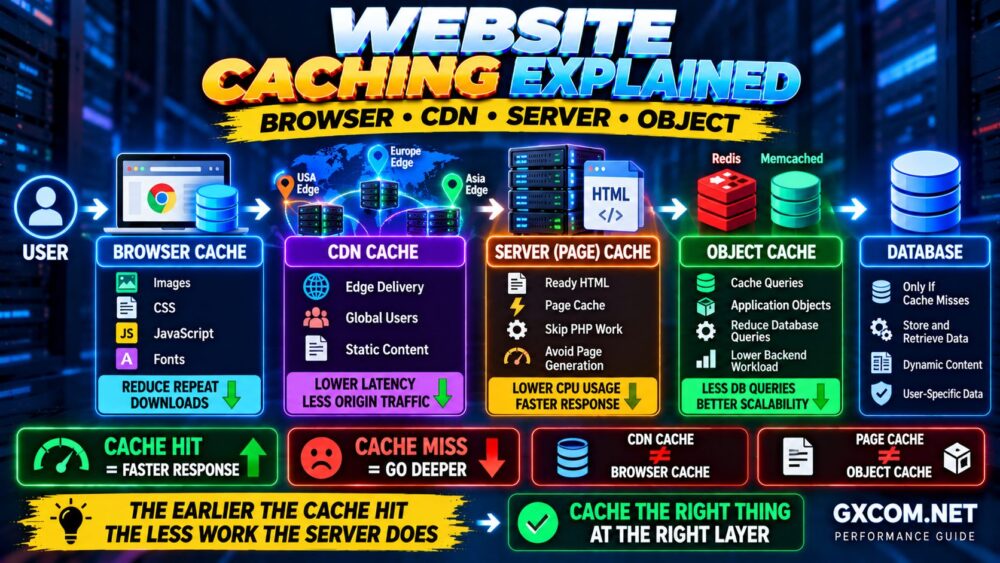
CDN vs Website Caching
A CDN and origin caching should not be viewed as competing technologies.
They can work together.
A strong architecture might be:
访客
↓
CDN 边缘缓存
↓
服务器页面缓存
↓
应用
↓
数据库
If the CDN has the resource, it can respond immediately.
If it does not, the origin's own cache may still avoid expensive application and database processing.
EDGE CACHE + ORIGIN CACHE = DIFFERENT LAYERS.
Does WordPress Need a CDN?
Not every WordPress website needs one.
A CDN becomes more attractive when a WordPress site has:
- Visitors from multiple countries
- Large numbers of images
- Significant static assets
- 不断增长的流量
- High origin bandwidth usage
- 流量激增
For a small local WordPress site already hosted close to its audience, caching and hosting optimization may deserve higher priority.
For WordPress-specific optimization, see 如何加快WordPress的速度.
Can a CDN Improve Website Security?
Performance is not the only reason websites use edge networks.
Depending on the CDN provider and plan, additional capabilities may include:
- DDoS mitigation
- Web Application Firewall
- Bot management
- 速率限制
- TLS termination
- Origin protection
However, these features vary significantly between providers and plans.
Do not assume that simply enabling CDN caching provides every security capability.
If DDoS resilience is important, read our Website and Server DDoS Protection Guide.
Can a CDN Make a Website Slower?
Yes, especially when poorly configured.
可能的原因包括:
- Low cache hit ratio
- Frequent cache misses
- Incorrect cache rules
- Unnecessary proxy layers
- Poor routing
- Origin connectivity problems
- Excessive cache revalidation
For example, if content repeatedly misses the edge cache, the request may still need to travel through the CDN to the origin before returning to the visitor.
This is why CDN performance should be measured after deployment.
USE A CDN → MEASURE IT.
Do not assume:
USE A CDN → AUTOMATICALLY FASTER.
How to Decide If Your Website Needs a CDN
Ask these seven questions:
- Are visitors geographically far from the origin?
- Do you have visitors from multiple countries or continents?
- Does the website serve many cacheable assets?
- Is origin bandwidth significant?
- Does the website experience traffic spikes?
- Would reducing origin load improve scalability?
- Would edge security features provide additional value?
If you answered yes to several of these questions, testing a CDN is reasonable.
If almost every answer is no and your website already performs well for its target audience, adding a CDN purely because “every website needs one” may not be necessary.
CDN Decision Matrix
| 网站类型 | CDN Priority | Reason |
|---|---|---|
| Global content website | 高 | Distributed visitors and cacheable content |
| Image-heavy website | 高 | Large static asset delivery |
| International e-commerce | 高 | Global latency and traffic resilience |
| Software download site | 高 | Bandwidth-intensive static files |
| Global WordPress blog | Medium-High | Static assets and international visitors |
| Local small business website | Low-Medium | Depends on audience and existing performance |
| Private internal application | 低 | May have limited edge-cache benefit |
| Highly personalized application | Depends | Static assets benefit; dynamic caching needs care |
How to Test a CDN Properly
Do not compare one speed test before and one after and declare a winner.
Use a more systematic process:
1. MEASURE WITHOUT CDN
Record your baseline.
↓
2. ENABLE CDN
Configure caching correctly.
↓
3. WARM THE CACHE
Do not judge every resource on its first cache miss.
↓
4. TEST MULTIPLE LOCATIONS
Especially regions where your real visitors live.
↓
5. CHECK CACHE HIT RATIO
Determine how much traffic is actually being served from edge cache.
↓
6. CHECK ORIGIN LOAD
Measure whether bandwidth and requests decreased.
↓
7. COMPARE COST
Include both CDN and origin infrastructure costs.
CDN vs No CDN FAQ
每个网站都需要CDN吗?
No. A small website serving users close to its origin may already perform well without a CDN. CDNs become more valuable as geographic distribution, traffic, static content and origin load increase.
Will a CDN make my website faster?
It can, particularly for cacheable content delivered to visitors far from the origin. The actual improvement depends on geography, cache configuration, cache hit ratio, routing and the existing performance bottleneck.
Is a CDN good for SEO?
A CDN is not an automatic SEO ranking boost. It can contribute to faster delivery and better user experience, but Google recommends evaluating page experience broadly rather than focusing on a single technology or performance metric.
Is a CDN expensive?
Not necessarily. CDN pricing ranges from free tiers to usage-based and enterprise plans. Whether it saves or increases total cost depends on traffic, bandwidth, features and how much origin traffic it offloads.
Do I need a CDN for WordPress?
Not always. A CDN is particularly useful for WordPress websites with international visitors, many static assets, substantial traffic or high origin bandwidth usage.
Can a CDN replace web hosting?
Usually no. Traditional CDN caching works in front of an origin that hosts the website or application. Some modern edge platforms can run applications directly at the edge, but that is a different architecture from simply adding a CDN to a conventional website.
Does a CDN reduce server load?
Yes, when requests are served from cache instead of the origin. The amount of reduction depends heavily on the percentage of traffic that is cacheable and the resulting cache hit ratio.
Can a CDN fix a slow server?
Not necessarily. A CDN can reduce some origin traffic and accelerate cached resources, but slow application execution, database queries, CPU saturation and other backend problems still need to be fixed at the server or application layer.
Final Verdict: CDN or No CDN?
A CDN is most valuable when it solves a real delivery problem.
USE A CDN when your audience is geographically distributed, your website serves significant cacheable content, origin traffic is growing or edge delivery provides meaningful performance and resilience benefits.
CONSIDER NO CDN when your audience is highly localized, the origin is already close to users, traffic is low and the website already performs well.
Most importantly, do not treat CDN as a substitute for website optimization.
A strong performance architecture looks like:
FAST ORIGIN
↓
EFFECTIVE CACHE
↓
CDN WHEN NEEDED
↓
OPTIMIZED FRONT END
↓
CONTINUOUS MONITORING
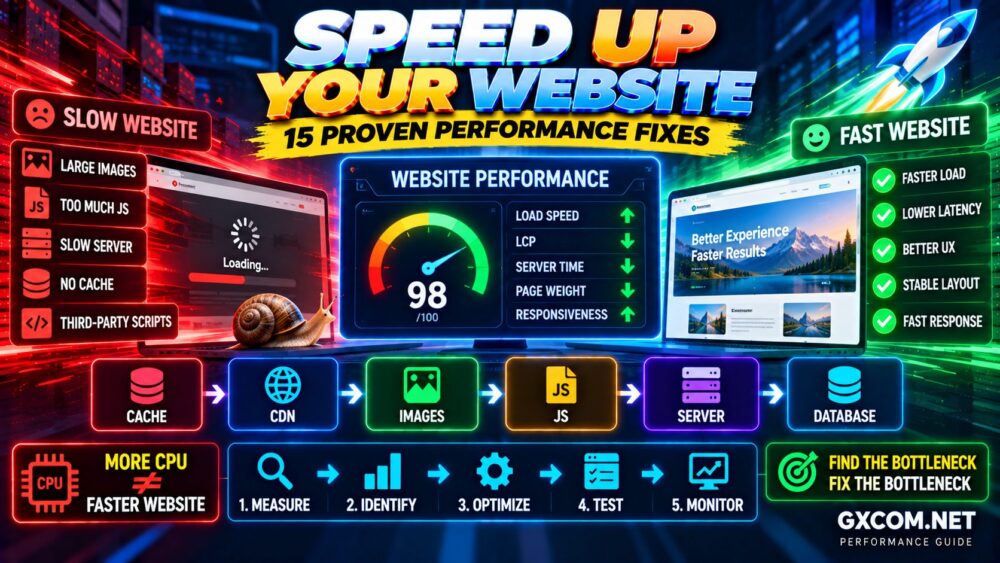
If your website is slow, start with our Website Performance Optimization Guide and identify the bottleneck before adding more infrastructure.
CDN ≠ AUTOMATICALLY FASTER.
RIGHT WORKLOAD + RIGHT CACHE + RIGHT CDN = BETTER DELIVERY.